• Prince Aviation
Charter
• Prince Aviation
Maintenance
• Belgrade (Nikola Tesla) Airport
BAN's World Gazetteer
• Serbia The bimonthly news publication for aviation professionals.
 Read this story in our December 2024 printed issue.
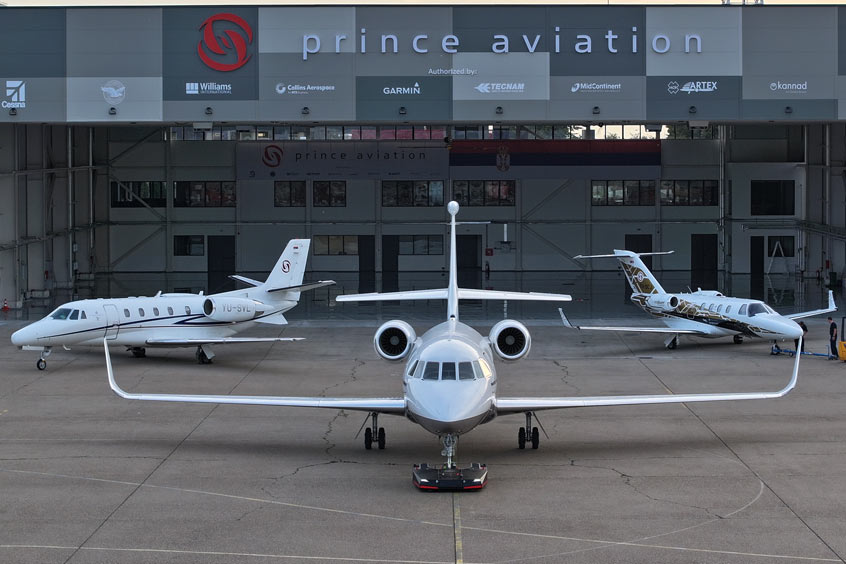
Serbia's Prince Aviation, which specialises in charter and MRO, celebrated a significant milestone in September with the grand opening of its 32,291 sq ft aircraft maintenance hangar at Belgrade Nikola Tesla airport. The ceremony, attended by industry leaders, government officials and diplomats, showcased the facility's technical prowess and signalled the company's ambitious plans for growth.
The new hangar, lauded as the most advanced in the region, quadruples Prince Aviation's MRO capacity. With maintenance space for up to nine aircraft complementing three lines in the existing hangar, the company is now equipped to service a diverse fleet, including large-cabin business jets like the Dassault Falcon 2000LXS. Technical director Srdjan Kragojevic hailed the hangar as ‘the gem of Belgrade airport’, pointing to features such as anti-static and heated flooring and towering, nearly frameless doors and state of the art solutions in tool control.
The guest list at the unveiling ceremony was a testament to Prince Aviation's stature in the industry. Textron Aviation flew in a Cessna Citation Latitude for the occasion, while representatives from Dassault Aviation, Pratt & Whitney, Collins Aerospace, Garmin and other industry giants were in attendance, underscoring their strong partnerships with the Serbian company.
In their speeches, Kragojevic and executive director Vladimir Jovanovic reflected on Prince Aviation's evolution from pioneers in a then-new local aviation segment to a regional powerhouse in business aviation. The company's success, they noted, is built on three pillars: pilot training, private charters and MRO services, with aircraft maintenance emerging as the biggest growth engine. The increased capacity afforded by the new hangar positions Prince Aviation to offer an expanded array of services to its clients.
Prince Aviation's recent achievements and collaborations underscore its commitment to innovation and growth. The company recently extended its cooperation with US-based Tamarack Aerospace, installing its Active Winglet technology on Cessna Citation business jets. It also showcased its pioneering installation of Collins' small-cabin Certus Wi-Fi offering during EBACE in May and became Pratt & Whitney's sole European post-rental inspection provider for PW100 series engines.
As Prince Aviation enters this new chapter, the state-of-the-art hangar at Belgrade Nikola Tesla Airport stands as a symbol of the company's technical expertise, industry leadership and ambitious vision for the future of business aviation in the region and beyond.