


 The bimonthly news publication for aviation professionals.
Research commissioned by Airbus Corporate Jets (ACJ) reveals that family offices are becoming increasingly international in their footprint and are relying more heavily on business aviation to support this global growth. The study, conducted amongst senior executives from family offices, who collectively manage US$303 billion in assets, shows a definite shift towards cross-border activity and a growing dependence on private aviation to manage it efficiently.
“As family offices become more international, business aviation is increasingly becoming a strategic necessity,” explains Chadi Saade, president of Airbus Corporate Jets. “Our study indicates that private aviation is not only enhancing operational efficiency but also enabling a more connected and productive workforce, one that increasingly spans multiple continents.”
Over the past five years, nearly 70 per cent of family offices surveyed said they have opened new offices in different jurisdictions. The key driver for those doing so is the rising number of family members now living abroad or across multiple countries (cited by 90 per cent of survey respondents), followed by increasingly diversified investment portfolios (72 per cent) and a need to manage geopolitical risk (28 per cent).
This international trend looks set to intensify as nearly all of the executives interviewed say they expect even more family members to reside in different countries over the next three years.
As family offices become more dispersed and agile, they are turning to business aviation to remain connected and effective. Currently 70 per cent of their business aviation travel is conducted via private aircraft, outpacing commercial routes. Over the past two years, 96 per cent of family office executives surveyed say their use of private jets has increased, and every single respondent believes it will continue rising over the next two years. In fact 85 per cent anticipate a 50-100 per cent increase in usage.
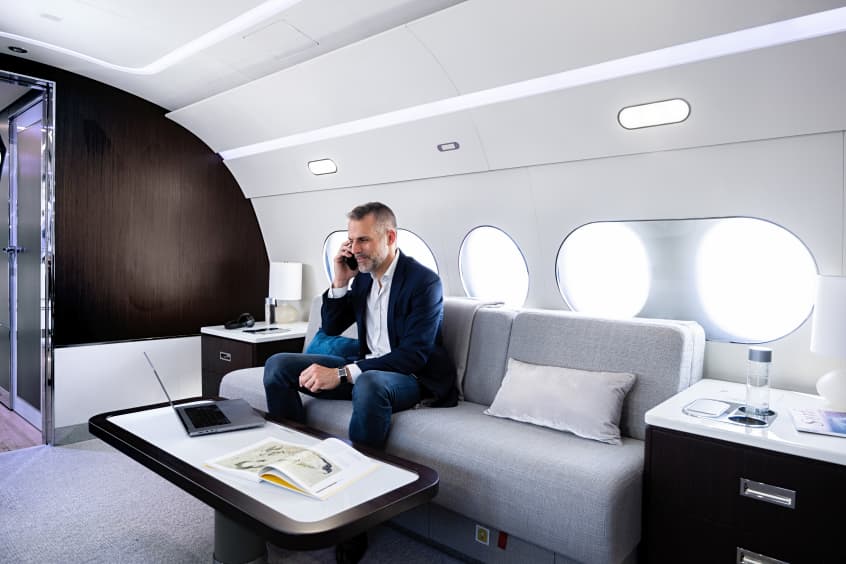
Private aviation is not just about convenience, it is a business enabler. The top-ranked benefit cited by the family offices surveyed was greater flexibility to work during flights, particularly on confidential matters. Having more control of their schedule was ranked second, with privacy and faster travel times ranking third and fourth respectively.
The research indicates that 89 per cent of family office executives save between two and three hours per trip by using business aviation, compared to flying commercially. Nine out of 10 (92 per cent) also say they are at least 25 per cent more productive on private aircraft.
The necessity of flexible air travel in supporting family office global operations is underlined by 67 per cent of respondents saying that 25–50 per cent of their private aviation trips are made to destinations not served directly by commercial airlines.
As family offices continue to expand, they are extending the benefits of business aviation to more members of their team, with 92 per cent saying they currently allow more staff to use private aircraft and nearly all (97 per cent) expect this increased access to grow over the next three years.
Demand for different types of aircraft is also expected to rise, with 43 per cent expecting a 50–75 per cent increase in large jet use. Over half (55 per cent) predict the same growth for medium-sized jets and around a third (32 per cent) anticipate an increased use of light aircraft by 50-75 per cent.