


 The bimonthly news publication for aviation professionals.
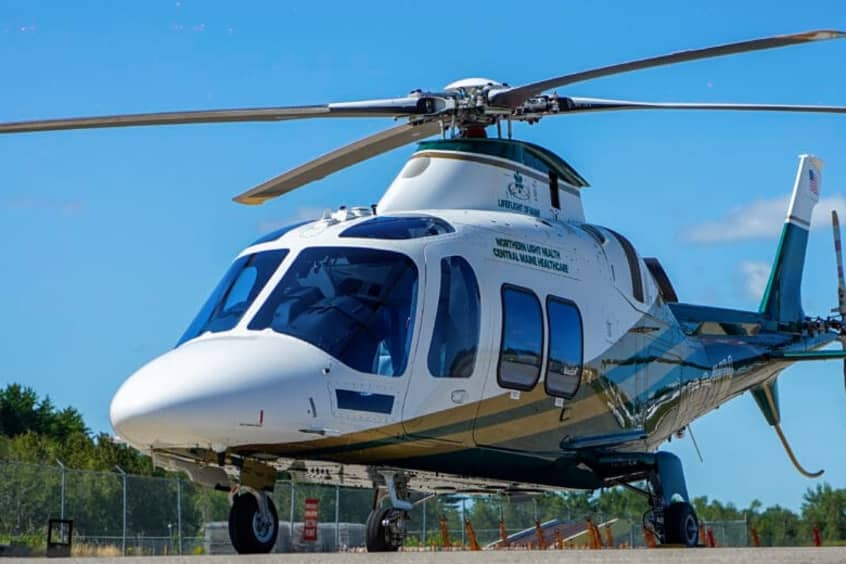
LifeFlight of Maine has added another medevac helicopter to its fleet. The aircraft is an Agusta 109 SP twin-engine helicopter, manufactured by Leonardo.
The US aeromedical service acquired this helicopter, referred to as ‘Yankee Mike’ for the last two characters in its tail number, N901YM, late last year and had the interior completely rebuilt to meet the specifications of its sophisticated air medical transport programme. Yankee Mike was built in 2018 and had a mere 300 hours of flight time when it was acquired by LifeFlight of Maine. For comparison, LifeFlight of Maine puts an average of 535 hours of airtime on each of its helicopters every year.
With the addition of Yankee Mike, LifeFlight of Maine now has four A109 SP helicopters, which are newer, faster and slightly larger than its predecessor, the A109 E, which LifeFlight first began flying as its primary aircraft in 2005. LifeFlight still owns two of these E model aircraft, which it relies on during required maintenance intervals for its primary aircraft. With the addition of the new helicopter, LifeFlight will begin phasing out its two A109 E helicopters.
“Before Yankee Mike joined our fleet, our helicopter with the least airtime, Whiskey Mike, had 2,336 total hours,” says Peter Cartmell, director of operations. “Most places, not necessarily EMS, will put 100 to 150 hours a year on a helicopter. Because of the number of patients we care for and the distances across Maine, we put four or five times that many hours on our aircraft each year. We need to keep investing in these aircraft so that we can continue to fulfil our mission.”
Standardising LifeFlight's helicopter fleet to all A109 SP models will help improve efficiency for helicopter pilots, who currently are trained to operate two different models of aircraft.
“The different models may seem the same to the naked eye, but when you look in the cockpits, the avionics between the E models and the SPs are very different,” explains Cartmell. “Every time pilots switch back and forth, there is a bit of a learning curve. We also must train new pilots on both systems, which takes additional time and resources.
“The autopilot in the SP is a four-axis autopilot, as opposed to a three-axis autopilot in the E models. As a result, they are a lot more stable and have more capability for instrument approaches than E models have.”
The SP models are faster, travelling at an average speed of 165 mph. They can make the trip from Bangor to Caribou in less than an hour. Additionally, these helicopters can fly approximately 1.5 hours before refuelling, depending on weather conditions and other factors.
The SP models are about 18 inches longer than the E models, creating more cabin room for the medical crew to care for a patient in the back of the helicopter. “With all of our medical equipment on board, the back of the helicopter is pretty tight when caring for a patient, so every bit of additional space makes a difference for clinical crews,” reveals Chuck Hogan, chief clinical officer.
While work on Yankee Mike is complete and it has been delivered to LifeFlight's Bangor hangar, the helicopter still needs to be certified by the FAA for air medical operations. Once this process is complete, the helicopter will officially join LifeFlight's fleet and be used to bring Mainers all over the state critical care when and where they need it.