• ABRAPHE Associacao Brasileira de Pilotos de Helicoptero
• Aero Dynamic Jets
Charter
• CTR Atmospherica
Charter

• Duncan Aviation
Maintenance
• Mavi Gok Airlines
Charter
• Smartflyer AG
Aircraft
• Transcend Air
Aircraft
BAN's World Gazetteer
• Brazil The bimonthly news publication for aviation professionals.


 Read this story in our July/August 2025 printed issue.
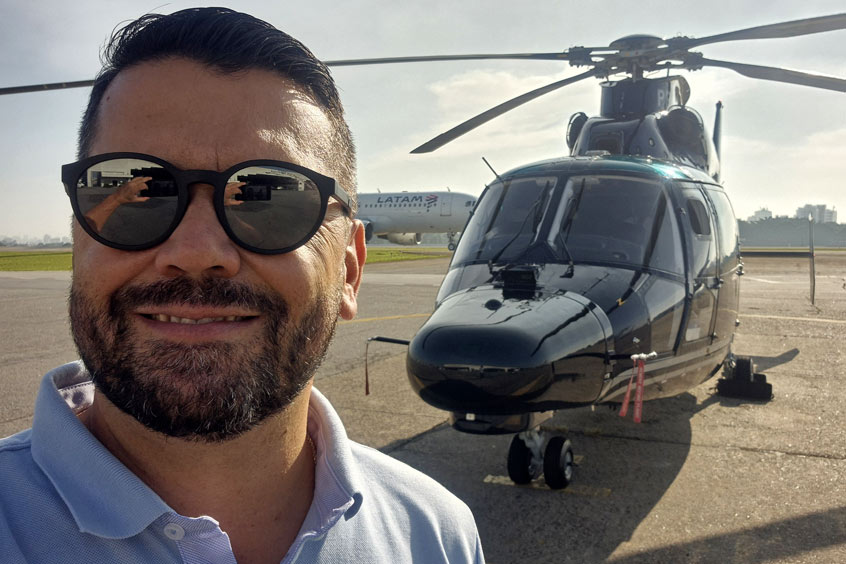
Sustainable aviation fuel (SAF) is only one part of the complex web of greening-up opportunities being explored within the aviation industry. Although challenges related to cost and scalability exist, the fuel is front and centre of net zero goals. Continued investment and innovation are likely to enhance its viability and, says Thales Pereira, president of ABRAPHE, the Brazilian Helicopter Pilots Association: “As the industry evolves, SAF will play a critical role in bridging the gap to future, even cleaner, technologies.”
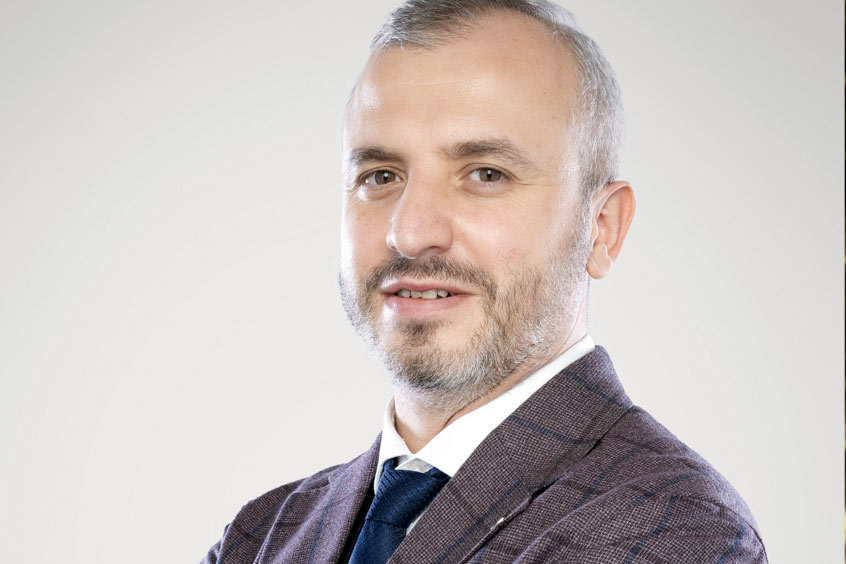
Projections suggest eventually $180bn dollars will be poured into battery and hydrogen aviation technology to address aviation’s carbon footprint but, according to Transcend Air COO Peter Schmidt, to date $15bn has been spent developing SAF. “Why?” he asks. “Because batteries and hydrogen can’t match the range and speed of jet fuelled turbines. They also require the complete redesign and replacement of all aircraft in service. So it’s easy to understand the investment in SAF. It is the only scalable option for decarbonising aviation as the world exists in 2025.”
Mavi Gok general manager Mehmet Abdullah Citci adds: “It’s one of the few technologies that can deliver a meaningful reduction in carbon emissions while still being compatible with existing aircraft and infrastructure. SAF works in any aircraft that is certified for conventional jet fuel, which means airlines don’t need to replace their entire fleet to start using it.”
Just how meaningful is that reduction, really? Duncan Aviation chief pilot Jon Kroesche notes that in 2023, United Airlines used over four billion gallons of jet fuel, having stated that it planned to use 10 million gallons of SAF that same year: “If we assume the SAF quantity is part of the four billion total, then its overall blend would be 0.25 per cent.”
SAF only realises an 80 per cent reduction in emissions if used unblended. “The highest blend approved is a 50 per cent blend. And even if all forms of aviation used a 50 per cent blend, this would only amount to a 1.2 per cent reduction in CO2 emissions. Why should taxpayers subsidise a product with such a small return on investment?” he asks.
Keith Sawyer, manager of alternative fuels at Avfuel, points out that when people talk about a reduction in lifecycle carbon emissions, they are talking about the environmental impact of the fuel from the moment of production through to fuel burn. A 30/70 blend brings the lifecycle reduction from 80 per cent to about 24. “Of course, innovations in aviation power sources and at the OEM level for airframes and engines can help increase lifecycle reductions,” he notes.
Atmospherica Aviation chairman of the board Alice Horvarth-Muska believes there are not many other ways to make flying greener: “However, the threshold for CO2 emissions is 10,000 tons per year. We are a smaller business, and we worked out that we would have to uplift SAF in at least a 40 per cent blend on one of our Phenoms to reduce our emissions by 500 tons per year. This is just not possible, as SAF is not available at enough of the airports we frequently fly to, and the blend varies as well.”
Both of Atmospherica’s new Phenom 300E and Praetor 600 aircraft are SAF certified to refuel to no more than half their tank volume. “This brings additional limitations to refuelling as it requires some sort of provable blend or refuel from two fuel trucks, which would mean more time needed for refuelling,” she adds.
The high price of SAF
Kevin Singh, CEO and founder, Icarus Jet believes private aviation must lead the way in SAF uptake: “There is more leeway to implement SAF earlier than for commercial airlines with their low profit margins and complicated route systems. Private jet clients are more inclined to accept higher costs for green solutions, and as a result SAF becomes a workable proposition in the luxury travel space.”
Pereira points out that SAF is currently more expensive than conventional jet fuel by a factor of two to four times. but that as technology improves and production scales, the cost is expected to decrease. Government incentives and increased investment in green technology can further lower prices, making SAF more competitive.
Captain Leo Gomez, chief pilot at Ninja Jet, adds that rising carbon costs could make fossil fuel more expensive, narrowing the price gap over time. And while efforts are underway to enable a 100 per cent SAF blend in the future, he believes there may be some compatibility issues due to the lower aromatic hydrocarbon content in SAF that can cause problems with seal integrity on older aircraft engines. He also notes that SAF has a lower energy density compared to fossil fuel, which means aircraft may need to carry more fuel for long haul flights, potentially affecting operational efficiency.
“I think we need to use SAF, but we must also keep in mind that the production of some feedstocks such as crops or municipal waste could lead to deforestation, habitat destruction or toxic emissions if it is not managed sustainably,” he points out.
Citci notes that many believe SAF could be cost-competitive with regular jet fuel within the next decade, especially if there’s more focus on innovation in feedstocks, production methods and a global carbon price, such as through the EU’s Emissions Trading System. But continued policy support such as subsidies or tax credits could help reduce the price gap in the short term.
Is SAF safe and sustainable?
SAF is simply jet fuel and, just like traditional, petroleum-based jet fuel, it meets ASTM D-1655 specifications and fully conforms to all US and international specifications under ASTM 7566. Any aircraft that runs on jet fuel can safely run on SAF, with no modifications necessary.
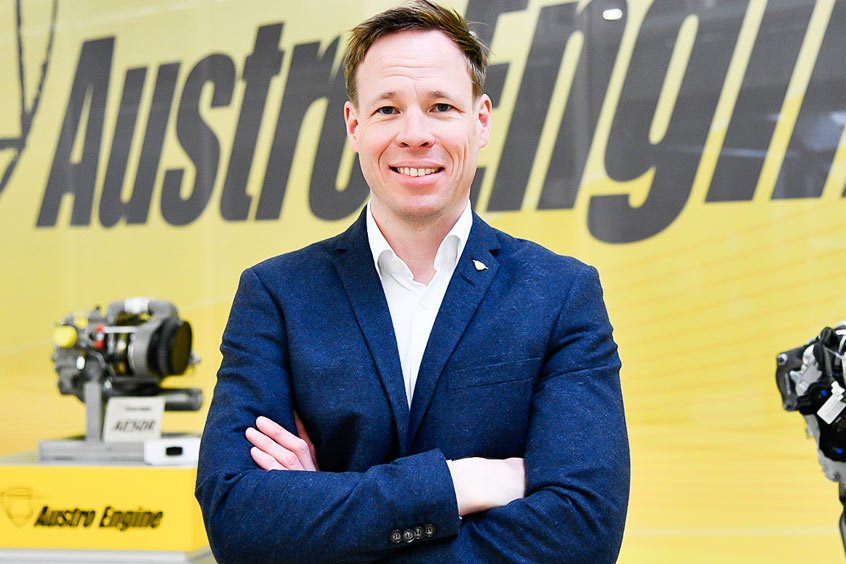
Felix Zahradnik, CTO of Austro Engine, is responsible for the future development of engines that are delivered to aircraft from sister company Diamond Aircraft. He notes that for the time being, SAF is always a blend with fossil-based fuels. “Even if you only blend one per cent, you can call it SAF. It’s a substitute for Jet A-1 and will burn nearly the same way in a turbine, though it’s slightly different on a piston engine. We must take care that all of the fuels burn properly in our engines.” Mavi Gok’s Citci believes there have been isolated reports of minor issues related to fuel quality, particularly with the early batches of SAF produced at smaller scales. These issues are usually more to do with the refining process and can be mitigated with improved quality controls, but in the longer term he worries about supply chain consistency, particularly as production scales up and more suppliers enter the market.
“My take,” says Aero Dynamic Jets president and chief pilot Cameron Fugal, “is that I will never believe that mixing fuels with bio fuel and other substances that are supposed to be better for the environment will be a good thing. I feel it only increases the risk of contamination, of messing up injectors or fuel nozzles, or of bio buildup in the fuel tanks. But my biggest concern is the chance, even if a small one, that this fuel could some day cause an engine disruption. For that reason I will forever work against any biofuel integrations, including SAF, because I see it as a risk to safety and a risk to the industry.”
Hydrogen, hybrid-power and synthetic fuels
Rolf Stuber, CEO and head of design at Smartflyer in Switzerland, reckons SAF will always be significantly more expensive than conventional jet fuel and the aviation industry, which operates on tight profit margins, will struggle to absorb these costs without passing them on to consumers, potentially making air travel less accessible. He believes that, ultimately, hydrogen power is the answer, although there are enormous technical and infrastructure challenges in its development. “Storing hydrogen requires larger tanks, which means completely new aircraft designs. Furthermore, the entire airport refuelling infrastructure would need to be rebuilt,” he says. “Even under optimistic projections, large hydrogen-powered commercial aircraft will not be in widespread use before 2040. SAF will play a role in aviation’s transition, but it is not the final answer. And it only addresses CO2 neutrality, while other emissions remain problematic.”
Trancend’s Schmidt says SAF includes eFuels made using solar power and CO2 captured from the air. eFuel is 100 per cent carbon neutral and burns cleaner than traditional jet fuel. Transcend has committed to using 100 per cent eFuels from US energy startup Prometheus, while American Airlines has committed to 10 million gallons.
Paul Wilkinson, angel investor, co-founder of EVO Fuels and EVO Flight Services and a 33-year veteran of the business aviation industry, believes the very survival of the business aviation industry depends on eSAF or synthetic jet fuel.
Large-scale biofuel production has environmental consequences. Synthetic jet fuel, on the other hand, is produced using water, renewable energy and captured CO2 through the Fischer-Tropsch process: a closed cycle where carbon is harvested from the atmosphere before combustion, then recaptured and reused, creating a perpetual ‘carbon loop’ for each aircraft that cleans up emissions before take off.
Synthetic jet fuel also burns cleaner than fossil-based jet fuel. Engineered with near-zero sulphur content, it eliminates harmful sulphur oxide emissions too.
Like SAF, eFuels are currently expensive, but the rapid expansion of clean energy sources like wind and solar will make them commercially viable in the near future. And the renaissance of nuclear energy, specifically Small Modular Reactors (SMRs), is a game-changer.
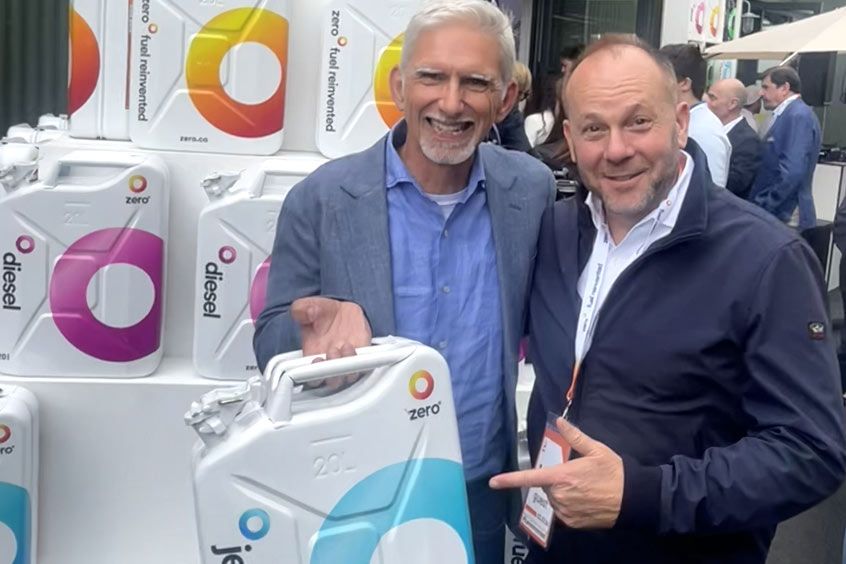
“These next-generation reactors are safer, more affordable and faster to deploy than traditional nuclear plants. SMRs can potentially enable large company flight departments and even FBO chains to produce their own clean jet fuel,” says EVO cofounder Chris Cartwright, who has invested in UK synthetic fuel producer Zero.
“Zero caught our attention when it set the Guinness World Record for the first aircraft powered entirely by 100 per cent synthetic fuel, in partnership with the British RAF,” says Wilkinson. “This first ever flight was basically powered by water, air and some pretty serious science.”