 The bimonthly news publication for aviation professionals.
 Read this story in our August 2023 printed issue.
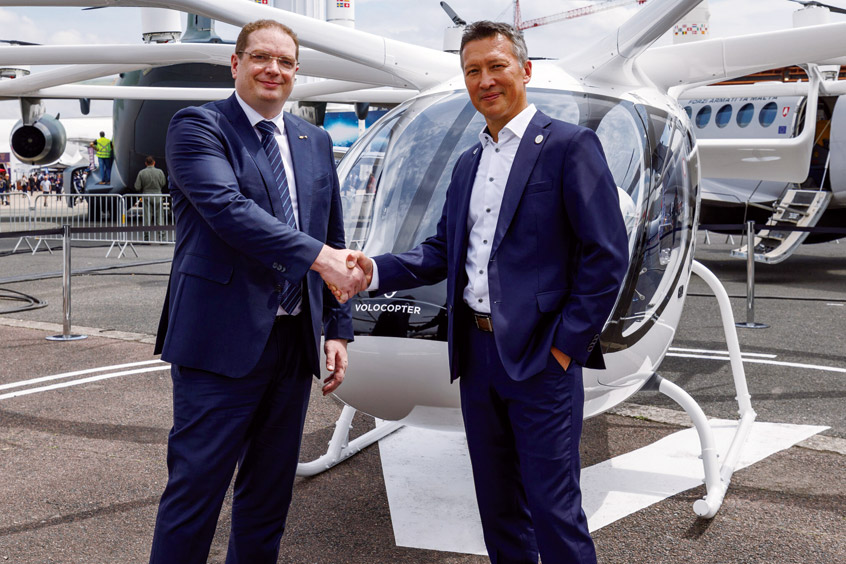
Germany-based air rescue service ADAC Luftrettung and Volocopter are to jointly customise next-generation eVTOLs for rescue services. Two milestone agreements were signed at the Paris Air Show, one to purchase two VoloCity aircraft, and another to secure an additional 150 Volocopter eVTOLs. The VoloCity aircraft will start research operations in late 2024 to provide supplementary EMS. Upon successful completion of these first operations, the additional eVTOLs will be considered for use in future rescue missions.
Since 2018, non-profit ADAC Luftrettung and Volocopter have been a part of a joint eVTOL feasibility study in EMS and rescue operations, sponsored by the ADAC Foundation with the Institut für Notfallmedizin und Medizinmanagement (INM, Institute for Emergency Medicine and Medical Management) at Ludwig Maximilian University in Munich. The study computer-simulated aeromedical missions in two regions in Germany and theoretically proved that the introduction of eVTOLs in life-saving situations would add a significant tactical advantage from a technical, sustainable and operational standpoint.
The two VoloCity aircraft will start research operations in Germany once type certification is received from EASA in 2024. A pilot and an emergency physician will be dispatched to incident locations to supplement, but not replace, rescue helicopters in order to provide rapid assistance from the air. After the successful completion of at least a two-year research operation in the German towns of Idar-Oberstein and Dinkelsbühl and their immediate regions, ADAC Luftrettung may deploy next-generation Volocopter eVTOLs in its rescue service operations roster. CEO Frédéric Bruder says: “From the very beginning, we have been convinced that these aircraft can shape and improve the rescue service of the future. With the higher ranges and operational speeds as well as significantly more payload of the next generation of eVTOLs, we can put the benefits for emergency care into practice and fulfil our statutory mission to further develop the rescue service from the air with pioneering innovations.”
Volocopter CEO Dirk Hoke adds: “There is no better way to start Volocopter eVTOL operations in Germany than by saving lives. ADAC Luftrettung is the leading European rescue service with highly trained pilots and successful missions. We have proven the emergency rescue use case works in theory, now we are concentrating on the delivery and execution to start EMS operations in Germany in 2024.”
Compared to a rescue helicopter, Volocopter’s eVTOLs are quieter and produce zero emissions in flight, improving sustainability and reducing the company’s CO2 footprint, while saving lives. The ADAC Luftrettung feasibility study and the opportunities for rapid emergency care using eVTOLs are also of interest to the Assistance Publique-Hôpitaux de Paris, and it has joined forces with Groupe ADP to explore the deployment of ADAC Luftrettung’s concept for EMS multicopter operations in the Paris region.