


• StandardAero (Langley)
Maintenance
• Airbus Helicopters H125/AS350
BAN's World Gazetteer
• Arizona The bimonthly news publication for aviation professionals.
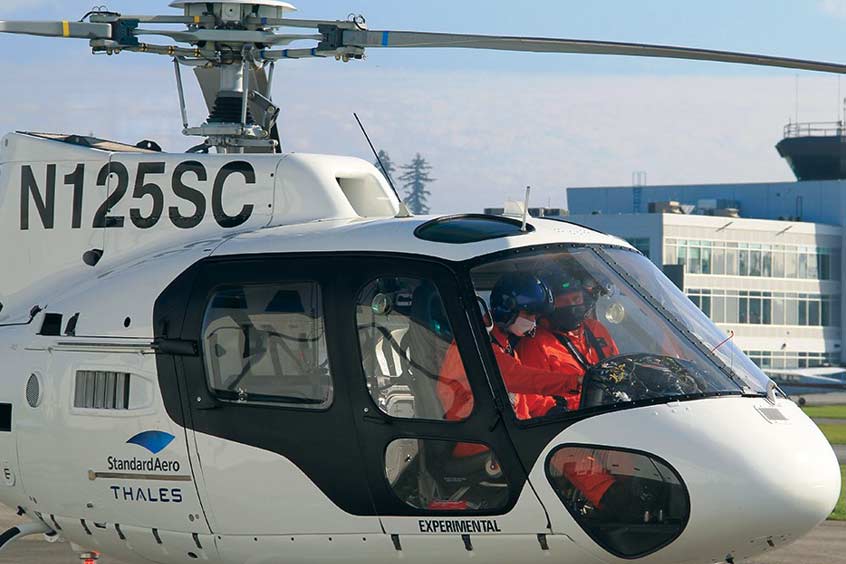
Thales and StandardAero have performed the successful first flight test of a new compact autopilot system designed to bring Airbus AS350 and H125 helicopters into a new era of performance and safety. The test lays the groundwork for an important phase of the STC process and the launch of an innovative autopilot solution to the light helicopter market by mid-2021.
Flight testing, which will continue throughout this winter at StandardAero's Langley, British Columbia, Canada facility, demonstrates Thales' and StandardAero's commitment to develop and certify an advanced four-axis helicopter autopilot system. Earlier this year, the companies announced that WeatherTech, a well-known automotive accessories company, has agreed to be its launch customer. The autopilot will initially be certified for installation on both the Airbus AS350 and H125 helicopter platforms.
“The launch of this flight test programme is a key milestone for StandardAero and Thales,” says Jean-Paul Ebanga, Thales VP of flight avionics activities. This product combines our autopilot experience, based on billions of flight hours accumulated and outstanding customer satisfaction, with StandardAero's extensive aftermarket capabilities in aircraft modification and certification. We aim to bring a user-friendly solution offering an unparalleled level of safety and reliability to the light helicopter market.”
The Thales/StandardAero compact autopilot is an intuitive automatic flight control system on the AS350/H125 that increases safety through reduced pilot workload. It provides stability augmentation, attitude retention and flight director modes such as altitude or heading hold and reduces the risk of aircraft incidents.
“This system has been designed as a straightforward retrofit and provides pilots with simplified operation that will help reduce wear and tear on the helicopter while making flying in normal and adverse conditions much easier and safer for the crew and passengers,” adds Elvis Moniz, VP of product development for StandardAero's helicopters business unit. “Moreover, with the increase in EMS flying and recent CFIT related helicopter accidents, anything that can help pilots navigate more safely is of paramount interest.”
StandardAero and Thales bring complementary expertise to the collaboration. Thales produces the essential components, including the advanced control management systems, four trim actuators, three intelligent linear actuators and the data concentrator/control panel. StandardAero brings expertise in aircraft modification and certification, which enables it to manage the detailed design of the mechanical and electrical systems integration. With a comprehensive FAA certification plan, approval is expected by the middle of next year.