 The bimonthly news publication for aviation professionals.

Electra.aero and VertiPorts by Atlantic are to assess infrastructure opportunities over the coming few weeks that could bring Ultra Short aircraft operations closer to where people live and work. This is the first time VertiPorts by Atlantic has formally explored non-traditional fixed infrastructure for a fixed-wing Ultra Short rather than eVTOL aircraft, shifting the conversation from helicopter-replacement to regional airline-replacement in the New York market.
Under an MoU, the companies will explore how different forms of infrastructure such as barges, piers or elevated surfaces could unlock Ultra Short operations at new and existing sites. This is the first step in a broader collaboration across multiple regions and advancing what Electra calls ‘Direct Aviation’, a model of point-to-point regional travel that complements the existing hub-and-spoke system with distributed access points.
“The demand already exists for regional travel that is faster and more convenient, and Direct Aviation is about meeting that demand,” says Diana Siegel, vice president, commercial programmes at Electra. “By assessing how new and existing VertiPorts by Atlantic sites could accommodate the EL9 Ultra Short, we are taking a step toward connecting New York City with communities across the region and showing what Direct Aviation has to offer.”
Electra is developing the hybrid-electric EL9 Ultra Short, designed to carry nine passengers, with 50lbs of luggage per passenger, up to 330nm. It will take off and land in as little as 150ft thanks to a combination of hybrid-electric propulsion with blown-lift technology. The regulatory pathway for its barge or pier-based fixed-wing operations will depend on the specific site and its intended use. The companies will assess how the aircraft could integrate with existing facilities, as well as potential new greenfield or brownfield sites. This assessment will help identify the operational, infrastructure and regulatory considerations associated with accommodating Electra aircraft at different types of locations, including potential waterfront sites.
VertiPorts by Atlantic is a wholly owned subsidiary of US FBO network Atlantic Aviation and is dedicated to developing and operating next generation vertiport infrastructure to support advanced air mobility (AAM).
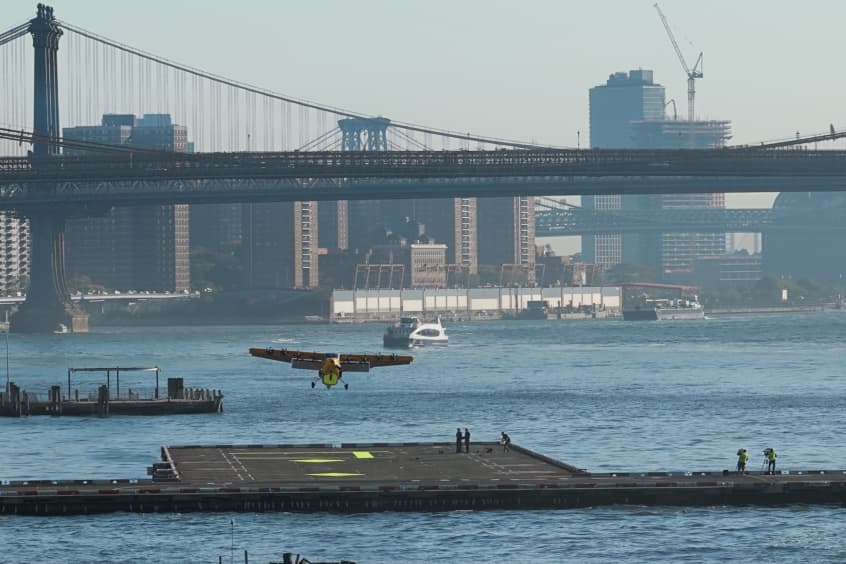
The joint initiative comes on the heels of Electra’s successful demonstration at Downtown Skyport in Lower Manhattan with the EL2 demonstrator, making what it believes to be the first time a fixed-wing aircraft without VTOL capability has landed at the heliport, using existing urban aviation infrastructure. This in turn followed a year of showcasing regional shuttle through demonstrations with ecosystem partners. The next step is to evaluate the operational, infrastructure and regulatory requirements necessary to support larger commercial aircraft like the EL9.
Electra’s inaugural Direct Aviation Market Outlook, a US-wide analysis of nearly one billion trips, identified 35m passenger trips each day across distances of 50 to 500 miles. By bringing air services closer to where trips begin and end, hours behind the wheel or high-friction commercial short haul service can be turned into quicker, simpler short regional flights. Potential time savings from NYC to Boston, for example, over commercial flight travel are estimated to be approximately three hours and 45 minutes, or one hour 45 minutes over the 214 mile drive.
“Electra’s ability to operate from dramatically smaller footprints presents exciting opportunities to reimagine how regional air transportation connects with urban environments,” adds Kevin Cox, CEO of VertiPorts by Atlantic. “Together, we’re assessing how existing and emerging infrastructure can support a new generation of aircraft and provide travellers with faster, more convenient connections throughout the Northeast and beyond.”
The EL9 does this while meeting the ‘Rule of Six’, the essential requirements needed to make AAM practical at scale: quiet operations, expanded access, uncompromising safety, meaningful payload, practical range and affordability. By delivering helicopter-like access with the safety benefits of fixed-wing flight, Electra aims to make regional air travel safer, quieter and more accessible to people and communities.
Electra will continue its demonstration series across traditional aviation infrastructure and new Ultra Short access points as it advances the EL9 toward certification, production and service. It submitted the EL9 to the FAA for Part 23 type certification and anticipates the first flight of a conforming aircraft in late 2027 or early 2028 with commercial passenger service by 2030.
The Springfield, Ohio, $850m production facility is planned in two phases, the first targeting 400 aircraft a year and the second doubling that to 800; construction is due to begin in 2027.
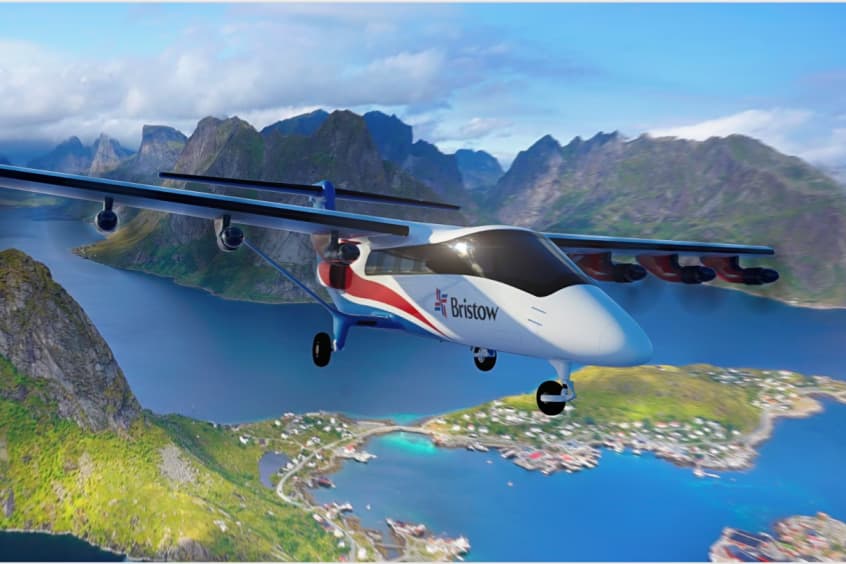
Bristow Group holds the first EL9 production slot and has said that ahead of deliveries it will fly the EL2 demonstrator at five Norwegian sites in 3Q27 to test operations at runways, quaysides and business parks.
In its Direct Aviation Market Outlook, Electra projects that this new category of regional air service could carry one million passengers per day within its first decade of operations. The company suggests that serving that demand will require an estimated 12,000 to 16,000 aircraft, supported by distributed access points, regional operators, regulatory frameworks and a scaled aviation supply chain.