The bimonthly news publication for aviation professionals.

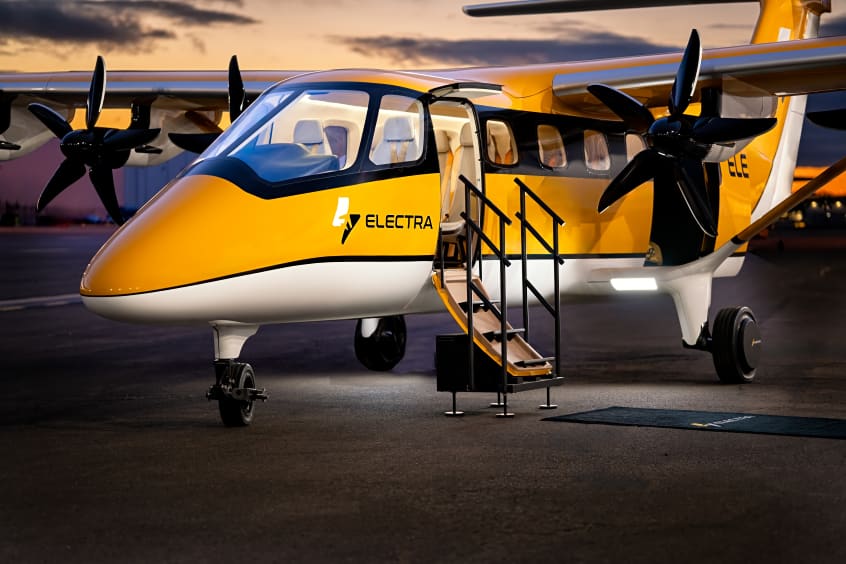
Electra has completed first-of-its-kind flights from a heliport on a commercial airport ramp at Roanoke–Blacksburg Regional Airport in Virginia, using its hybrid-electric EL2 Ultra Short aircraft to show how fixed-wing aircraft can use vertical flight landing areas and helicopter-style instrument procedures without adding traffic to congested airport runways.
The flights tested point-in-space procedures and dedicated instrument routings across numerous Virginia airports, including Virginia Tech/Montgomery Regional Airport (KBCB) in Blacksburg, Roanoke–Blacksburg Regional Airport (KROA) and Allan C Perkinson/Blackstone AAF Airport (KBKT). At each of these locations, plus two additional sites in Newport News and Richmond, the aircraft took off and landed on small heliports, vertiports, taxiways and other Ultra Short access points historically only accessible by helicopters.
Electra conducted the work in coordination with the FAA eVTOL and AAM Integration Pilot Programme (eIPP), the Virginia Smart Airspace Programme, Virginia Tech, the Virginia Department of Aviation and PennDOT, the lead eIPP participant for Virginia operations. During the flights, Electra and its partners collected operational data to compare aircraft performance against procedure requirements. Through over a year of programme development leading up to this month’s testing, Smart Airspace partners and the FAA designed flexible vertiport and heliport approaches for the Ultra Short, tested novel approach and departure instrument procedures and workshopped air traffic concepts to allow the aircraft to land off-runway at airports safely and efficiently.
Marc Allen, CEO of Electra, says: “We showed that fixed-wing, Ultra Short aircraft can use vertical flight landing areas and a new generation of instrument procedures to reach places conventional airplanes were never designed to access.”
Dr Parker Vascik, director of product strategy at Electra, adds: “This is a first step toward developing guidelines and procedures for Ultra Short operations at major airports and novel access points.”
The work will support future operations of Electra’s flagship EL9 Ultra Short, which is designed to deliver helicopter-like access with the benefits of fixed-wing flight. Electra’s contracted customers include the US Air Force, US Army, US Navy and NASA, along with over 2,200 letters of intent from more than 60 commercial customers, including airlines and helicopter operators. Lockheed Martin Ventures, Honeywell Aerospace and Safran are among its strategic investors.