• Beta Technologies
Aircraft
• Sanford (Raleigh Executive Jetport) Airport
• Manteo (Dare County Regional) Airport
BAN's World Gazetteer
• Vermont The bimonthly news publication for aviation professionals.
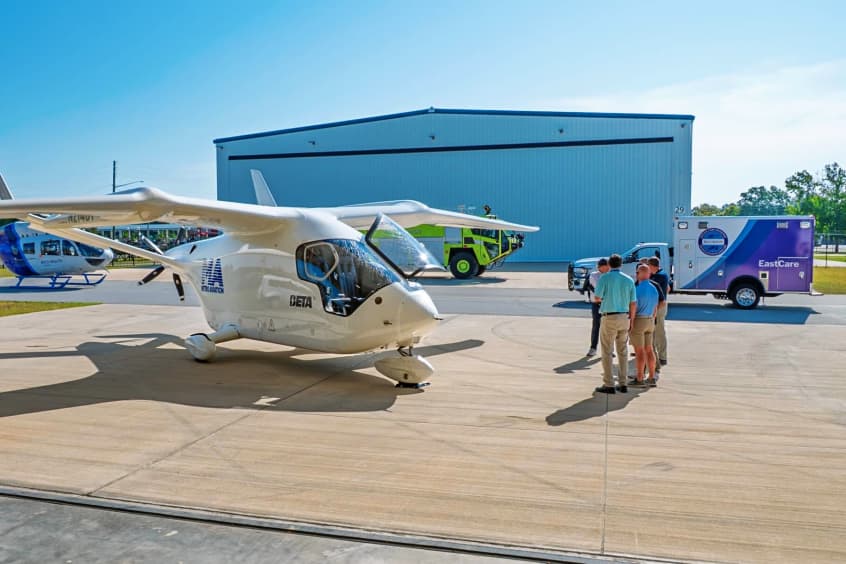
Beta Technologies, a US aerospace and defence company, is launching flight operations in North Carolina's eLIFT programme under the US Department of Transportation's (US DOT) and FAA eVTOL Integration Pilot Program (eIPP).
Since mid September, Beta has conducted all-electric operations, including a historic flyover of the Wright Brothers National Memorial and simulated deliveries of essential healthcare cargo to rural medical access points, including a deployable medical field tent and supplies. The operations will demonstrate how lower-cost, all-electric aviation can reduce the time required to deliver critical supplies, strengthen the resilience of regional healthcare networks and improve access to care across the state.
“Under President Trump, we are unlocking the future of flight, one test flight at a time,” said US Transportation Secretary Sean P. Duffy. “More than 120 years after the Wright Brothers took to the skies at Kitty Hawk, North Carolina is again leading the charge to transform how Americans move. Thanks to these tests, we are closer than ever to welcoming next-generation aircraft into our skies.”
Working with the North Carolina Department of Transportation (NCDOT), air medical operator Metro Aviation and healthcare partners across the state, including ECU Health and WakeMed, Beta designed the flight campaign to test how electric aviation could strengthen connections between regional medical centres and the rural and coastal communities they serve. The campaign covered more than 1,300 nautical miles and focused on future healthcare missions connecting the Research Triangle, including routes between Raleigh Executive Jetport and Pitt-Greenville airport, with communities such as those served by Dare County Regional airport.
“We are supporting North Carolina's world-class healthcare systems by using cost-effective, electric flight to overcome the distance that can make it difficult to get critical supplies, specialists and care where they need to go,” says Kyle Clark, founder and chief executive officer of Beta Technologies. “Medical applications have been part of Beta's DNA from the beginning, and the best way to prove our technology is to put it to work on real missions that deliver for the healthcare community. Alongside our customers and partners, we're flying and learning from every operation and showing how aviation can extend the reach of healthcare networks to rural and coastal communities across the state.”
The eIPP operations will use Beta's Charge Cube at Raleigh Executive Jetport, which was installed in 2024. More than 15 additional charging sites are in development across North Carolina, creating the infrastructure needed to test a repeatable model for moving critical supplies and care teams between regional medical centres and community hospitals.
The work also builds on Beta's broader investment in North Carolina. Beta's Morrisville facility supports the development and testing of advanced flight-control computers used in its electric aircraft. These onboard systems translate pilot inputs and aircraft data into commands that help the aircraft respond predictably in flight, work that is fundamental to aircraft safety, reliability and certification. Since opening in 2023, the facility has created nearly 70 jobs and is part of Beta's long-term investment in North Carolina's aerospace workforce.
“As healthcare becomes increasingly regionalised, large medical centres and community hospitals must work together to ensure rural patients remain connected to timely care,” comments Stuart Ginn, medical director, WakeMed Innovations, and chair of the eLIFT-NC Health Advisory Subcommittee. “Accessible vertical flight gives us an opportunity to treat aviation not simply as transportation, but as part of the healthcare infrastructure, supporting both urgent needs and routine care by moving critical resources and expertise where they are needed. As a physician and lifelong aviator, I see the potential for this technology to become a practical tool that helps us reimagine how care reaches rural communities.”
“For Metro, this is about bringing new technology to an air medical network we already know how to operate,” adds Todd Stanberry, vice president of Metro Aviation. “North Carolina lets us learn where electric aircraft can complement the services we provide today. The goal is to lower costs, expand access and safely create new options for moving supplies, clinicians and, eventually, patients.”
eLIFT-NC's long-term vision includes bringing specialised care closer to patients rather than requiring every patient to travel to a major medical centre, expanding accessibility to residents that otherwise face long commutes to primary or specialty care. The programme will also explore how electric aviation can support a resilient statewide network for disaster response, including in North Carolina's hurricane-prone coastal communities. Future routes are designed to extend toward the Outer Banks, where flooding, storm surge and infrastructure damage can disrupt road and ferry access. The programme will evaluate whether aircraft can maintain critical medical supply chains and move healthcare personnel when surface transportation is compromised.
North Carolina represents the latest operational deployment for Beta under eIPP. Beta is participating in seven of the eight programmes selected nationwide and has already supported operational missions in Virginia, Maryland, Louisiana and Texas. Across these programmes, Beta is working with customers and state and local partners to put electric aircraft into real operating environments and generate the data needed to support safe, scalable commercial adoption.