 The bimonthly news publication for aviation professionals.
 Read this story in our May/June 2026 printed issue.
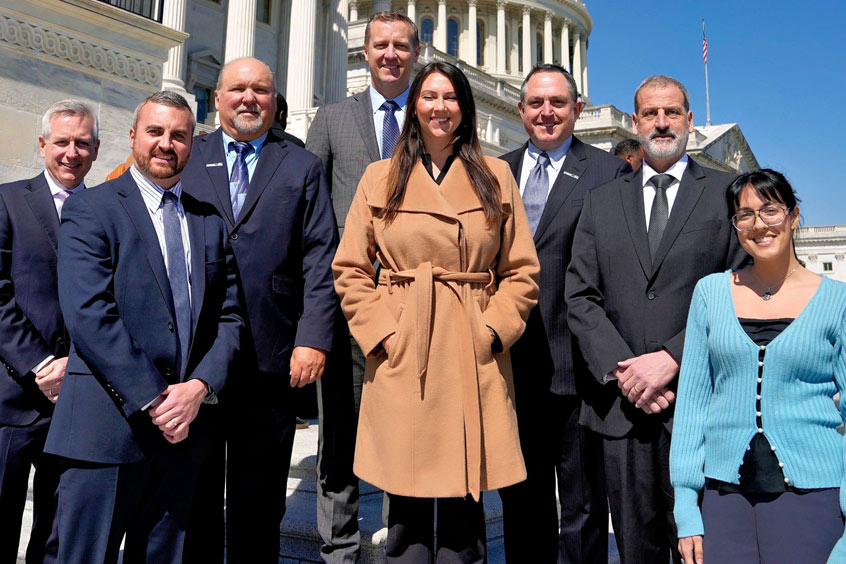
Business aviation representatives lobbied congressional lawmakers and staff on Capitol Hill on 18 March to accelerate policy support for sustainable aviation fuel (SAF) production. The representatives positioned it as central to achieving net-zero emissions by 2050 while reinforcing energy independence and rural economic growth.
Organised by the National Business Aviation Association (NBAA), the Climbing. Fast. Capitol Hill Fly-In highlighted the sector’s economic footprint, supporting 1.3 million jobs and nearly $340 billion in output, alongside its role in advancing cleaner technologies.
At the centre of discussions was bipartisan legislation aimed at scaling SAF supply. Industry participants urged support for the Securing America’s Fuels Act, which would restore the Section 45Z Clean Fuel Production Credit for SAF to $1.75 per gallon through 2033, and the Farm to Fly Act, which would classify SAF as an advanced biofuel eligible for U.S. Department of Agriculture programmes.
“The reduced tax credit has made it more financially advantageous for producers to make renewable diesel instead of SAF,” says Scott Cutshall, president of real estate and sustainability at Clay Lacy Aviation. “Restoring the credit to $1.75 is critical to give producers the confidence to continue building production capacity.”
Operators pointed to existing adoption momentum. Clay Lacy Aviation has offered SAF since 2021 and was among the first 10 U.S. airport locations to do so, demonstrating early infrastructure readiness.
Business aviation has already reduced its carbon footprint by 40% over four decades, while newer aircraft deliver roughly 35% greater efficiency. SAF offers further gains, with lifecycle emissions reductions of up to 80% compared to conventional jet fuel.
“It’s a collaborative ecosystem, and every part of the industry plays a role,” says Corey Hanlon, manager of communications and government relations at Morristown Airport. “Strengthening the 45Z credit will help drive new production capacity across the country and make SAF more widely available.”
Economic projections reinforced the case. The Americans for Clean Aviation Fuels Coalition estimates domestic SAF production could add more than $78 billion to U.S. GDP by 2035 and support over 400,000 jobs at peak output, including new opportunities for rural communities.
Alongside SAF, the industry continues to advance a broader sustainability roadmap including operational efficiencies, airspace modernisation and the development of electric, hybrid and hydrogen propulsion technologies.