


• Aloft AeroArchitects
Maintenance
• Federal Aviation Administration
• Gogo
BAN's World Gazetteer
• Delaware The bimonthly news publication for aviation professionals.
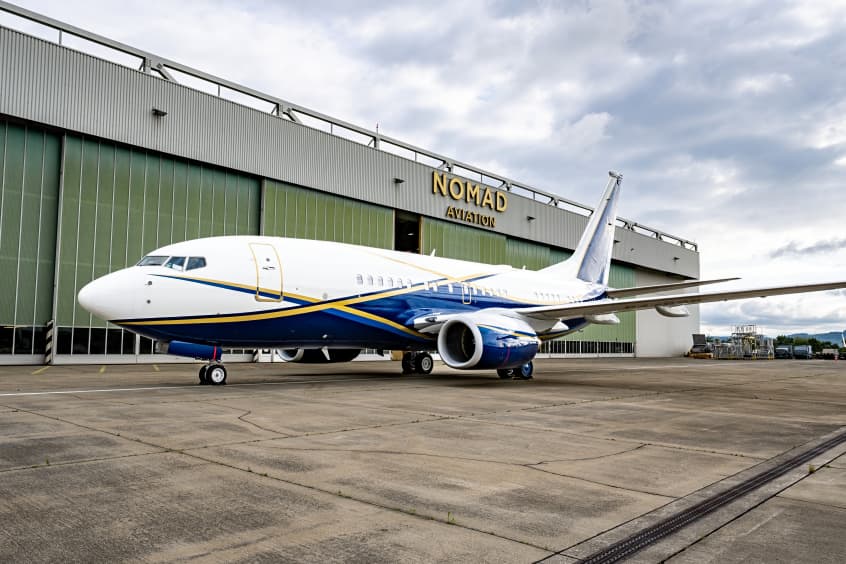
Gogo's first STC for the Gogo Galileo FDX terminal has been issued by the FAA. Generated by Aloft AeroArchitects, the inaugural certificate covers Boeing 737NG-based BBJ (Boeing Business Jets) 1 and BBJ2, and BBJ MAX models, and can be modified to support subsequent Boeing BBJ 737 STC variants.
Located in Georgetown, Delaware, Aloft AeroArchitects is a specialist in completions, inspections, overhaul, maintenance and auxiliary fuel systems installations for large cabin head of state, VVIP and government aircraft. Gogo worked closely alongside the Aloft engineering team to develop the STC. An initial Gogo Galileo FDX installation has already been completed on an undisclosed customer's Boeing BBJ 737-700IGW that was previously without connectivity.
Complementing the advanced technology terminal, Gogo's FlightDeck Freedom (FDF) datalink service has also been activated to support crew operations. FDF supports trip planning, flight tracking, automated real-time weather information, geo-notifications, security events and other critical flight path data for improved situational awareness, enhancing operational efficiencies.
“We are extremely pleased to confirm this approval. This first FDX STC marks another major milestone as we strive to deliver multi-orbit, multi-band connectivity for all types of aircraft. We're even more proud that the customer has trusted Gogo to be its first connectivity provider and flight deck datalink service,” says Chris Moore, CEO, Gogo. “It clearly demonstrates that Gogo is still the only company that can fulfil every aspect of an aircraft's operational nose-to-tail connectivity needs from a single resource.”
Leveraging the full potential of the Eutelsat OneWeb low-earth orbit (LEO) satellite constellation, the FDX terminal supports global, high-speed broadband with up to 195Mbps download and 32Mbps upload speeds throughout the cabin. The Gogo Galileo FDX terminal is purpose-built for business aviation and optimised for super-midsize, long-range and executive airliner aircraft types. The terminal allows multiple passengers using multiple devices to simultaneously enjoy an at-home digital experience at altitude for improved productivity, enhanced entertainment and increased data speeds.
“Our customer needed to equip secure, global connectivity, and as a first-time user, knew that the technology would be supported wherever they flew. The Gogo Galileo FDX terminal meets those needs and was also, despite being our first install, straightforward to fit,” says Scott Meyer, CEO, Aloft. “We're dedicated to ensuring our customers get the right solution for their needs, and in this instance we not only did that but also succeeded in generating the very first Gogo Galileo FDX STC. It's a great achievement, and we're looking forward to working on more installs.”
The second variant in the Gogo Galileo portfolio is now available to support the some 200 Boeing BBJ 737s in the global fleet that regularly fly international legs. Comprising just two line-replaceable units (LRUs), the full-duplex FDX, flat-panel, electronically steered antenna (ESA) and either an SDR Gateway or Avance router platform, installation is minimally invasive, resulting in reduced downtime. The software-driven architecture is future-proofed and optimised for rapid switching between satellites, as required to deliver uninterrupted broadband service. Subsequent approval from the European Union Aviation Safety Agency (EASA) is expected to follow later in 2025.