• Flapper
• flyvbird
Charter
• McMahon Airborne Logistics
Charter
• Professional Helicopter Services
Charter
• Universal Aviation Spain
FBO/Handler (Barajas / Madrid)
• Norrkoping (Kungsangen) Airport
• Montevideo (Carrasco Intl) Airport
• Muenster-Osnabrueck International Airport
• Olbia (Costa Smeralda) Airport
• Reading Regional Carl A Spaatz Field Airport
• Pendleton (Eastern Oregon Regional at Pendleton) Airport
• Augusta (Bush Field) Airport
• Moses Lake (Grant County) Airport
• Oxford (London Oxford) Airport
• London (London Heliport) Airport
BAN's World Gazetteer
• Denmark The bimonthly news publication for aviation professionals.
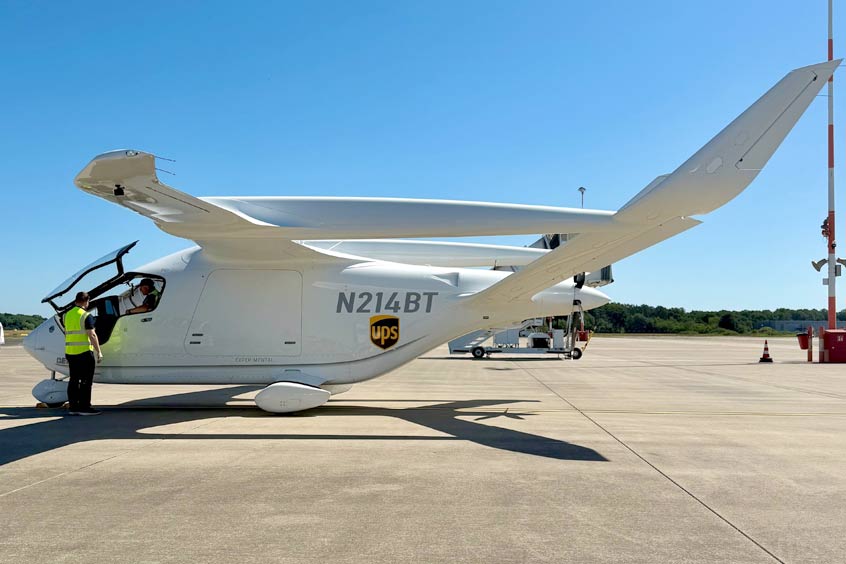










The next 10 years could see the start of a transition from diesel and petrol engines to electric powertrains; the world needs new, fuel-efficient engines to replace these older types. Airworthiness legislation compels either the overhaul or replacement of old engines, and some feel that the turboprop market is simply too small for an engine manufacturer to invest in new turboprop technology. So what impact could the arrival of the Beta Alia and Archer Midnight have on turboprop aircraft?
Martin Winther Andersen, co-founder and CEO of Copenhagen Helicopter believes the market for traditional turboprops will probably decrease anyway as jet engines become better, but the advent of new battery-electric aircraft may open a new market for smaller turboprop engines to be used as generators to provide electricity on board. He mentions a couple of new hybrid-electric aircraft designs, like the Electra EL-9 and Aura Aero ERA, which will use a turboprop-generator to supplement electricity and recharge batteries in the air.
Some operators lack enthusiasm for a change to electric power; they foresee problems with the heavy weight of current batteries and the dearth of re-charging facilities, certainly of rapid ones. Others have committed to offer feedback and use-case data to OEMs to support aircraft design optimisation for short hops and low-turnaround regional missions. A considerable number have placed pre-orders, hedging their bets to gain early positioning and visibility with the manufacturer while leaving room for due diligence and future financing alignment.
Within the corporate landscape, companies that currently fly turboprops often have fixed contracts with governments, large cargo conglomerates or health insurance providers. Flapper Technologies CEO Paul Malicki explains: “That’s because turboprops are largely utility aircraft. Those that fly privately can afford them, and won’t switch anytime soon. They are certainly not dead or in decline.”
In Brazil, turboprops correspond to 20% of the entire general aviation fleet, as of March 2025, according to ANAC data. With a fleet of 2,128 it is the second largest turboprop market in the world, but also the one which mostly depends on them, due to infrastructure issues such as short runways, a complicated geography and a prevalence of agro-business within the general aviation sector. The number of turboprops grew by 15% in the year to March 2025 in Brazil, compared to 16% for jets and 10% for turbine helicopters.
German on demand platform flyv is actively balancing the practical value of today’s turboprops with the transformative promise of electric and eVTOL aircraft. CEO Tomislav Lang believes turboprops will be good for at least the next decade; their reliability, proven economics on short to mid-haul routes and AOC readiness make them indispensable, especially in underserved regional markets where infrastructure is limited and flexibility is essential. But he also believes their role will gradually evolve. They will increasingly act as bridge technology, essential in proving demand, unlocking new markets and preparing the operational ground for future electric fleets.
Change comes slowly
When operators do transition to a short-hop electric fleet it will be gradual. First, perhaps, in defined niches such as routes under 300km with high frequency and predictable demand; through airports with charging infrastructure and low-noise requirements; and within regions under pressure to decarbonise or reduce subsidy dependency.
flyv has placed pre-orders with electric aircraft manufacturers not as a PR exercise, but as a strategic hedge: “We want to be early adopters where it makes sense, both economically and politically,” Lang says.
Winther Andersen says short hop business will flourish once again. People used to commute on small nine to 19 seater aircraft, not so much today since the cost per seat per mile has increased too much to be profitable. This, he says, is why operators were forced to utilise larger and larger aircraft, to keep the cost per seat down, but then needed a much larger catchment area from which to fill them. Many of the old routes just couldn’t attract the passenger numbers, so they closed.
“Based on our surveys, calculations and budgets, we can reverse that negative trend by using electrified aircraft. We could go back and open the small routes once again, at a competitive cost per seat per mile,” he notes. “In short, just as an EV is cheaper to run per mile than a conventionally-powered, similar sized and new car, we will see the same in aviation.”
Where new aircraft use distributed electric propulsion, there is no centralised combustion engine with transmission axles and gearboxes. Energy efficient, light, cheaper and low maintenance, these aircraft will deliver near helicopter performance as a small commuter aircraft but at lower cost. This would open up new routes on purpose-built very short runways, getting passengers even closer to where they really need to be.
Such an aircraft, Andersen believes, could outcompete most upcoming eVTOLs, particularly in those parts of the world where icing is a risk and where night flights are in demand. They might also take some of the revitalised short route commuter market, as well as charters to destinations without charging infrastructures.
A price crash?
Prices for new turboprops may face pressure as electric alternatives enter the market, but this will not apply uniformly. flyv’s Lang says his company expects a price bifurcation, where older turboprops may lose value while newer, highly efficient models like the Tecnam P2012 or Pilatus PC-12 NGX will hold value due to hybrid potential or retrofit pathways. Also, an uptick in demand for used turboprops in emerging markets may occur as operators in Europe and the US shift to electric, and a temporary market squeeze as operators purchase turboprops to secure near-term capacity for proof-of-concept operations may arise.
Who’s buying?
flyv currently operates in partnership with turboprop operators and is actively evaluating further aircraft acquisition or ACMI-based partnerships, in the five-to-nine seat segment. Lang says turboprops offer operational flexibility, a path to near-term revenue generation and time to mature a AI-driven flyvAI scheduling platform before deploying on electric aircraft: “So our near-term fleet strategy includes more turboprops, but in a modular, tech-prep way.”
As battery capacity improves and electric aircraft gain traction with a new clientele within the airport shuttle, scenic flight and cargo segments, Malicki believes existing clients will gradually switch due to cost advantage, which he anticipates will amount to roughly a 30% difference: “We consider the cost of operating but include financing in that calculation. It’s definitely not 50% like most AAM players say. We signed six MoUs, did our internal estimates and that’s what we got. In some cases, the operating costs plus financing and amortisation actually exceed the equivalent for turboprops.”
The consensus seems to be that turboprops are here to stay, for now. But electric aircraft will disrupt route economics, accessibility and public perception. Operators who prepare early, says Lang, those who pilot hybrid models and build scalable tech, will lead the transition.
Several key barriers remain: Lang says certification timelines are sliding across the board, and with their limited range and payload, most current models fall short of real-world use cases without significant compromise. There are unknowns around resale, support and upgrade pathways, and ground readiness is patchy and often overlooked. flyv believes the biggest barrier is not technological but operational: “We need electric aircraft to slot into real-life scheduling and dispatch models,” he adds. “That’s why we’re building our own AI-based demand-aggregation system, to make electric flying commercially viable, not just technically possible.”
Malicki suggests advanced air mobility might not necessarily replace existing supply; instead it will create new use cases and is likely to convert those customers that currently use premium cars to ride to airports or those companies that couldn’t previously avoid hiring aircraft for cargo.
Heli impact
It is not just in the airplane arena that electric power is gaining traction. Robinson is to retrofit its R66 with an electric powertrain following success with its R44, and Professional Helicopter Services chief engineer Peter Elston has been considering the R66 to replace his ageing Bell 206 JetRanger fleet. He says: “We operate five to seven turbine aircraft in a remote hot tourism environment in central Australia. The entry level B206 aircraft are becoming harder to source spares for, and the reliability factor of the avionics is decreasing with age."
The constant sunny environment would suit solar-powered battery stations to provide charge to an electric fleet, but the initial cost would be high, with many changes required on company ops, type training and emergency services awareness.
Since PHS runs larger seven-seater turbine helicopters, the electric version of an R66 would sit alongside jet A-fuelled aircraft, and if there were a group management decision to conduct the transition, the company would run multiple aircraft types over the next 10 years. A major hurdle would be getting the approvals from the multiple airports it operates at to have a charging station installed, and having all personnel and emergency services aware of the dangers posed to charging and long term sun exposure.
Many of its tourism flights range from 20 to 45 minutes so the electric range would suit well, although it normally continually operates with hot loads and hot refuelling for a period of two to three hours at a time. “What can the electric charge hold with multiple take off and landings?” he wonders.
Nick McMahon, president of McMahon Airborne Logistics believes electric aircraft could potentially replace small helicopters that are providing short range transportation for passengers to or from existing heliports, but notes that its an extremely limited market that exists only in places like New York City and Vancouver, due to their geography. “For electric aircraft manufacturers to think they will be developing new market demand elsewhere is naïve,” he says. “Conventional helicopters have been filling the market demand where it exists for decades. Electric aircraft will likely find a place in the personal transportation market and possibly EMS, since charging stations can be located onsite at hospital facilities.”
How soon?
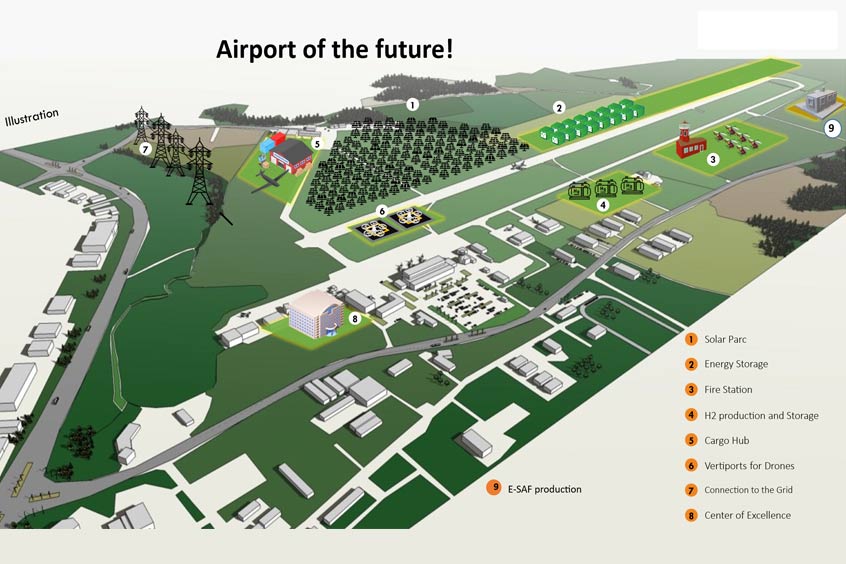
The exact timing of entry into service of electric aircraft will depend on technology maturity and regulatory certification in different regions. In the meantime, some FBOs and airports are factoring electric support into long-term plans while others have already installed electric chargers. Business developer Svante Rudstrom of Norrkoping Airport in Sweden reckons GA aircraft will use dual use interfaces similar or identical to those for cars. Norrkoping aims to be ready for hybrid commercial aircraft from around 2030 and is in the contract phase of an ‘Airport of the Future’ project to realise a multimodal, multi use airport infrastructure (see rendering).
In the short term, multiple charger types are likely to coexist until the industry converges on common standards. Aeropuertos Uruguay, the operator of Carrasco International Airport in Montevideo, hopes to stay flexible enough to adapt efficiently as the industry evolves, closely tracking market and regulatory developments as standards are set. Pembrey Airport in Wales is well underway with installing equipment to accommodate various types and has been making arrangements with Aerovolt since July 2024 to provide the some of the equipment.
In Germany, Hof-Plauen Airport CEO Ralf Kaussler expects electric aircraft will operate from smaller airports, like his. To which end the Bavarian government has issued a grant to build a charging infrastructure network between Hof, Straubing, Landshut, Augsburg and Kempten airports, initially with three charging options: fast charging with 150kW and two points with CCS2+ plugs; a charging station with 22kW and type 2 plugs; and an electric station for DC plugs and adapters.
Munster/Osnabruck airport in Germany is planning a 70ha photovoltaic park to provide green electricity from 2027, initially with a mobile charger. It is also working with the Euregio on the Momo-C project (Mobile Modular Charger) and with future operators like Evia Aero and flyv, which hope to introduce the MDA1 from MD Aircraft and the Electra STOL aircraft respectively some time in the late 2020s. Although, given that the full electric Beta CX300 Alia CTOL visited the airport recently on its grand tour of Europe, aviation marketing manager Detlef Doebberthin reckons this could potentially enter service first.
Olbia airport in Italy will focus on electric-powered passenger transfers within a 40km radius of the airport. It plans to construct a series of vertiports, along with vertistops positioned at yachts, resorts and villas. Subsequently, a tarmac area will be converted to parking and charging space for electric business jets, but it will have to scale up to meet the significant power demands. The airport estimates that a vertiport requires at least 1MW, and the charging demand per electric business jet parking stand, equipped with high-capacity batteries, is expected to be of a similar magnitude. It will also integrate charging stations with cooling systems that are capable of managing the high thermal dissipation that occurs during rapid charging cycles.
Graz airport in Austria has installed photovoltaic systems that will support the recharging of aircraft. And while Universal Aviation Spain awaits guidelines from ICAO and EASA, it is building a 5,000sqm hangar at Madrid Barajas where solar panels in the roof will aid power provision.
And all this has to be paid for. Reading Regional Airport Authority in Pennsylvania is currently estimating a fee for electric aircraft parking or services to compensate for overheads.
The attraction for operators
But there is more to infrastructure than just chargers. To attract eVTOL operators, airports, landing zones must offer fixed electric charging stations, additional taxiways, upgraded fire suppression systems, separate hangars and capable MRO facilities.
Dan Bandel, airport manager of Eastern Oregon Regional Airport in Pendleton, Oregon and its UAS Range expects, to see models like Ampaire’s retrofit Cessna Caravans and Heart’s ES-19 on his tarmac alongside six-to-nine seat electric turboprops and light business jets by 2028/30. He notes that several OEMs are rolling out parallel-hybrid platforms in the mid-2020s, bridging the gap to all-electric, and from around 2026 expects scheduled air-taxi demos and logistics flights from companies like Joby, Archer and Beta evolving into limited passenger service by 2030.
By 2030, he reckons there will be networked DC fast chargers; most FBOs will host at least one 500 kW+ DCFC stall (CCS1/CCS2 standard) to recharge a 500kWh aircraft battery to 80% in 30–45 minutes. Mid-speed 100–200kW units for turn-around flights and 50kW units for overnight top-offs will be common, and standardised plug-and-play ground connections (similar to existing GPU/APU interfaces) will emerge as industry conventions.
Therefore the required infrastructure planning and changes must incorporate electrical capacity upgrades such as substation enhancement, microgrid integration and on-site battery storage to buffer peak loads. On the apron and in the hangar there should be designated charging pads with reinforced pavement, cable-reel systems and overhead charging gantries. It would seem that early engagement with utilities to secure supply contracts, demand-charge management agreements and interconnection approvals would be an advantage, as would the fitting of new Class D/E fire-suppression systems and spill-containment protocols for high-voltage systems.
Augusta Regional Airport in Georgia, USA is the base airport for the annual Masters Golf Tournament and experiences five times the normal amount of airport traffic and some 40,000 commuting patrons during the event. It recognises that eVTOLs could offset land traffic issues associated with commuters and supplies, and, since it is at the centre of 32,000 sqm of territory void of major highways, basing eVTOLs there can expedite transit services for people and goods, which will have a profound impact on the economic viability and quality of life in the area. It already has a Beta Tech aircraft charger on the general aviation ramp and has identified an area for a future vertiport where additional charging stations can be constructed and that could house hangars for storage and maintenance if needed.
Real-world practicalities
Grant County International airport at Port of Moses Lake in Washington was home to the first flight of the magniX-powered Caravan, the Eviation Alice and the Universal Hydrogen fuel cell engine. Airport director Rich Mueller is optimistically cautious, believing entry into service is farther off than most think: “Density of two kinds is to blame; the energy density of batteries and the sheer density we have seen at the FAA when it comes to integrating anything new. Watching UAS approval policy fall over backwards in the last year has made me worry that some up-and-coming flight testing may be put off because there is no clear direction on certification or regulation.” The airport itself is open to any type of flight testing and certification programme, but will have to work out charging both quickly and practically. But power is an issue; grids across the US are maxing out power provision. At Port of Moses Lake power is in large part renewable hydroelectric, and the hub is working to add power to the local grid to accommodate this increased reliance on electrical charging.
Will Curtis, managing director of London Oxford airport and the London Heliport, questions real-world practicalities; before any battery-electric aircraft can use a UK-licensed aerodrome, the matter of how to extinguish and make safe a large capacity battery fire will need to be resolved to the satisfaction of both the aerodrome operator and the UK CAA. There is, he says, currently no known means of safely controlling and/or extinguishing such a fire. Battery fires typically generate extremely high temperatures and emit highly toxic fumes that present a serious danger to life. Battery fires can burn for a week or more before they finally dissipate. Battery-electric aircraft, unless very small (up to 20kWh), are therefore presently incompatible with safe aerodrome operations given the current firefighting provisions mandated at UK-licensed aerodromes. The London Heliport believes the hazard created by toxic emissions would have real implications for surrounding residential and business premises, probably requiring complete evacuation, which is a matter that must be satisfactorily resolved.
A further emerging consideration is rotor downwash speeds, which, in the case of some eVTOL designs, are proving to exceed safe limits for personnel and proximate aircraft, potentially prohibiting operations in confined areas such as heliport aprons.
At present, there are no firm plans to install any electric aircraft charging infrastructure at the airport or heliport because, quite apart from the above safety considerations, no standardised specification has been identified. Additionally, many areas of the country are struggling with grid capacity constraints. Many UK airports will be unable to spare the more than 10 megawatts of grid capacity that is likely to be needed to support a basic eVTOL charging installation without substantially handicapping the ability to service their existing estate. Until the national grid is substantially reinforced, this position is unlikely to change and will arguably be exacerbated by the government’s current drive towards mandating electric road vehicles, which is expected to place an increasing strain on the existing grid infrastructure. “I know, from industry colleagues, that we are not alone in adopting this position,” says Curtis.
Further, he believes the cost of electricity in the UK, by far the most expensive in the G20, must fatally dent the economics of eVTOL and battery-electric aircraft operations. “A 1kWh unit of electricity delivered to an aircraft will cost in the region of £0.60 at today's prices and likely considerably more by the end of the decade as demand and green levies increase,” he adds. “A litre of Jet A1 today costs around £0.90 but contains 12kWh of energy, equating to £0.075 per kWh. So, fuel costs for an electric aircraft are likely to be in the region of eight times more expensive than those of a Jet A1-powered helicopter or aircraft. The electric aircraft may possibly use the energy aboard more efficiently than its conventionally powered equivalent, but this will be unlikely to sufficiently close the economic and practical void between the two.”
Curtis detects a reluctance to address these practicalities and feels the sector continues to develop products with compromised real-world performance capabilities that are projected to cost substantially more than their highly developed, proven, conventionally powered and commercially viable counterparts, ie helicopters.
PIPISTREL BOX
Pipistrel provides the Velis Electro, the first and currently only type-certified electric aircraft, with an optional Single Phase or Three Phase charger. An eTextron spokesperson says that multiple stakeholders, including the FAA, EASA, GAMA and NBAA, are collaborating on the issue of a charging infrastructure, as a common and scalable system will be essential for driving the adoption and integration of Advanced Air Mobility.
Pipistrel’s second-generation batteries are already in use on the aircraft, supporting its enhanced performance and reliability by providing greater energy density, longer flight durations and more efficient power management.