


• Aerocardal
Charter
• Aerotree Defence & Services
Charter
• FAI rent-a-jet
Charter
• FL3XX
• Helic Fly Aero Taxi
Charter
• Le Bas International Air Charter
• Maverick Air Charters
Charter
• Northern Jet
Charter
• Toyo Aviation
Charter
• Voluxis
Charter
BAN's World Gazetteer
• Chile The bimonthly news publication for aviation professionals.



The emergence of digital systems is remorseless, with a steady flow to market that ‘threatens’ to streamline operations flexibly, easily and cost-effectively. We are past the stage where we question whether digitalisation is necessary; it most definitely is. Nearly every aspect of our lives is shaped by technology. Automation, integration and the rapid rise of artificial intelligence have become inseparable from modern operations.
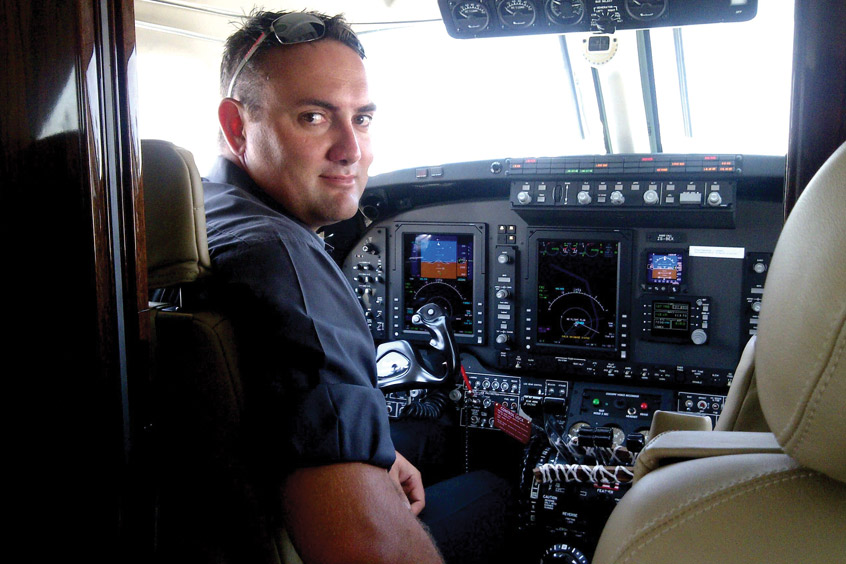
“For those of us who were fortunate enough to grow up in the analogue era of the early 1980s, the transition has been both remarkable and instructive,” says Lourens Human, of South Africa-based Maverick Air Charters. “We witnessed the world shift from paper logbooks and filing cabinets to cloud platforms and predictive analytics, and this dual perspective has helped me and many of my peers not only understand the benefits of digital systems but also manage the challenges that come with adopting them in business aviation.”
One of the greatest challenges is human. Ensuring that employees embrace digital tools requires sensitivity, patience and training. This is especially true for senior staff who remember the days when workflow management meant a reliable pen and a sturdy notebook.
The shift from paper-based record-keeping to cloud-based storage has perhaps been one of the most universally appreciated advancements. Hangars and offices once housed mountains of archived documents such as maintenance logs, flight plans and crew records. Today, we rely on secure digital platforms that can be accessed from anywhere in the world. Audits become faster, compliance becomes cleaner and data retrieval, once a task of searching through boxes, becomes instantaneous.
However, the journey to where we are today has been far from seamless. For many years, digital systems were designed primarily for large scheduled airlines, which left smaller corporate operators, charter companies and private flight departments with tools that could not flex to their unique needs. The mismatch between system complexity and operational scale often limited adoption.
Fortunately, that gap has closed, leaving the business aviation market spoiled for choice. Yet the growing sophistication of these systems brings its own set of pros and cons. Real-time aircraft tracking improves operational oversight; predictive maintenance reduces downtime; crew scheduling algorithms minimise fatigue risk while improving productivity; AI-assisted dispatching enhances decision-making, especially during irregular operations; and digital billing systems reduce errors while speeding up revenue cycles. But complexity can be a barrier.
Some systems try to do everything, which results in steep learning curves. Integration between platforms is better than it once was, although not always seamless, and while customisable systems offer flexibility, they often require significant commitment during the setup phase, including time, financial investment and the willingness to rethink established workflows. Support and training remain critical, especially for smaller operators.
“Despite these challenges, one truth has become clear: digital solutions now offer such significant operational advantages that competing without them is nearly impossible,” Human continues. “The data they provide, from performance metrics to maintenance trends and utilisation insights, empowers operators to optimise resources in ways that analogue tools never could.”
The transition to digital technology is being implemented quickly and differently in areas like Latin America, while it has been under development for many years in the US and Europe. For Chile-headquartered Aerocardal, technology is only good if it enhances safety, boosts efficiency and meets budgets. Digital transformation should never come at the expense of customer service, human experience or intuition. “Our customers still value human experience and know that Latin America also requires adaptability beyond what any software programme can deliver,” says CEO Ricardo Real.
Technology needs to fix problems, not develop new ones. Many digital aviation solutions exist to integrate everything into a single system, but while this strategy is effective for some companies, it is too much for others.
Latin America is characterised by constantly fluctuating routes, wide variations in weather influenced by geographic differences, diverse interpretations of regulations by local administrations and differences in airport infrastructure from one country to another. A rigid system suited for standardised environments may not always work. “In our world, the answer is always the same: does this system reduce or create operational friction?” Real notes.
A platform may have several levels of navigation to accomplish one simple update or may impose one workflow but does not necessarily conform to how dispatch teams operate in the region: efficiency is thus compromised from theory to reality.
While expectations around AI are high, its day-to-day usefulness in aviation is grounded in simple, pragmatic tasks.
Predictive maintenance is one area where AI already shows tangible benefit. When component stress trends or risk of unscheduled maintenance can be discerned by software systems, aircraft availability is positively impacted. In areas of the world where parts logistics contribute to significant delays, analytics beyond simple convenience are highly beneficial.
AI-based booking and quoting solutions have minimised labour and response time. “Given that most business aviation flights to Latin America take place within 24 to 48 hours, any improvement in this timeframe is also beneficial for aircraft quotes,” Real continues. “However, such solutions are just support. The choice of aircraft, operational viability and safety factors must be manually assessed.”
Fuel costs are among the most significant variables for regional private jet flights. Fuel price comparison platforms combined with taxes and airport fees facilitate effective planning and management by operators. When used properly, such platforms help operators optimise movements without negatively affecting safety margins or dispatch reliability.
Digital tools cannot replace skilled personnel, and air transport is still a human-related service. It is successful because its staff understand customer expectations and local knowledge. Technology can improve communication, automate keying data and avoid redundant effort, but it does not have the same value judgments or experience as humans. “Clients still value the dispatcher who recognises when a weather model does not reflect actual conditions, the crew scheduler who can identify fatigue risk beyond what duty-limit calculations show, the maintenance chief whose understanding of an aircraft’s history extends beyond any algorithm, and the service representative who understands the cultural nuances and expectations that shape each client interaction,” Real explains.
“Here in Belo Horizonte, where we operate helicopters focused on executive flights, we have adopted different digital solutions to gain efficiency, safety and predictability. And the truth is, when properly integrated, these systems really do make life easier,” says Helic Fly director of operations and chief pilot Romulo Lima.
The company is actively working to add inflight aircraft monitoring into its air-taxi operation, making it possible to track in real time engine parameters, vibration, temperature and torque trends, as well as precise location, speed and altitude. What once depended solely on the pilot’s report now arrives automatically at the operations and maintenance departments. And it brings two immediate benefits: operational safety, where earlier detection of abnormal trends allows preventive actions before they become actual failures; and flight control, where the operations centre can view the entire fleet, predict arrival times and anticipate crew changes, refuelling and cleaning.
On the maintenance side, platforms have replaced old spreadsheets and manual records: every cycle, flight hour, installed component and life limit is tracked automatically. This drastically reduces input errors, simplifies audits and allows maintenance downtime to be planned more strategically.
The benefits are clear, but not everything is perfect. “Complex systems require constant training, and the lack of integration between different platforms remains a common challenge,” Lima notes. “Often, the maintenance team uses one software, the operations department uses another, and the pilot uses a third. This is where efficiency gains can be lost.”
Speaking of integration, few elements are as sensitive as crew management. Tools that centralise scheduling, medical certificate validity, training, days off, flight hours and regulatory limits make a significant difference in operations with multiple legs on the same day; something very common in air-taxi work. With automations, the system prevents assigning a pilot who is close to exceeding duty-time limits, reducing operational risk and avoiding regulatory penalties.
“In practice, we’ve found that the greatest value of digital systems lies precisely in their ability to connect the three areas of flight, maintenance and crew into a continuous flow of data,” explains Lima. “When this happens, decisions become faster and more informed. But when integration fails, rework, duplicate entries and frustration appear.”
The digital promise in business aviation is a powerful one, adds Aerotree Defence and Services COO Zamri Yeop Zainon, but success hinges on strategic implementation that places human factors and operational logic at the forefront, not just the technology itself. “The industry's most significant challenge is the lack of universal interoperability, often leading to a ‘digital patchwork’,” he says. An operator might possess best-in-class solutions for individual functions, but if these systems cannot communicate, they create new layers of complexity. Data must be manually re-entered or reconciled, fostering inefficiency and risk. In this environment, a system’s sophistication is irrelevant if its interface is cumbersome.
“User adoption is the ultimate litmus test,” Zainon continues. “If our crews, schedulers and maintenance controllers find a system obstructive, they will inevitably create workarounds, negating the investment and fracturing the very data integrity we seek to build.”
This leads to the critical balance between customisability and out-of-the-box functionality. The allure of a fully bespoke system, moulded perfectly to an operator’s unique workflow, is undeniable. Yet, this path can lead to becoming a permanent beta tester, entangled in endless development cycles. Conversely, a rigid, off-the-shelf product may force undesirable compromises in service delivery. The pragmatic solution lies in a configurable platform that offers sufficient flexibility to respect an operator’s competitive advantages while providing the stability and continuous updates of a proven product.
Ultimately, the true value of any digital system is tested not in a conference room demo, but at early morning in a remote hangar, where the vendor’s commitment to training and support becomes the most critical component of the investment. The best platforms are partnered with responsive, expert support teams that act as a true extension of one’s own. The quantifiable time and cost savings in automated billing or streamlined reporting are undeniable. However, the most profound returns are often strategic: predictive maintenance alerts that prevent an AOG event, optimised crew pairing that enhances wellbeing and alertness, and data-driven insights that empower proactive decision-making. These systems pay for themselves not just by accelerating old tasks, but by enabling a new standard of operational excellence.
Digital systems are powerful tools that, when wielded with wisdom and a human-centric strategy, elevate capabilities and simplify complex workflows. The goal is no longer simply to be digital, but to be intelligently and resiliently connected, ensuring that technology delivers efficiency, not complexity.
Customer comments:
Donough Hughes, COO, Le Bas International: “Stack.aero’s platform has streamlined our quoting process, allowing us to deliver faster, more accurate quotes to our clients.”
Greg Mangione, director of operations at Northern Jet Management, says that since adopting Web Manuals in 2020: “Compliance linking makes it easy to demonstrate regulatory alignment during audits, and our manuals are now cleaner, standardised and much easier for our team to manage and navigate.”
Laurin Claus, manager of development and charter sales, FAI Aviation Group: “We operate in a fast-paced environment with constant schedule changes and new scenarios every day. Working with FL3XX to automate our scheduling, dispatch and overall operations has greatly simplified the complex workflows and reduced our workload. The result is faster reactions, more efficient decision-making and better situational awareness across the company. It’s increased internal communication and predictability, which is critical in our line of work.”
TrustFlight Tech Log:
Andrew Boxer-Missen, COO of Voluxis: “Tech Log works nicely for Voluxis as it can allow for worldwide management of our growing global fleet of aircraft in the simplest possible way. It is an intuitive, easy to use system which the flight deck crew all appreciate and has significantly made Voluxis flight documentation processes more efficient.”
TrustFlight Centrik and Tech Log:
Gheorghe Oprea, compliance monitoring and safety manager at Toyo Aviation: “Centrik and Tech Log have enabled us to consolidate safety, compliance and technical oversight into a single, structured environment. The ability to link reports, risks, documentation and training within a traceable workflow has strengthened both our internal processes and our readiness for regulatory oversight. These tools are now embedded in our operational culture and play a central role in ensuring continuous improvement and compliance assurance across the organisation.”