


 The bimonthly news publication for aviation professionals.
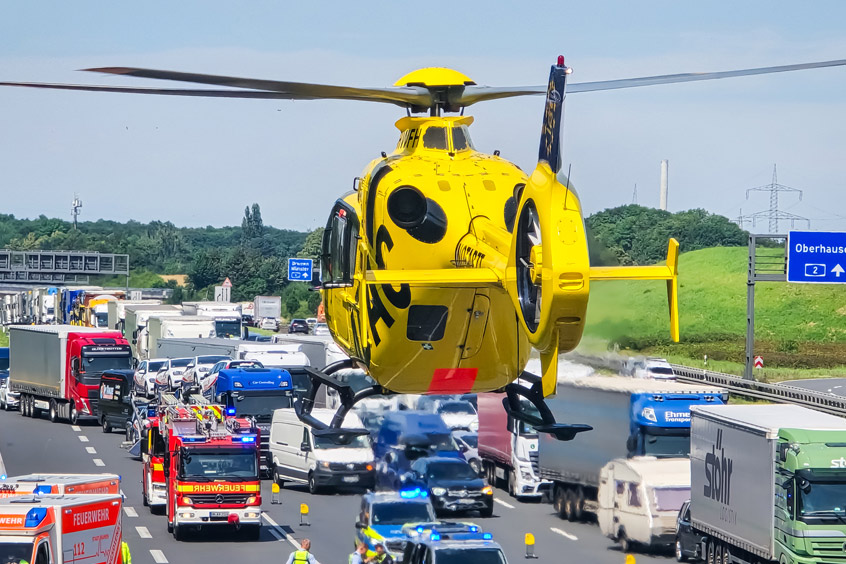
ADAC Luftrettung responded to 49,048 emergencies nationwide in 2024, according to the annual report of the German non-profit rescue service organisation. This means that the number of missions by the ADAC rescue helicopters fell by 4.5 per cent compared to the previous year (minus 2,299). On average, the machines were alerted to almost 135 emergencies every day.
“The helicopter crews were able to ensure the emergency medical care of people without restrictions in 2024. Regardless of whether it is day or night, in the mountains or at sea or in the event of a disaster, the population can continue to rely on our rapid assistance from the air in the future,” emphasises Frédéric Bruder, managing director of ADAC Luftrettung.
The number one reason for deployment was injuries following accidents (31 per cent). These include leisure, sports, work, school and traffic accidents. This was followed by cardiovascular emergencies such as heart attacks and cardiac arrhythmias (26 per cent). In 13 per cent of cases, the air rescuers diagnosed neurological emergencies such as strokes. In seven percent of cases, the cause was a respiratory emergency such as acute shortness of breath or asthma. The majority of patients were men (59 per cent). Almost one in 10 patients were children or young people.
In addition to normal operational fluctuations and weather-related flight cancellations, ADAC Luftrettung believes the reasons for the decline in missions are the expanded powers for emergency paramedics and the increasing use of tele-emergency doctors. The number of cases in which an emergency doctor is required on site has therefore decreased. In order to improve emergency care overall, ADAC Luftrettung has now founded its own telemedicine unit ADAC Telenotarzt GmbH.
According to ADAC Luftrettung, the importance of rapid help from above will continue to increase despite the current drop in deployment numbers, says managing director Frédéric Bruder, with a view to necessary changes in the health care system: “Our first wish for the new federal government is a rapid reform of the emergency and rescue services. In addition, there is a need for cross-state deployment and planning as well as nationwide deployment options for our rescue helicopters at night.” He already sees the increasing number of long-term contracts for the construction and operation of air rescue stations as positive, as well as the cooperative partnership with control centres, clinics, rescue services, the responsible authorities in the state and the municipalities, as well as the police and fire brigade.
Most deployment locations in 2024 were in Bavaria with 12,015 (previous year 12,998), and this is also where most stations are located. This is followed by Rhineland-Palatinate with 7,907 (8,761), North Rhine-Westphalia with 5,603 (5,796) and Lower Saxony with 5,394 (5,705). The ADAC rescue helicopters ‘Christoph 31’ in Berlin (2,070), ‘Christoph 15’ in Straubing (1,814) and ‘Christoph 18’ in Ochsenfurt (1,795) are at the top of the list of cities with the most alarms among the 38 stations. The ‘Christoph 67’ helicopter, which was stationed in Itzehoe in Schleswig-Holstein in 2024, already flew 548 missions in the first half of the year.
Special operations with rescue winches have settled into a high level. The crews of the six winch stations in Munich, Murnau, Straubing (all Bavaria), Sande (Lower Saxony), Westpfalz (Rhineland-Palatinate) and Hamburg flew a total of 552 winch operations (previous year 546). The winches, which are 90 metres long and have a load capacity of around 250 kgs, enable patients to be treated and rescued much more quickly in hard-to-reach locations. The winch helicopters are also available in disaster situations to rescue people in emergency situations. The recent floods in southern Germany showed once again how important these are.
The number of rescue flights at dusk and in the dark also increased slightly to 3,159 (previous year: 3,122). These included highly demanding emergency missions at night with landings at unlit sites. These are made possible, among other things, by special night vision goggles as part of a highly modern night vision imaging system, known as NVIS for short. The crews fly such missions in Greven and Cologne (both North Rhine-Westphalia), Senftenberg in Brandenburg, Sande in Lower Saxony, Mainz in Rhineland-Palatinate and Ulm in Baden-Württemberg.
Depending on the region and requirements, the ADAC Luftrettung crews can rely on the most modern rescue helicopters of H135 and H145 types from Airbus Helicopters for their work. These include, as were recently introduced in Munich and Mainz, several H145 machines with five-blade rotors for greater range and significantly more payload. Newly purchased additional helicopters of the smaller H135 type, for example for ADACs' Straubing, Siegen and Zwickau bases, were also purchased due to their lower weight and size. They are cheaper to buy, use less kerosene, are particularly manoeuvrable and cause less downdraft when taking off and landing. This makes them particularly suitable for emergencies in inner-city areas.
To ensure emergency medical care by air in Germany, around 1,350 people work for ADAC Luftrettung GmbH and its subsidiaries nationwide, including around 180 pilots, 645 emergency doctors, around 230 emergency paramedics (TC HEMS) and more than 200 employees in technology and maintenance. The team at a station usually consists of three pilots, five emergency paramedics and 15 emergency doctors. The ‘Christophorus Europa 3’ station in Suben, Austria, is operated jointly with the ÖAMTC Christophorus Air Rescue Association. ADAC Luftrettung flies here with helicopters and pilots in the winter months while the ÖAMTC does so in the summer.