


 The bimonthly news publication for aviation professionals.
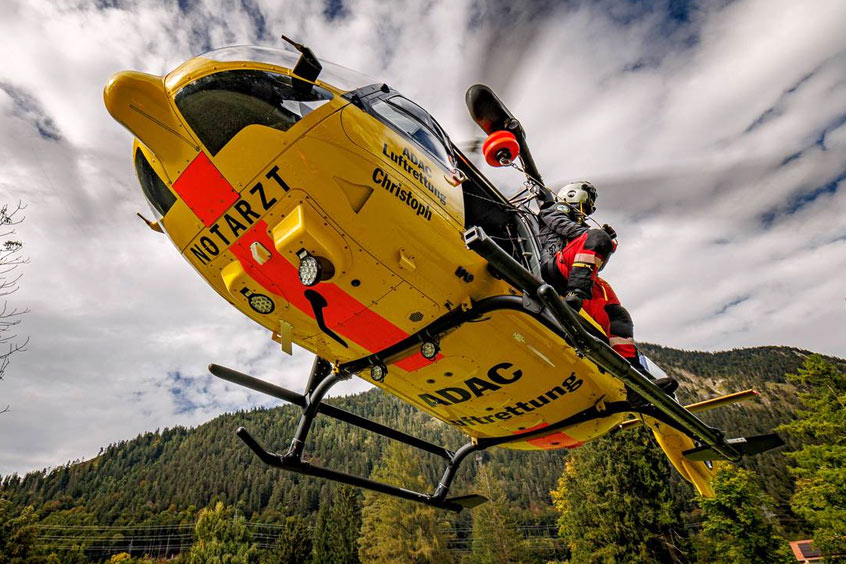
ADAC Luftrettung's ‘flying yellow angels’ responded to approximately 49,000 missions across Germany in 2025. This equates to an average of 134 emergency calls per day for ADAC rescue helicopters, according to the annual report published by the German non-profit rescue organisation. Among the 48,908 missions (compared to 49,048 the previous year), 3,314 flights were conducted at night, marking a five per cent increase. The number of highly demanding special rescue operations using winches also rose by five per cent to 580.
The most frequent reason for deployment, accounting for almost one in three cases (31 per cent), was injuries sustained in accidents. These included leisure, sports, work, school and traffic accidents. Approximately one in four call-outs (26 per cent) involved cardiovascular emergencies such as heart attacks and cardiac arrhythmias. In 13 per cent of cases, ADAC air rescuers diagnosed neurological emergencies such as strokes, while in eight percent, the cause was acute respiratory distress or asthma. Nearly one in 10 patients were children or adolescents.
To ensure the continued availability of emergency medical services from the air, the reform of emergency care currently being promoted by Germany's Federal Ministry of Health must now be implemented, says Frédéric Bruder, managing director of ADAC Air Rescue. "The rescue service must be further developed. We urgently need longer operating hours, including during the night, more flexible working time models, comprehensive digital networking of control centres and cross-state operational and needs planning with uniform quality standards,” he explains.
In 2025, Bavaria, which is home to the majority of ADAC's helicopter rescue stations, again recorded the highest number of deployments with 11,742 (compared to 12,015 the previous year). This was followed by Rhineland-Palatinate with 7,786 (7,907), North Rhine-Westphalia with 5,310 (5,603) and Lower Saxony with 5,367 (5,394). The ADAC rescue helicopters ‘Christoph 31’ in Berlin, ‘Christoph 18’ in Ochsenfurt and ‘Christoph 10’ in Wittlich were among the stations with the most call-outs, performing 2,430, 1,942 and 1,747 missions respectively.
Flights at dusk and in darkness increased significantly last year. Their number rose by five per cent from 3,159 to 3,314, including highly demanding emergency missions at night with landings at unlit airfields. These are made possible, among other things, by special night-vision goggles as part of a state-of-the-art Night Vision Imaging System (NVIS). Crews from six stations fly such missions: Greven and Cologne (both in North Rhine-Westphalia), Senftenberg in Brandenburg, Sande in Lower Saxony, Ulm in Baden-Württemberg and Mainz in Rhineland-Palatinate. The latter has been ADAC Luftrettung's fourth 24-hour station since January 1, 2026.
The number of rescue winch operations also increased by five per cent. The crews of the six winch stations in Munich, Murnau, Straubing (all in Bavaria), Sande (Lower Saxony), Westpfalz (Rhineland-Palatinate) and Hamburg flew a total of 580 such highly demanding special missions, compared to 552 the previous year. The 90-metre winch, with a lifting capacity of approximately 250 kgs, enables significantly faster patient care and rescue at difficult-to-access locations. The winch helicopters are also available for rescue operations in disaster situations.
ADAC Luftrettung has further strengthened its commitment to civil protection and disaster relief. This includes not only additional winch helicopters and highly qualified crews, but also 10 specialised air rescue consultants who will be available to emergency medical service providers and relevant authorities to assist in managing major incidents throughout Germany, around the clock.
With its own dedicated civil protection officer, the ADAC air rescue service will now also address its increased social responsibility in strengthening civil-military cooperation between the federal government, states, municipalities and emergency services, as required by the federal government. ADAC Luftrettung will therefore contribute its expertise to exercises with the German Armed Forces to further develop nationwide disaster response.
ADAC Luftrettung deliberately employs a multi-fleet strategy, enabling it to respond appropriately, sustainably and cost-effectively to the complex challenges of emergency medical services and all operational scenarios. Depending on the region and requirements, crews can utilise state-of-the-art H135 and H145 rescue helicopters from Airbus Helicopters. The H145 helicopters are particularly well-suited for higher payloads and longer distances during patient transfers. The smaller H135 helicopters are especially suitable for emergencies in urban areas. They are particularly manoeuvrable and generate less downwash during takeoff and landing. Furthermore, they are less expensive to purchase and consume less fuel. In the future, ADAC Luftrettung will also utilise the new H140 generation of rescue helicopters from Airbus Helicopters, which combines the best features of both existing models, having placed an order for five aircraft in March last year.
Since October 2025, the new headquarters of ADAC Luftrettung has been located at the special-use airport in Oberpfaffenhofen near Munich, the most important aerospace hub in Germany. Under the motto ‘United in Safety’, the ADAC campus unites the entire range of services offered by the ADAC Group under one roof, including flight operations, medicine, research, education, training and maintenance, as well as administration. This makes the new ADAC Luftrettung campus a unique centre of excellence for helicopter pilots, rescue services and emergency medicine, both nationally and internationally. The campus is designed with sustainability and energy efficiency in mind, and includes a multifunctional event space for trade fairs, symposia and conferences for approximately 300 participants.
To ensure emergency medical care from the air in Germany, more than 1,500 people work for ADAC Luftrettung and its subsidiaries nationwide, including approximately 180 pilots, 670 emergency physicians, 245 paramedics (TC HEMS) and more than 200 technical and maintenance staff. A typical station team consists of three pilots, five paramedics and 15 emergency physicians. The ‘Christophorus Europa 3’ station in Suben, Austria, is operated jointly with the ÖAMTC Christophorus Air Rescue Association in Vienna. ADAC Luftrettung operates helicopters and pilots from this station during the winter months, while ÖAMTC takes over during the summer.