 The bimonthly news publication for aviation professionals.
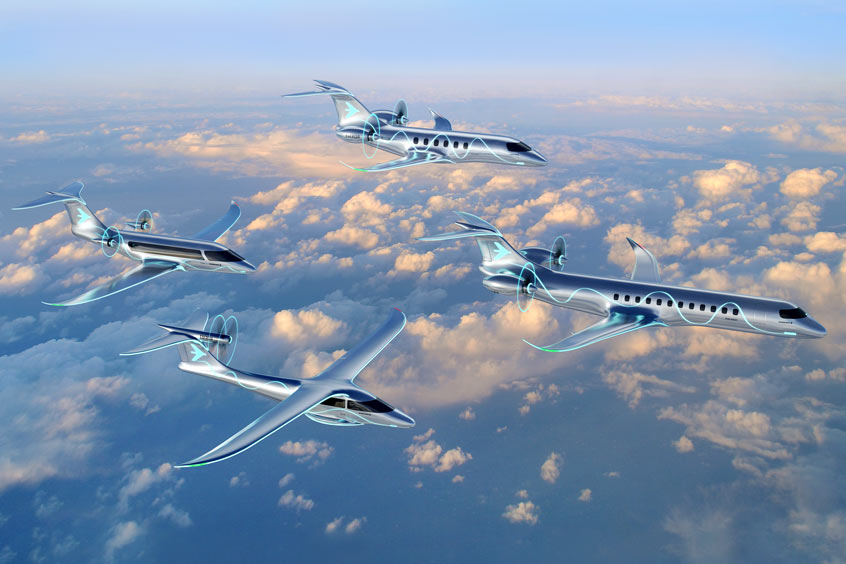
With an eye on net zero carbon emissions by 2050, Embraer has unveiled its Energia family of concept aircraft on a live YouTube broadcast from its São José dos Campos manufacturing facility.
This Sustainability in Action initiative comes about following partnerships with an international consortium of engineering universities, aeronautical research institutes and small and medium-sized enterprises, that allowed Embraer to better understand energy harvesting, storage and thermal management, and their applications for sustainable aircraft propulsion.
“We see our role as a developer of novel technologies to help the industry achieve its sustainability targets. There's no easy or single solution in getting to net zero. New technologies and their supporting infrastructure will come online over time,” explains Embraer SVP of engineering, technology and corporate strategy Luis Carlos Affonso. “We're working right now to refine the first airplane concepts, the ones that can start reducing emissions sooner rather than later. Small aircraft are ideal on which to test and prove new propulsion technologies so that they can be scaled up to larger aircraft. That's why our Energia family is such an important platform.”
The Energia family is comprised of four concept aircraft of varying sizes that incorporate different propulsion technologies; electric, hybrid-electric, hydrogen fuel cell and dual fuel gas turbine. Each aircraft is being evaluated for its technical and subsequent commercial viability.
The all electric nine seat Energia Electric (E9-FE) has aft contra-rotating propellers and produces zero CO2 emissions.
The nine seat Energia Hybrid (E9-HE) has hybrid-electric propulsion from rear-mounted engines that reduce CO2 emissions by up to 90 per cent. The company assumes technology readiness in 2030.
The emissions-free, 19 seat Energia H2 Fuel Cell (E19-H2FC) has hydrogen electric propulsion and rear-mounted electric engines. Technology readiness is assumed for 2035.
And the 35 to 50 seat Energia H2 Gas Turbine (E50-H2GT) has hydrogen or SAF/JetA turbine propulsion and rear-mounted engines. There will be virtually no CO2 emissions and the technology should be ready for 2040.
Talking of the company’s strategy regarding sustainability, Embraer Commercial Aviation president and CEO Arjan Meijer adds: “We will see a big transformation in our industry towards more sustainable aviation. With 50 years' experience in developing, certifying and supporting regional aircraft, Embraer is in a unique position to make viable the introduction of new disruptive green technologies.”
Although the Energia aircraft are still on the drawing board, Embraer has already made advances in reducing emissions by testing drop in SAF, mixes of sugarcane and camelina plant-derived fuel and fossil fuel, on its family of E-Jets.
The company expects all Embraer aircraft to be SAF-compatible by 2030.
Last August, it flew its electric demonstrator, a single engine EMB-203 Ipanema, wholly on by electricity. A hydrogen fuel cell demonstrator is planned for 2025 and an eVTOL vehicle is being developed to enter service in 2026.