


 The bimonthly news publication for aviation professionals.
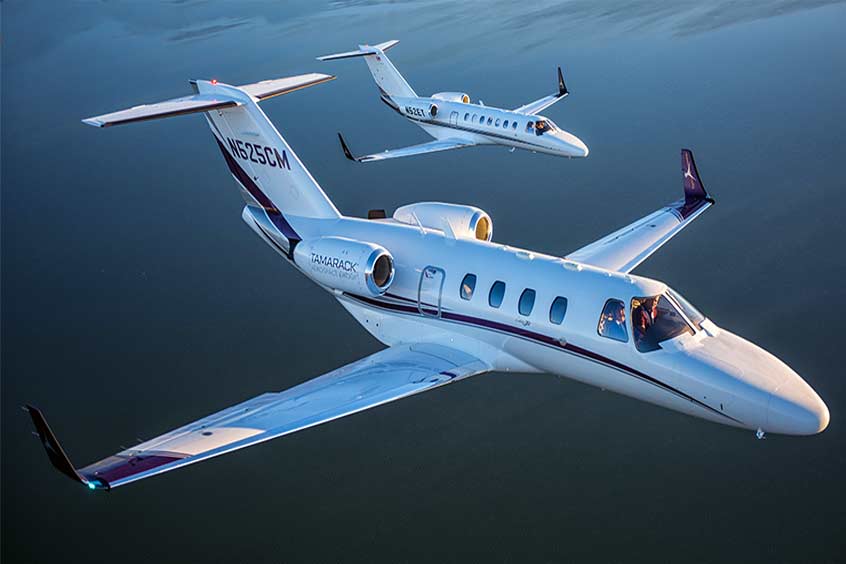
Tamarack Aerospace, the developer of aftermarket Atlas Active Winglets, has released an Aviation Sustainability Initiatives white paper. Thhis outlines how its active winglets and other fuel saving and sustainability technologies can partner to reach international climate change goals.
The document also shines a spotlight on the current state of aviation and the environment, and why the aviation industry must act on climate change now while longer-term solutions are being developed. The white paper was released to coincide with Earth Day, during a time for the world and the aviation industry alike to recommit to a more sustainable future.
“Climate change is one of the most significant challenges currently facing human civilisation. The industry needs technology that delivers meaningful reductions in carbon emissions, that can be applied to the existing fleet quickly and economically, as well as simply and effectively embodied in the production of future aircraft. Tamarack Active Winglets are that technology,” says Tamarack CEO and founder Nicholas Guida. Guida is also the inventor of Active Winglet technology, which currently provides up to 33 per cent fuel savings for a fleet of business jets operating worldwide.
As demonstrated in the Aviation Sustainability Initiatives white paper, Tamarack Active Winglets are a scientifically proven and game-changing technology. “A case study conducted by Tamarack estimated that if Active Winglets were to be fitted to the commercial jet narrow-bodied fleet (Airbus A320/Boeing 737 variants) alone, that 1.6 billion tons of CO2 can be saved by 2040, reducing the (aviation industry's) emissions gap by approximately 20 per cent,” cites the document. “Tamarack's technology offers a greater reduction in fuel burn and carbon emissions for existing aircraft than any other retrofittable solution available at present.
“With aviation being dependent on high density, high energy fuel, sustainable aviation fuels appear to be main path to carbon neutral operations. However scaling SAF to the required volumes is still decades away,” shares Ian Bannister, chartered aeronautical engineer and author of the Aviation Sustainability Initiatives white paper. “However, to tackle climate change we need to act now where we can. Of the solutions available today, fitting Active Winglets delivers by far the greatest reduction in fuel burn and emissions and would be a significant step forward for operators looking to achieve carbon neutral operations. They are a win-win for operators and the environment.” Additional co-authors of the Aviation Sustainability Initiatives are aeronautical engineers Sam Middlewood and Alice Goodwin.
Tamarack has a growing fleet of over 130 Cessna CitationJets worldwide. Owners and operators are said to be thrilled with Active Winglet technology. Unlike the passive winglet offerings on other platforms, which only offer about four per cent fuel savings, Active Winglets instantly and automatically adjust to turbulence, leveraging patented load alleviation and sustainability technology to reduce fuel usage up to 33 per cent. In addition, the system provides smoother and safer rides with takeoffs and landings on shorter runways, as Active Winglet modified business jet aircraft reach optimum altitude much faster than other aircraft, with less noise pollution impacting airports and surrounding communities.