 The bimonthly news publication for aviation professionals.
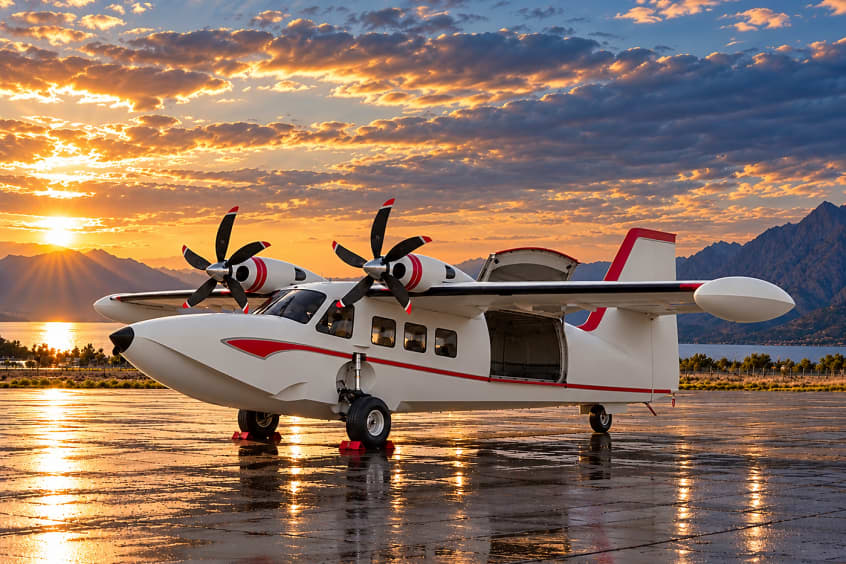
Maxwell Aircraft has introduced the M1 Hybrid, a patent-pending hybrid-drive amphibious aircraft designed to combine payload, range and operational flexibility for cargo and passenger transportation.
Designed for demanding missions where airports may be unavailable, the M1 Hybrid is being developed in a cargo configuration designated M1-HC, with a five-foot-wide cargo door. The M1-HC is designed to carry a 2,000-pound payload over 1,000 nautical miles on the same flight, combining high-power electric assistance for takeoff and climb with Jet A-fuelled compression-ignition engines for cruise.
At the heart of the aircraft is a mechanically coupled hybrid-drive architecture designed to match propulsion technology to each phase of flight. Conventional aircraft must carry engines sized for takeoff even though they use only a fraction of that power in cruise. Maxwell’s patent-pending drive combines electric motors with compression-ignition engines, with design targets of up to 1,500 horsepower for takeoff and initial climb and approximately 300 horsepower combined during cruise (150 horsepower per engine). Limiting electric boost primarily to these high-power phases reduces the battery capacity and battery weight the aircraft must carry.
During cruise, the M1 relies on compound-turbocharged, direct-injection compression-ignition engines operating on widely available Jet A fuel, providing the energy density required for long-range operations.
David Dillon, CEO of Florida-based Maxwell Aircraft, says: “Our goal with the M1 Hybrid Cargo was to rethink what an amphibious aircraft can do. The M1-HC is designed to be a practical working aircraft, not just a technology demonstration.”
The carbon-fibre and Kevlar airframe is based on the composite Gweduck, itself a fifth-generation evolution of the Grumman seaplane design. Composite construction eliminates the corrosion concerns traditionally associated with metal aircraft operating in marine environments while reducing weight.
The five-foot cargo door enables loading and unloading of palletised freight, while the amphibious configuration allows operations from both unimproved runways and waterways. This flexibility could make the M1 Hybrid Cargo well suited to missions involving remote communities, island operations, logistics, disaster response, government agencies and defence organisations.
The M1 Hybrid Cargo is available under experimental aircraft regulations, including commercial use for government purposes.