


 The bimonthly news publication for aviation professionals.

 Read this story in our May/June 2026 printed issue.
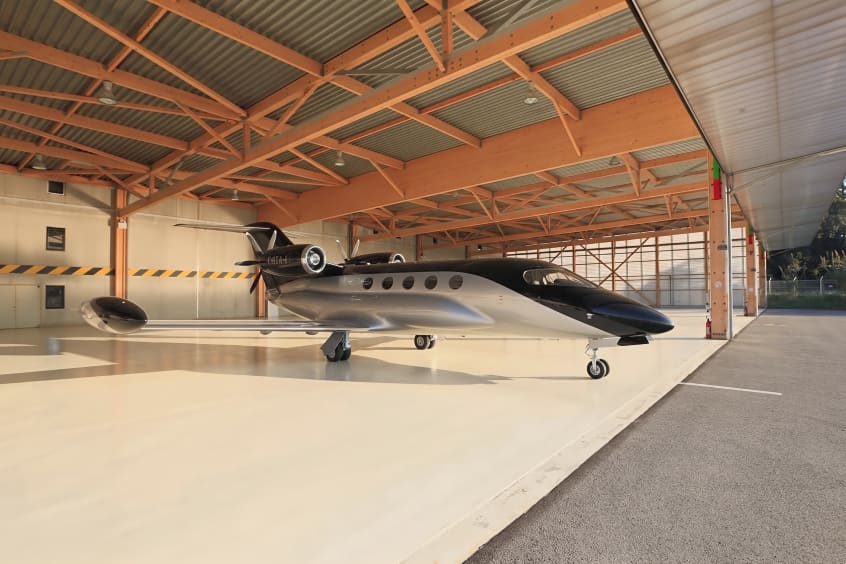
France’s Beyond Aero has completed the preliminary design review of its Beyond Aero One hydrogen-electric business jet and has advanced its certification pathway under CS-25 and Part 25, aligning the programme with transport-category requirements from EASA and the FAA.
The milestone confirms the integration of hydrogen storage, electric propulsion, thermal management, fuel cell systems and safety architecture into a certifiable aircraft configuration, allowing the programme to progress into detailed design, engineering and validation planning.
Wind tunnel testing has validated aerodynamic assumptions and confirmed correlation between computational modelling and physical results during the preliminary design phase.
“The Preliminary Design Review confirms that the aircraft configuration and its major systems, including propulsion, hydrogen storage, aerodynamics and avionics, have reached the level of maturity required to support a certifiable architecture. With this milestone completed, the programme moves on schedule into detailed design and verification of the aircraft's integrated systems,” says Luiz Oliveira, chief engineer at Beyond Aero.
“The completion of the Preliminary Design Review demonstrates that a certifiable hydrogen-powered business aircraft is achievable. Our objective is to develop a new business aircraft tailored to the constraints of hydrogen-electric propulsion, while meeting the performance, safety and operational standards expected in business aviation,” adds Eloa Guillotin, chief executive officer of Beyond Aero.
The aircraft is being developed under CS-25 and Part 25 alongside Certification Review Items for hydrogen propulsion, embedding transport-category safety processes from programme inception and supporting early regulatory alignment.
Beyond Aero is executing a pre-application contract with EASA and progressing its Design Organisation Approval application, with Phase 1 complete and Phase 2 underway. More than 34 compliance procedures have been implemented alongside the Design Organisation Handbook and safety manual.
Validation continues across multiple hardware campaigns including sub-scale and full-scale propulsion testing and ground laboratory work totalling 1,200 kW capacity. The programme is supported by partners including EKPO, FEV, AVL, Aeronnova, TAT Technologies, Airbus Protect and Bureau Veritas, with more than 80 engineers working on the aircraft.