


 The bimonthly news publication for aviation professionals.
 Read this story in our March/April 2026 printed issue.
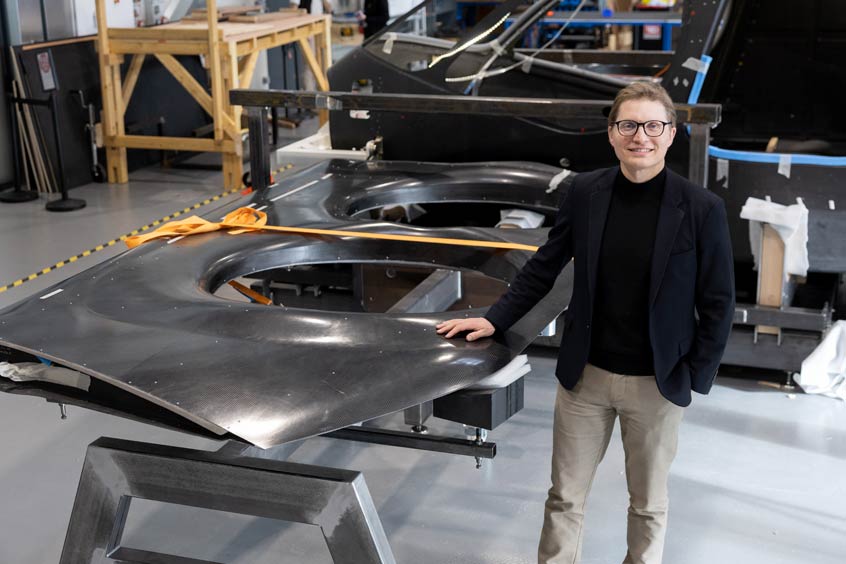
Ascendance has moved its Atea eVTOL aircraft into its final integration phase following completion of the demonstrator’s structure at its Toulouse facility. The structure was engineered by Ascendance’s teams and manufactured by Duqueine Group, which specialises in aeronautical composite structures.
The milestone follows years of design work, aerodynamic optimisation and industrialisation. Alongside Atea’s development, Ascendance is deploying its Sterna hybrid-electric propulsion technologies with partners in the drone sector and in civil aviation. These collaborations validate the hybrid architecture in operational environments and support its industrial maturity.
Before prototype production, Atea’s architecture underwent advanced design campaigns, structural analyses, aerodynamic studies and wind tunnel testing. This validated a hybrid VTOL configuration integrating distributed propulsion and fly-by-wire flight controls.
With the structure complete, integration will begin of the Sterna hybrid-electric propulsion system incorporating Safran’s ENGINeUS electric motor, a distributed propulsion architecture, avionics systems and fly-by-wire controls.
Ascendance says its hybrid propulsion system has completed more than 500 hours of bench testing over four years. Avionics systems and flight control laws were also tested through advanced flight simulations involving test pilots and EASA-certified pilots.