


• Beta Technologies
Aircraft
• Civil Aviation Authority of New Zealand
• Wellington International Airport
• Blenheim (Marlborough/ Woodbourne) Airport
BAN's World Gazetteer
• Vermont The bimonthly news publication for aviation professionals.
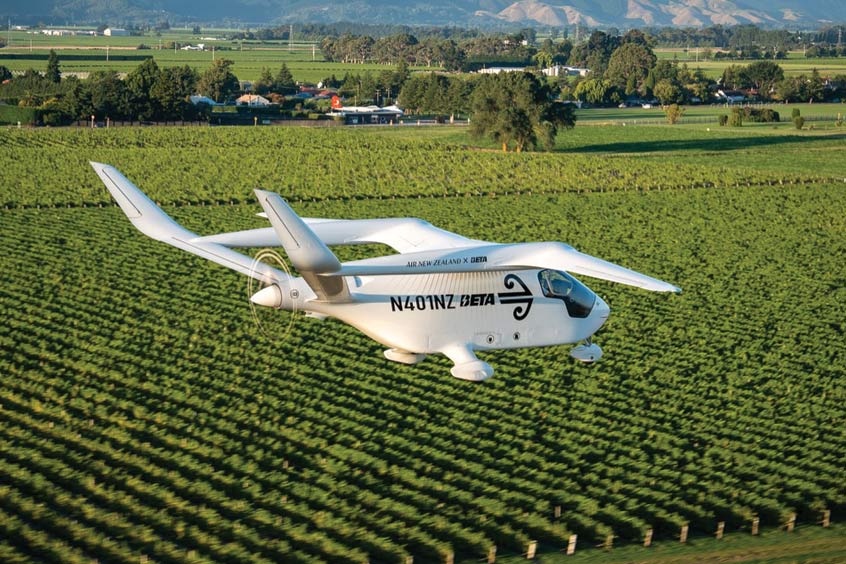
Air New Zealand and Beta Technologies have completed a four-month next-generation aircraft technical demonstrator programme in New Zealand, advancing understanding of how emerging aircraft technologies could operate in the country’s aviation network.
During the programme, Beta’s battery-electric Alia CX300 completed more than 100 flights, flew 13,000 kilometres and visited 12 airports or aerodromes across the North and South Islands. Two Air New Zealand pilots and eight Beta pilots operated the aircraft in a range of conditions, building operational experience alongside the Civil Aviation Authority of New Zealand and airport partners in Hamilton, Wellington and Marlborough.
“This programme was about learning by doing,” says Baden Smith, general manager strategy, networks and fleet at Air New Zealand. “Flying the aircraft in real conditions, across real routes, with our people and partners involved has given us a much deeper understanding of what next-generation aircraft could mean for New Zealand aviation in the future. We worked through everything from pilot training and flight planning to energy use, airport interfaces and airspace integration. Those learnings will directly inform how we think about the future of our fleet, our network and scaling this type of technology.”
A key milestone was New Zealand’s first low-emissions instrument flight rules operation in December. IFR operations allow pilots to rely on flightdeck instruments rather than visual cues, enabling flights in low-visibility conditions. The programme also included Wellington to Marlborough crossings across Cook Strait to assess real-world performance.
Operational comparisons highlighted cost differences, with the Wellington–Marlborough route showing conventional fuel costs of about $110 in a Cessna Caravan compared with electrical energy use of around $20 in the Alia CX300. More than 20 tonnes of mock cargo were carried and approximately 700 people viewed the aircraft during the trial.
“What stood out was how strongly people responded once they could see and touch the aircraft,” Smith adds. “It’s helped move the conversation from ‘what if’ to ‘how might this work’, which is exactly what a technical demonstrator programme should do.”