 The bimonthly news publication for aviation professionals.

 Read this story in our January/February 2026 printed issue.
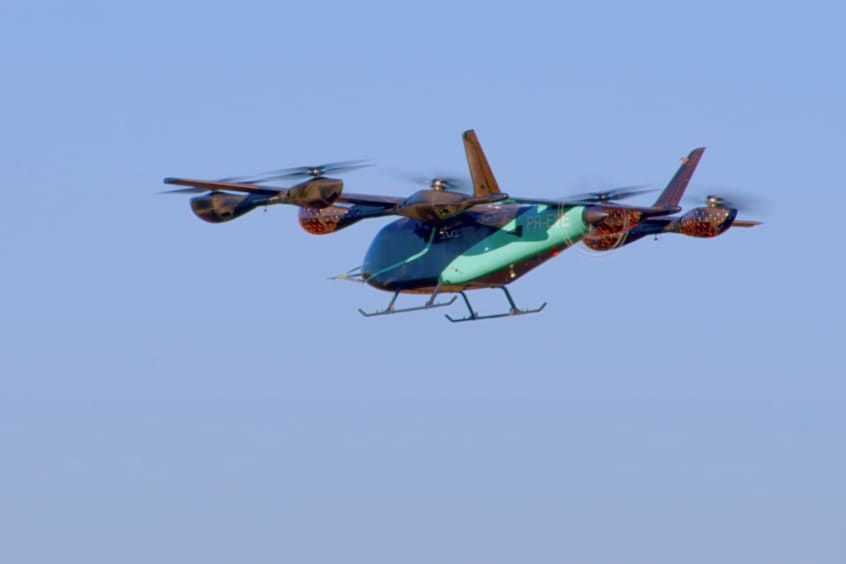
Eve Air Mobility has completed the first flight of its uncrewed full-scale eVTOL prototype at the Embraer test facility in Gaviao Peixoto, Sao Paulo.
The inaugural flight initiates Eve’s flight test phase and confirms the integration of key systems, including the fifth-generation fly-by-wire concept and the fixed-pitch lifter rotors. The company will go on to perform multiple flights, gradually expanding the envelope to transition into full wingborne flights throughout 2026.
“This is a historical milestone for our employees, customers, investors and the entire ecosystem,” says CEO Johann Bordais. “This flight validates our plan, which has been executed with precision, to deliver the best solution for the market. We were able to capture high-fidelity data that will allow us to move forward with safety and confidence towards the certification path.”
Eve will manufacture six conforming prototypes to conduct the flight test campaign, aiming for certification. The company continues to engage with ANAC, Brazil’s civil aviation authority and Eve’s eVTOL primary certifying authority, to advance the certification process. Looking ahead, Eve expects type certification, first deliveries and entry into service in 2027.
“We exercised our control laws, verified the integration of the eight lifters and assessed energy management, the aircraft’s dynamic response and noise footprint,” notes CTO Luiz Valentini. “The prototype behaved as predicted by our models. With these data points, we will expand the envelope and progress toward transition to wingborne flight in a disciplined manner, ramping up to hundreds of flights throughout 2026 and building the knowledge required for type certification.”
“This flight gives the product a clear green light to advance what matters to operators: reliability, efficiency and simplicity,” adds chief product officer Jorge Bittercourt. “We validated critical elements, from our lifter architecture to aircraft flight mechanics, and now we move into the flight test phase, aiming to advance the product maturity.”
Next steps for the programme include progressive envelope expansion and transitions to wingborne flight, as well as continued engagement with ANAC, other regulators and validating authorities, including FAA and EASA.