 The bimonthly news publication for aviation professionals.
 Read this story in our January/February 2026 printed issue.
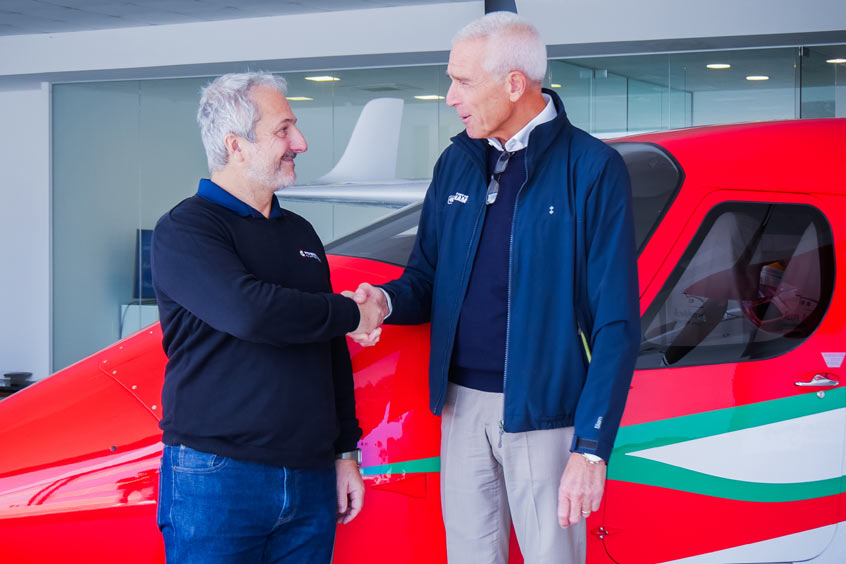
Professional Aviation has taken delivery of a factory-new Tecnam P2006T NG, the first of its kind to be operated by a flight academy in Italy. The delivery heralds a new chapter in the longstanding partnership between Tecnam and the Bologna-based flight school.
The P2006T NG (Next Generation) represents the evolution of Tecnam’s twin-engine trainer, widely recognised by flight schools worldwide. The aircraft is equipped with a Garmin G1000 NXi integrated glass cockpit, improved ergonomics and Rotax 912 iS Sport engines, offering greater fuel efficiency, lower emissions and enhanced training capability.
The delivery ceremony, held at Tecnam’s Capua headquarters, also included two new Tecnam P2008JC aircraft, further expanding Professional Aviation’s single-engine training capacity and ensuring fleet standardisation across all training phases.
Professional Aviation Academy, an EASA (IT.ATO.034) and GCAA-approved international training organisation based at Ozzano dell’Emilia in Bologna, operates one of Europe’s most modern fleets. The academy currently flies 22 Tecnam aircraft, with additional units on the way, supporting the training of more than 350 students from around the world.
“Introducing the first P2006T NG in Italy is another important step in our strategy of continuous innovation,” says Vito Preti, CEO and accountable manager of Professional Aviation. “Our goal has always been to provide our cadets with the most modern aircraft available, reflecting the operational environment of today’s airlines. Together with Tecnam, we are raising the standard of pilot training once again.”
“We are delighted to see the first P2006T NG join the fleet of one of Europe’s most dynamic and forward-thinking flight academies,” adds Tecnam CEO Paolo Pascale Langer. “Professional Aviation has always been at the forefront of training innovation, and we are proud that Tecnam aircraft continue to play a central role in shaping the next generation of airline pilots.”