


 The bimonthly news publication for aviation professionals.
 Read this story in our November/December 2025 printed issue.
Corporate aviation is becoming increasingly strategic for Asia-based organisations, according to a study commissioned by Airbus Corporate Jets (ACJ). The research was conducted with 34 senior executives at major corporations and 33 family offices, hedge funds and private equity firms with a combined AUM of US$141 billion.
It found that 63% of the surveyed executives’ business travel is now conducted via business aviation. The proportion rises to 69% for private equity managers, hedge funds and family offices. Respondents reported substantial time savings, with almost all estimating they save between two and three hours per journey compared with using commercial airlines. A further 5% reported saving three hours or more, while 72% said that at least a quarter of their routes are not served by commercial flights.
Chadi Saade, president of Airbus Corporate Jets, says: “This research confirms what we're seeing on the ground; that for many Asian organisations, business aviation isn't just faster, it's smarter. It allows professionals to recover valuable hours, work securely and make better use of their time in transit.”
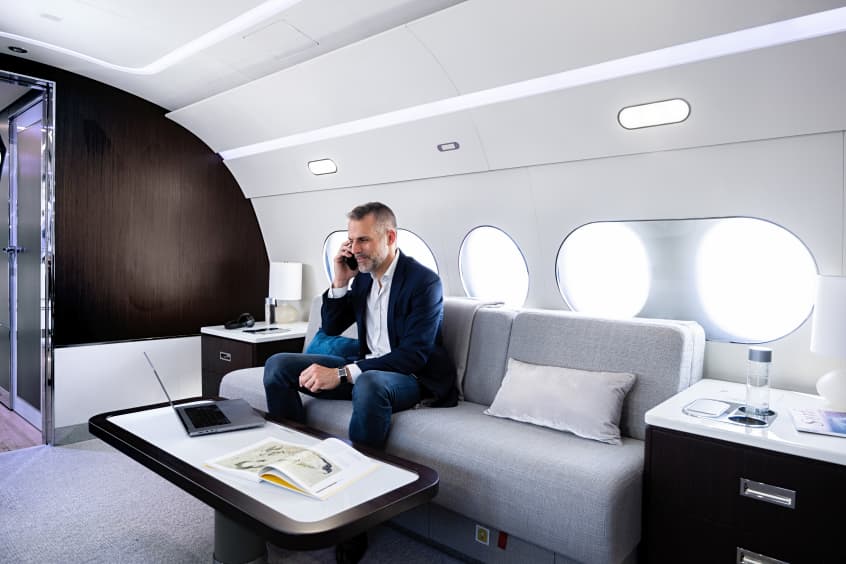
The survey showed that more than half of organisations expect their business jet usage to rise by 50% to 75% in the next two years. Nearly nine in 10 executives rated their productivity as between 25% and 50% higher on business jets compared with airlines, while 8% put the figure at 50% to 75%. Confidentiality and greater schedule control were also noted as key benefits.
Nearly all respondents also reported deploying their aircraft for humanitarian or charitable purposes, including emergency medical transport, organ transfers and crisis relief. Saade adds: “Business aviation is no longer reserved exclusively for top-tier executives or emergency travel. Forward-thinking organisations are increasingly acknowledging its value across their business, particularly for employees whose roles demand on-site presence to manage international affairs.”
ACJ highlights the role of its ACJ TwoTwenty, described as an “Xtra Large Bizjet”, offering twice the cabin space of comparably priced long range jets and one-third lower operating costs. With a range of 5,650 nm, it can connect major Asian cities with destinations including Anchorage, Auckland and Istanbul. The jet can fly with up to a 50% blend of sustainable aviation fuel, part of Airbus’ wider goal for all aircraft to operate on 100% SAF by 2030.