 The bimonthly news publication for aviation professionals.
 Read this story in our July/August 2025 printed issue.
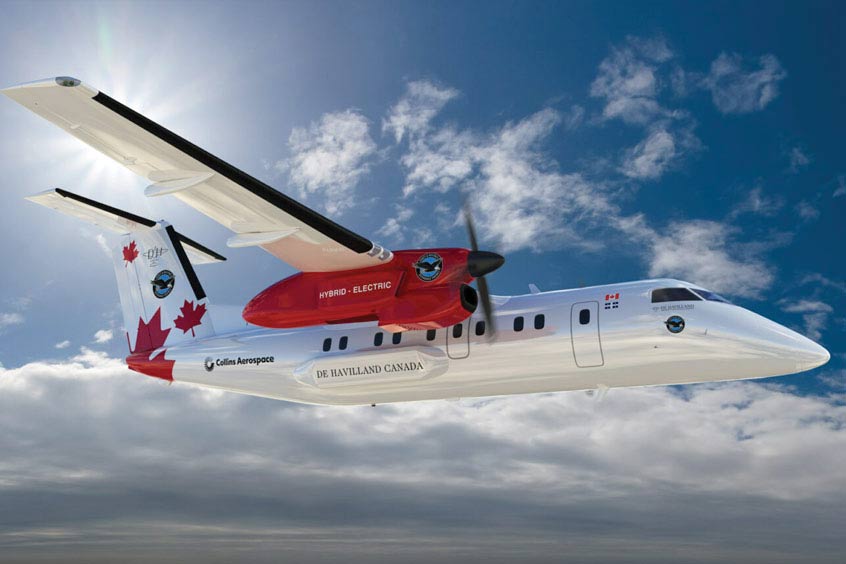
Pratt & Whitney Canada has reached a milestone in the RTX Hybrid-Electric Flight Demonstrator project, by testing the integrated propulsion system and batteries to full power. While ground testing of the hybrid-electric propulsion system continues in Longueuil, Quebec, Pratt & Whitney Canada has selected AeroTEC to support future flight testing of the De Havilland Canada Dash 8-100 experimental aircraft.
The new end-to-end test marks the first battery-powered operation of the propulsion system, which combines a highly efficient Pratt & Whitney Canada thermal engine with a one megawatt (MW) electric motor developed by fellow RTX business, Collins Aerospace. The 200 kilowatt-hour (kWh) batteries, supplied by H55 S.A., have also been successfully charged and discharged using the high-voltage mobile charging unit co-developed by Pratt & Whitney Canada, the National Research Council of Canada and the Innovative Vehicle Institute. H55 is supported by RTX Ventures, the venture capital arm of RTX.
“Performing end-to-end tests of our pioneering hybrid-electric propulsion system and batteries marks another critical milestone toward our goal of demonstrating this promising technology in flight,” says Jean Thomassin, executive director, new products and services introduction, Pratt & Whitney Canada. “Ultimately, we are targeting up to 30 per cent improved fuel efficiency compared to today's regional turboprops, and insights from this project are also helping us advance the development of hybrid-electric technology to address multiple future platforms.”
AeroTEC joins De Havilland Aircraft of Canada, which is providing critical baseline data and engineering expertise for the Dash 8-100 experimental aircraft. Other collaborators on the programme include GKN Aerospace, which is providing high-voltage electrical wiring and interconnection systems, and Ricardo, which is supporting the development of the hybrid-electric propulsion system.
“AeroTEC's mission is to accelerate the evolution of aerospace, and our collaboration with Pratt & Whitney Canada on the RTX Hybrid-Electric Flight Demonstrator project is a clear example of that commitment,” notes Justin Morigeau, president, AeroTEC. “In our role leading the modification and flight testing of the experimental aircraft, we're proud to support the demonstration of cutting-edge technologies that will define the future of sustainable flight.”
Hybrid-electric propulsion is a core part of RTX's technology roadmap for improving fuel efficiency and performance in future aircraft, leveraging the industry-leading aircraft propulsion and electrical systems expertise of Pratt & Whitney and Collins Aerospace, respectively. The two RTX businesses are collaborating on a range of technology demonstrator projects, including the Clean Aviation SWITCH project, which is developing a hybrid-electric Pratt & Whitney GTF engine demonstrator.