• 56th International Paris Air Show
• Gulfstream Aerospace Corporation
Aircraft
BAN's World Gazetteer
• France The bimonthly news publication for aviation professionals.
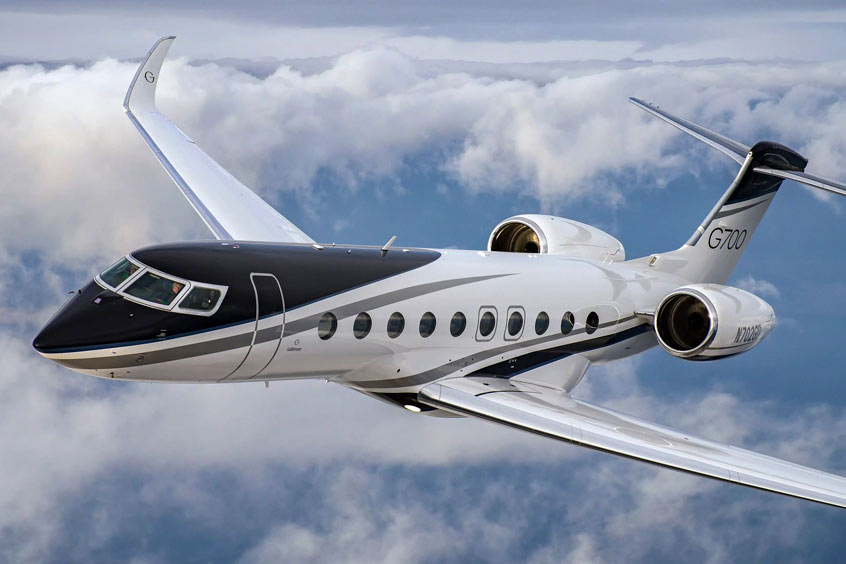
Gulfstream Aerospace's G700 has set two new city-pair speed records en route to the International Paris Air Show at Paris-Le Bourget airport. The G700 flew the record flights on SAF and will receive Sustainable Wings accreditation from the National Aeronautic Association (NAA) for each flight.
The aircraft flew from Teterboro, New Jersey, to San Francisco, travelling 2,272 nm in four hours and 57 minutes at an average speed of Mach 0.91. It then flew from San Francisco to Paris, travelling 4,947 nm in nine hours and 26 minutes at an average speed of Mach 0.91.
“Recognition from our partners at the NAA and these latest record-breaking flights further demonstrate Gulfstream's industry-leading commitment to sustainability,” says Mark Burns, president, Gulfstream. “We are excited for the G700 and our award-winning Gulfstream G600 to return to the International Paris Air Show this year and look forward to showcasing the compelling combination of advanced technology, performance and comfort as increased demand for our next-generation aircraft continues in Europe.”
The G700 features the most spacious cabin in the industry and the Gulfstream Cabin Experience with 100 per cent fresh air, natural light from 20 Gulfstream panoramic oval windows and a low cabin altitude. With a maximum operating speed of Mach 0.935 and a high-speed cruise of Mach 0.90, the ultra long-range G700 has more than 80 city-pair speed records to date.
The performance capabilities of the G700 can be attributed to the combination of Rolls-Royce Pearl 700 engines, Gulfstream-designed advanced aerodynamic wing and high-speed winglet introduced on the aircraft. The G700 is also outfitted with the Predictive Landing Performance System and dual head-up display featuring Gulfstream's new Combined Vision System that unites Enhanced Flight Vision System (EFVS) and Synthetic Vision System (SVS) in a single image, increasing pilot situational awareness and access to more airports.