


 The bimonthly news publication for aviation professionals.
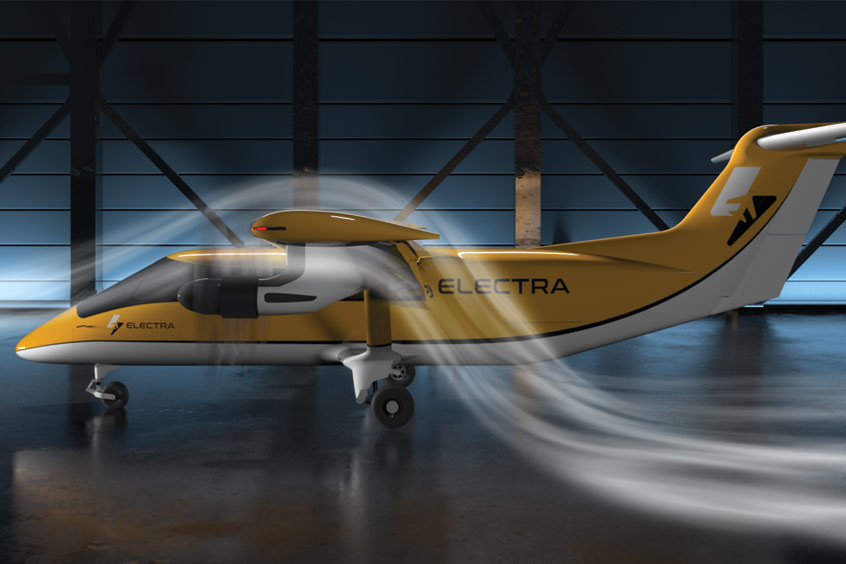
Electra, a US eSTOL aircraft developer, has completed powered wind tunnel testing for its nine-passenger EL9 Ultra Short hybrid-electric aircraft, confirming that the company’s blown wing design delivers the high lift needed for take off and landing in just 150ft. This is 10 per cent of the distance typically required by conventional aircraft of the same size.
Using a 20 per cent scale model of the EL9 wing, the tests demonstrated lift coefficients greater than 20, seven times greater than the 2.5 to 3 range typical of unblown wings. The results validate the potential of electric blown lift to increase the wing’s lifting capability at low speeds, enabling safe take off and landing operations from soccer field-sized spaces. The tests also confirm the EL9’s approach and landing profile meets all FAA Part 23 safety and stall margin requirements, ensuring safe and predictable handling at slow speeds.
This breakthrough design opens the door to a range of new capabilities for commercial and defence operators, including enabling air operators to connect communities that lack aviation infrastructure, fly into airports with strict noise restrictions, create new opportunities and business models for cargo services and save travellers significant time and hassle. It also introduces entirely new logistics capabilities for warfighters including the ability to land on unimproved surfaces, improve safety and reduce cost, power ground operations and carry out critical logistics transport.
“This is a major milestone in demonstrating the EL9’s ability to take off and land in spaces never before possible for fixed-wing aircraft,” says Chris Courtin, director of technology development at Electra. “Verification of the effectiveness of the optimised EL9 wing shows that the EL9 is both transformative and practical. These results give us high confidence in our ability to accurately predict the impacts of electric blown lift on the aircraft, bringing us closer to making our vision of ‘Direct Aviation’ a reality.”
The US Army collaborated with funding for the testing through a Small Business Innovation Research (SBIR) contract as it explores the potential for Electra’s blown wing technology and dual use hybrid-electric aircraft to expand its military capabilities.
The company is further refining the design of its EL9 production aircraft on the basis of these findings and its ongoing flight tests and demonstrations of the EL2 demonstrator aircraft, advancing the development of a quieter, more efficient and sustainable future for regional air mobility.
Electra has over 2,200 pre-orders for the EL9 from more than 50 operators worldwide, valued at more than $10 billion, one of the largest order pipelines in the advanced air mobility sector. The first test flights are planned for 2027, with certification and commercial service entry anticipated in 2029 under FAA Part 23 regulations.