 The bimonthly news publication for aviation professionals.

 Read this story in our October 2024 printed issue.
Garmin co-founders Dr Min Kao and the late Gary Burrell have been inducted into the prestigious National Aviation Hall of Fame (NAHF). The honours took place at the 60th annual enshrinement ceremony at the National Museum of the United States Air Force in Dayton, Ohio in September. The NAHF honours individuals whose groundbreaking contributions have shaped the world of flight.
“Thirty five years ago, Gary Burrell and Dr. Min Kao founded Garmin with the strong belief that superior navigation and communications products could enrich and even save people's lives. To truly honour their pioneering work and the foundation they laid for Garmin's acclaimed products, there is no greater tribute than seeing them inducted into the National Aviation Hall of Fame,” says Cliff Pemble, Garmin president and CEO.
Dr Kao continues to serve Garmin as executive chairman of the board, and the late Gary Burrell's servant leadership and dedication to excellence remains foundational to the company today. Under their leadership, Garmin developed a wide array of products and technologies that advanced modern aviation safety and capabilities, including navigation, communications, flight controls and sensor systems.
Noteworthy Garmin aviation innovations include:
1991: Garmin's first aviation product, the GPS 100AVD, is introduced and is immediately regarded as the first panel-mounted GPS navigator accessible to the masses of general aviation.
1994: The Garmin GPS 155 becomes the world's first certified GPS receiver to achieve FAA TSO-C129 Class A certification for instrument approaches, allowing pilots to fly instrument flight rules (IFR) from take off to touchdown using no ground-based navigation aids.
1998: The iconic GNS 430 and GNS 530 product family combines a panel-mounted GPS navigator with a colour moving map, VHF navigation and communication becoming the industry standard for nav/com systems in the cockpit.
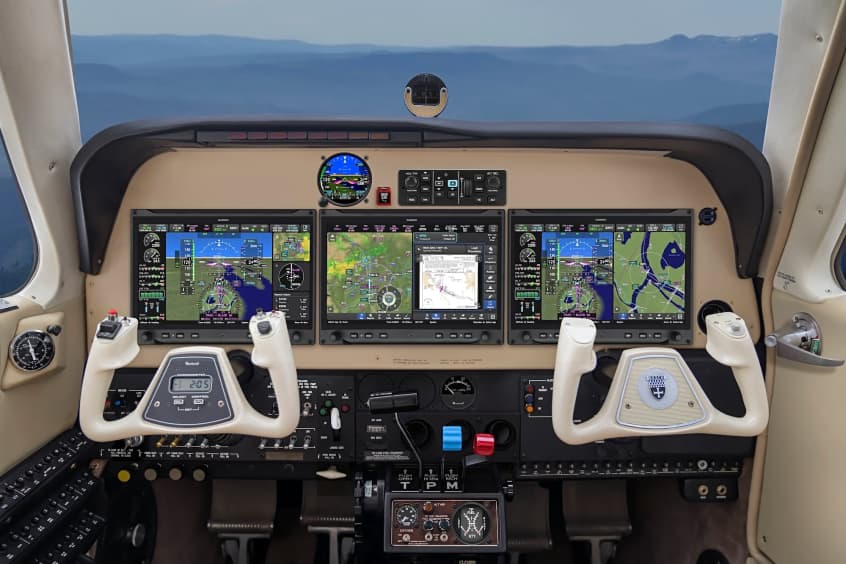
2004: The G1000 integrated flight deck sets the standard for cockpit innovation and catapults Garmin to be the leading provider of integrated flight decks across a broad range of aircraft from single-engine piston to advanced business jets.
2010: Garmin introduces the Electronic Stability and Protection (ESP) system, the first in a series of Autonomí safety features that help pilots avoid loss of control accidents.
2020: Garmin receives the prestigious Robert J Collier Trophy for Garmin Autoland, the world's first certified autonomous system that protects lives by activating during an emergency to control and land an aircraft without human intervention.