


 The bimonthly news publication for aviation professionals.
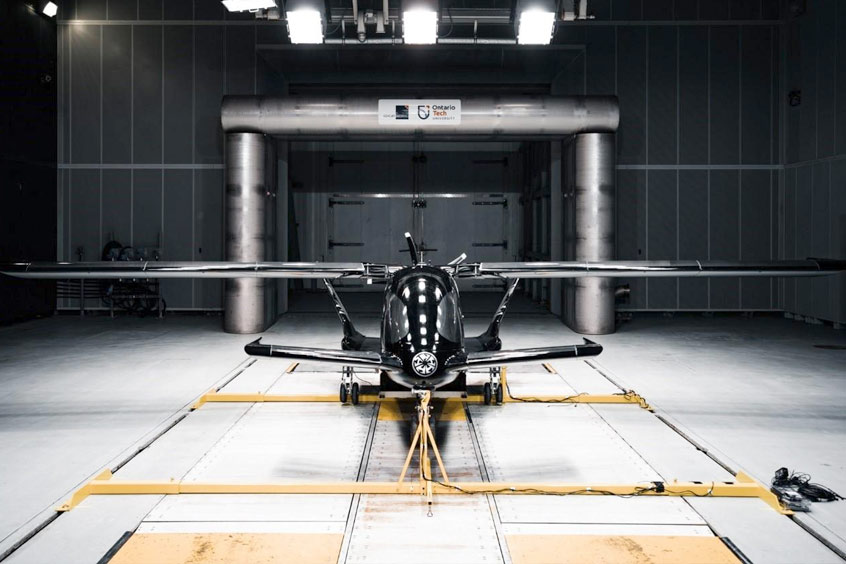
Horizon Aircraft has improved the design of its prototype hybrid eVTOL aircraft and is now targeting the future production of a seven seat capacity model. Initially the company had planned to design and produce a five seat aircraft, but following the positive flight test results of its half-scale prototype, alongside sophisticated aerodynamic, structural and electrical analysis, the company now believes it can expand its initial prototype to include room for one pilot and six passengers. Potential customers in the medevac, business aviation and commercial cargo sectors have advised that larger aircraft with lower passenger seat mile costs better align with their needs. The enlarged prototype design is now called the Cavorite X7, rather than the Cavorite X5.
The Cavorite X7 would have a gross weight of an estimated 5,500lbs with a projected useful load of 1,500lbs. With an estimated maximum speed of 250 miles per hour and an average range of over 500 miles with fuel reserves, the company believes that this experimental aircraft, if eventually licensed for commercial use, would not only be well-positioned to excel in medical evacuation, critical supply delivery, disaster relief and special military missions but in regional air mobility, moving people and cargo 50 to 500 miles.
Unlike many in its category, the Cavorite X7 is being designed with a hybrid electric power system. After its vertical take off, it will re-charge its batteries enroute when it is flying in a configuration like a traditional aircraft. After a vertical landing and completion of a mission, the company is designing the Cavorite X7 to recharge its battery array in under 30 minutes to be ready for its next mission.
CEO Brandon Robinson says: “The shift to a seven seat aircraft has been discussed since the beginning of our hybrid eVTOL initial concept. It's a size that just makes sense commercially. We are very confident our unique fan-in-wing technology can support this new and larger platform and our testing results have provided us with confidence that we can potentially scale to an even larger aircraft.”
Horizon believes that its innovative approach and technology will allow the Cavorite X7 to fly 98 per cent of its mission in a very low-drag configuration like a traditional aircraft, making it safer and easier to certify than other radical eVTOL designs. The company is continuing the testing of its half-scale aircraft to reduce technical risk moving forward as it continues to develop its full-scale aircraft.