


 The bimonthly news publication for aviation professionals.


Business air transport is experiencing unprecedented demand. The impact of COVID-19 aside, the industry has seen a sustained increase that is predicted to continue over the coming decades. Now, under intense sustainability pressures from governments across the globe, it is searching for new and innovative solutions to reduce its environmental impact and carbon footprint. As a result, many businesses are switching to electricity as a more sustainable power source for ground support equipment and machinery. The danger here is the subsequent potential for fires that can have extensive and costly consequences if not properly addressed. Holger Pfriem, managing director of Dafo Asia and business manager of Dafo Vehicle Fire Protection, discusses the risks associated with electric ground support equipment and explains how to maximise safety while minimising downtime and damage.
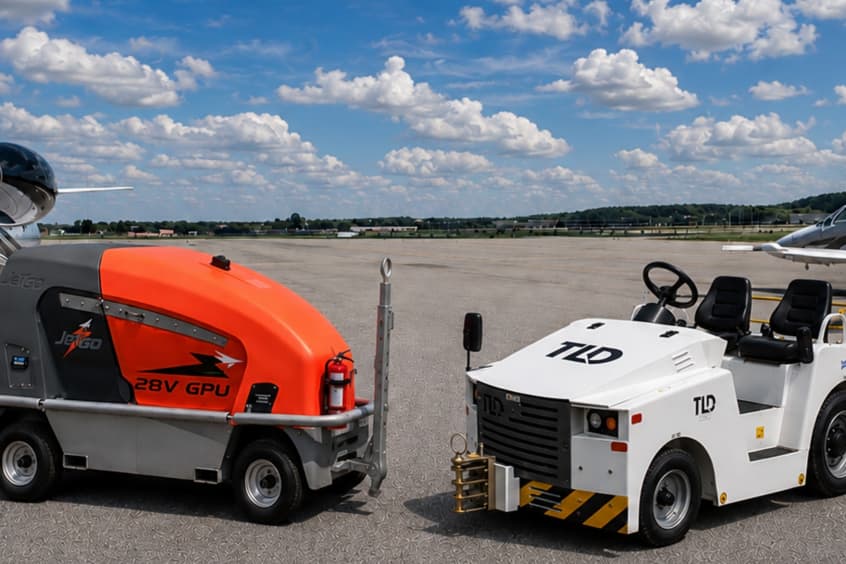
Whether it’s refuellers, transfer buses or push back tractors, the entire aviation industry is actively switching from traditional combustion engines to electric alternatives for the vehicles and machinery operating on the ground. They bring with them fire risks that are not effectively addressed by the usual fire detection and suppression solutions. Many electric vehicles (EVs) and the machinery used for ground support operations are powered by lithium-ion (li-ion) batteries. Despite the fire risk being arguably lower for li-ion-powered EVs vs internal combustion engine (ICE) vehicles, the consequences of any fire, if it does happen, are significantly greater.
There are four main risks associated with li-ion batteries, each with the potential to cause an internal short circuit:
- Overcharging or undercharging, when battery power is charged too rapidly or drained too quickly. - Mechanical influences or failures that are caused by factors such as vehicle collisions. - Exposure to heat: li-ion batteries are extremely sensitive so temperatures need to be continuously monitored. If they’re exposed to high external heat, perhaps if a fire were to occur near or in the EV, the battery is at a much greater risk.
- Production issues: due to their compact nature and thin cell layers if particles, no matter how small, are able to enter li-ion battery cells they can cause internal component damage. A short circuit is the primary cause of thermal runaway, an incredibly dangerous state where rapid increases in battery temperature can cause fire, toxic gas emissions (such as carbon monoxide) and large explosions. These rapid temperature rises are a crucial signal that thermal runaway is in progress, and if it happens it can be incredibly challenging to control or reverse the process.
Prior to any temperature increases, li-ion batteries will vent toxic gases. This acts as a pre-cursor to the thermal runaway entry phase. At this point, if identified successfully, the process can be reversed. But often traditional fire detection and suppression solutions will only pick up on rapidly increasing temperatures, not the toxic gas emission. There is clearly a need now for a protection solution that can detect toxic gas emissions ahead of temperature increases.
The Dafo fire suppression system, for example, consists of four integrated elements; detection, alarm, suppression and control. The detection system consists of a linear heat detector wire with a fixed temperature sensor that triggers an alarm signal when 180°C is reached. This signal causes the release of a suppressant liquid that removes oxygen from the air, cools down the overheated engine parts and prevents re-ignition. At the same time, a horn sounds and a light signal in the panel alerts the driver.
Ground support equipment operates close to passengers, airport workers and aircraft, so any fire risk can have significant consequences not just for the environment but for people and assets in the surrounding area. Airports have a duty and a financial imperative given consequent downtime and associated costs to ensure that ground support equipment is safe, whether it is electric or diesel-powered. But how can one minimise the fire risk?
Pfiem says that to maximise safety and prevent unnecessary downtime, you must understand how all ground equipment works. When you know the risks, you can develop a tailored fire protection solution to address them.
For electric equipment in particular, you should ensure it is disconnected from charging ports once fully charged. You must consider how to protect the location of the charging stations where power is stored. And note that larger battery units storing power for individual vehicles are subject to the same risks, often on a much larger scale. Quarantine protocols for damaged EVs must including monitoring systems to identify thermal runaway ahead of temperature increases. Suppressing fire risks effectively, says Pfiem, is about considering the whole operation, understanding how the vehicles work and developing a bespoke protection solution to address prominent risks effectively.