


 The bimonthly news publication for aviation professionals.
 Read this story in our November 2022 printed issue.
ZeroAvia has agreed to explore the development of hydrogen fuel infrastructure, regulatory framework requirements and resourcing required for delivering zero-emission flights from Aberdeen and Glasgow airports in the UK with AGS Airports.
The team at AGS, which owns and operates Aberdeen, Glasgow and Southampton airports, will work closely with ZeroAvia's specialist airport infrastructure team to assess the opportunities for hydrogen production onsite, as well as exploring potential commercial routes.
VP, infrastructure Arnab Chatterjee says: “In recent months we have stepped up our work with airports significantly to better understand the operational needs and requirements for hydrogen as a fuel. Working with the team at AGS allows us to plan for some of the commercial routes that we will be able to support in a little over two years' time and do so in the setting of a major international airport.”
Switching some routes to aircraft powered by ZeroAvia's hydrogen-electric powertrain will help AGS Airports to significantly reduce Scope 3 carbon emissions from aircraft and reduce noise and air quality impacts locally. At the same time, AGS will explore how hydrogen can be used to remove emissions across ground operations, further extending the impact.
ZeroAvia will share its experience in developing and operating its Hydrogen Airport Refuelling Ecosystem (HARE) at Cotswold airport in Gloucestershire. The partners will work towards a flight demonstration powered by ZeroAvia's ZA600 600kW hydrogen-electric engine, which is on a path towards certification by 2025. Commercial routes from Scotland's biggest city, Glasgow, could follow soon after.
AGS Airports chief executive Derek Provan says: “The development of hydrogen powered aircraft has the potential to completely revolutionise aviation, and it is becoming an increasingly viable option for regional and short-haul aircraft. As a regional airport group serving the Highlands and Islands of Scotland as well as the Channel Islands from Southampton, AGS will be the perfect testbed for hydrogen flight. Through our partnership with ZeroAvia we'll address some of the challenges associated with the generation, delivery and storage of hydrogen on-site and how we can prepare our infrastructure to support zero emission flights.”
The agreement will form an important part of AGS Airports' drive to reach net zero carbon emissions by the middle of the next decade. The airport operator's sustainability strategy is market-leading in its ambition for tackling environmental impact from flight.
Zero-emission route flights will better connect Scotland's major cities to remote areas in the Highlands and Islands, but also to other parts of the UK within the next few years. Given the reduced operating costs and lower noise profile offered by hydrogen-electric engines, operating more flights becomes attractive and can thus boost regional economic growth. Aircraft relevant to ZeroAvia's first commercial offering (ZA600) already operate from Glasgow, and there is a potential to expand zero-emission flights across the AGS group to Aberdeen and Southampton.
Minister for Transport Jenny Gilruth says: “This is an encouraging development as hydrogen has the potential to be a true zero emission fuel and could play a key role in helping the Scottish aviation sector reach net zero. Many of the routes that operate from Glasgow and Aberdeen to airports across the Highlands and Islands are served by small aircraft, and real social, economic and environmental benefits could be delivered by cleaner, quieter and lower cost aircraft. I congratulate AGS Airports and ZeroAvia on this partnership and will follow its progress with interest.”
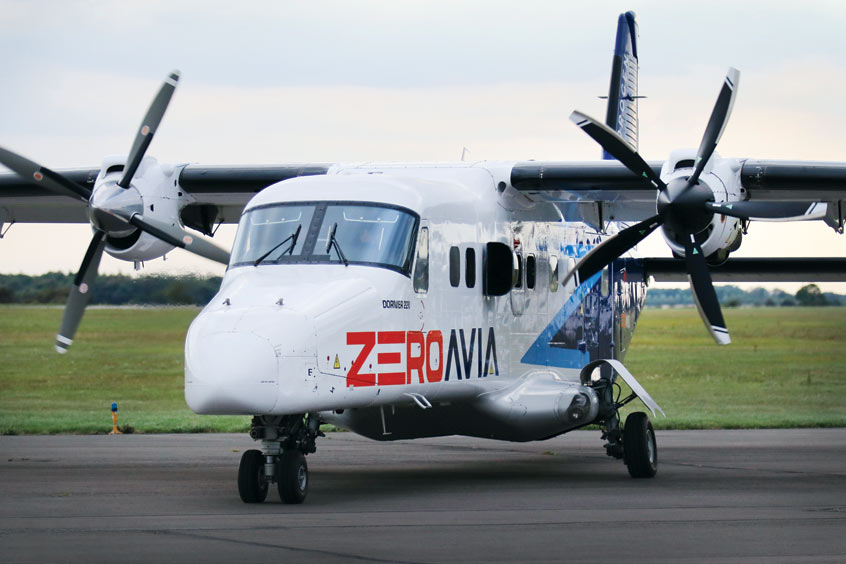
The ZA600 is designed to power nine-19 seat aircraft up to 300 nautical miles and will soon be flight tested for the first time in a 19 seat Dornier 228. ZeroAvia's mission is to deliver hydrogen-electric engines in every aircraft, having identified the technology as the most practical, economical and furthest reaching solution for reducing aviation's climate change and clean air impacts. Hydrogen-electric engines use hydrogen in fuel cells to generate electricity, which is then used to power electric motors to turn the aircraft's propellers, with the only byproduct being water.
ZeroAvia's infrastructure team is working to deliver low-cost, low-carbon, resilient and reliable hydrogen to decarbonise airport ecosystems and fuel hydrogen-electric powertrains. The team is working with airports and other partners to deliver last-mile hydrogen delivery and refuelling infrastructure to support airline operators, supported either by upstream fuel supplier partnerships or building of distributed production infrastructure.