 The bimonthly news publication for aviation professionals.
 Read this story in our December 2021 printed issue.
Under the terms of a joint venture with PSB Leasing, Russian Helicopters is to provide helicopter rental services across Russian and foreign markets. This will enable the OEM to develop new sales markets and will provide operators with an opportunity to purchase a helicopter on an operational lease for two to four years, and take delivery of it straightaway.
Currently, the aviation services market has widespread short-term and medium-term contracts, often in the construction, fuel and energy industries, the implementation of which requires large numbers of helicopters. Going forward, domestic and overseas operators will be able to lease helicopters for the required period of time without the obligation to subsequently purchase the machines.
Contracts will be established with Russian customers during 2022, and with foreign operators in 2024. It is expected that by 2030 the fleet belonging to the joint leasing venture should number around 140 vehicles.
"Operational leasing is a new instrument for the sale of aviation equipment for Russia, which implies not only financial investments but also the availability of competencies in the promotion and maintenance of helicopter equipment," says Russian Helicopters general director Andrey Boginsky. "By joining forces with PSB we are becoming pioneers in this area in Russia, but the analysis of the comparative cost of Russian helicopters and their flight hours gives us confidence that we will be competitive in the world market as well."
“PSB has been actively developing its business in the aviation leasing segment for the past few years. We have become one of the market leaders and have increased our portfolio dozens of times," adds chairman Petr Fradkov. "Therefore, the decision to create a new enterprise with a leasing product that is completely unique for the Russian market is fully consistent with our strategic goals. There have always been high-priority projects to support the export of high-tech products of domestic production, so the joint venture plans to actively enter international markets. We will continue to strengthen our position in the aviation leasing market, thereby contributing to the further development of this sector in general and the expansion of domestic products abroad in particular."
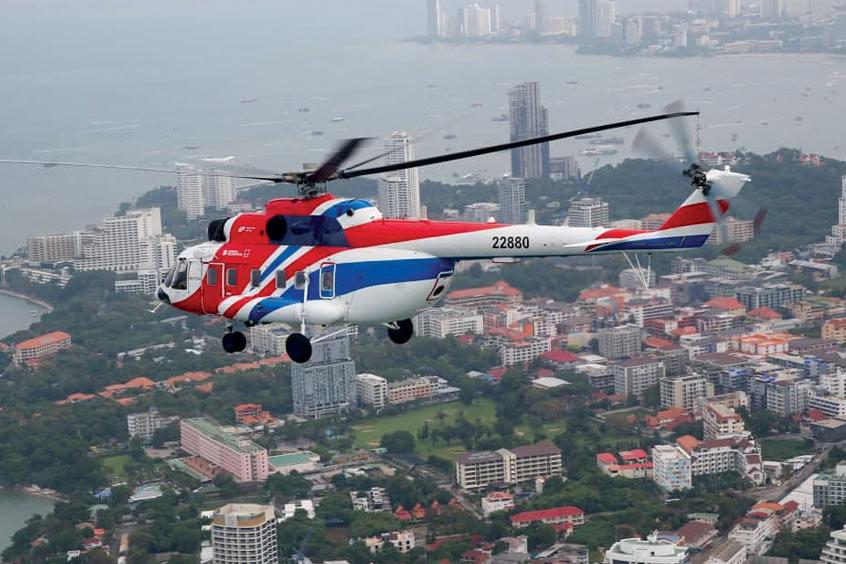
The joint venture will use its own funds as well as bank financing to secure leasing contracts. In addition to Russia, the main target markets will be the countries of southeast Asia, the Middle East and Latin America. The joint venture fleet will include practically the entire line of modern Russian civilian helicopters; the Ansat, Ka-62, Ka-32, Mi-8, Mi-171A2/A3 and Mi-26.