 The bimonthly news publication for aviation professionals.
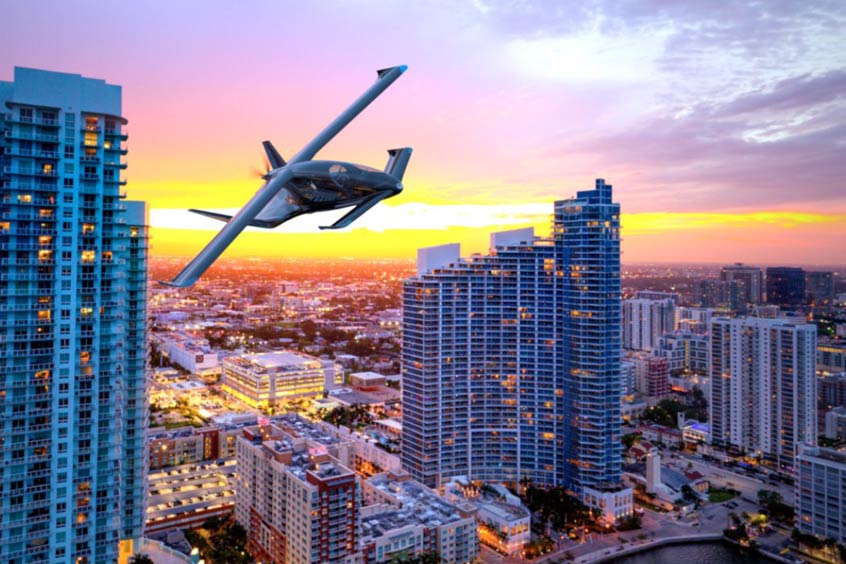
Astro Aerospace, a manufacturer of eVTOL aerial vehicles and drones, has announced that more than 200 test flights have been successfully completed on a sub-scale prototype of the Cavorite X5, a five-seater hybrid-electric eVTOL. Canada's Horizon Aircraft has designed, engineered and overseen all testing of the Cavorite X5.
On 18 February, Astro entered into an agreement to acquire Horizon to accelerate Astro's Alta and Elroy programmes, one of the first modern eVTOL aircraft to fly with people on board. Astro's existing roots in the industry and expertise, combined with Horizon's engineering competencies, are expected to position the company as one of the leaders in the eVTOL market. Astro expects to complete the acquisition of Horizon in April.
The primary objective for the sub-scale eVTOL prototype's test flights is to verify aerodynamics, control systems and transition flight. The Cavorite X5 features fully autonomous self-learning autopilot software and an array of specialised 3D-printed lifting fans in the wings that provide additional thrust for vertical takeoff and landing. For vertical flight, the wing surfaces retract to open its ducted fans before closing again, maximising the craft's aerodynamic efficiency.
Horizon co-founder and CEO Brandon Robinson states: “Completing more than 200 test flights is extremely exciting for the entire teams at both Horizon and Astro. Soon, our merged company will have the capital and resources to bring our extensively tested Cavorite to market, offering urban centres a reliable, comfortable and high-efficiency eVTOL.”
The full-scale Cavorite X5, which will travel up to an estimated 450 km/h with a 500 km range, is designed for reduced hydrocarbon emissions, poor weather, traffic avoidance and low-time pilots. The patented fan-in-wing allows the Cavorite to be the world's first eVTOL that can fly the majority of its mission exactly like a normal aircraft.
“The testing of the Cavorite X5's sub-scale prototype has exemplified to the global eVTOL market that Horizon's engineered design is the new standard,” says Astro CEO Bruce Bent. “The soon-to-be completed acquisition of Horizon is expected to add tremendous value to the combined entity as we move towards the expected commercial launch of the X5 into the growing $46.7 billion eVTOL aircraft market.”
Meanwhile Horizon says that the current battery technology being used by some eVTOL aircraft could make them commercially unviable. It warns that some of the batteries used are simply too heavy for long-range commutes that and their charging times too slow to support the number of flights required. Furthermore, the lifecycle of many batteries being used is also too short. Many prototypes currently under development must use advanced, high energy density variants. However, these lighter batteries can be damaged easily, increasing the rate at which they need to be replaced, which will increase costs.
Robinson says: “The type of batteries used by eVTOL aircraft will also impact which vertiports and vertistops they can use. One of the biggest operational barriers to deploying a VTOL fleet in cities is finding sufficient locations to place landing pads, and the facilities needed to recharge and service aircraft. eVTOL aircraft with heavy batteries or ones that take too long to recharge will have access to fewer vertiports and vertistops.
“eVTOLs need to be safe, affordable and have an operational cost structure that makes them economically viable. The batteries used by some eVTOL aircraft will make this impossible to achieve.”
The weight of batteries used for the Cavorite X5 is only 200 kg, providing it with a range of 500 km with a hybrid-electric power system. Some high-profile eVTOLs are using batteries that weigh 600kg or more and have a range of between 100 km and 200 km.