


• Axis Flight Training Systems
• Federal Aviation Administration
• Loft
Training
BAN's World Gazetteer
• Austria The bimonthly news publication for aviation professionals.
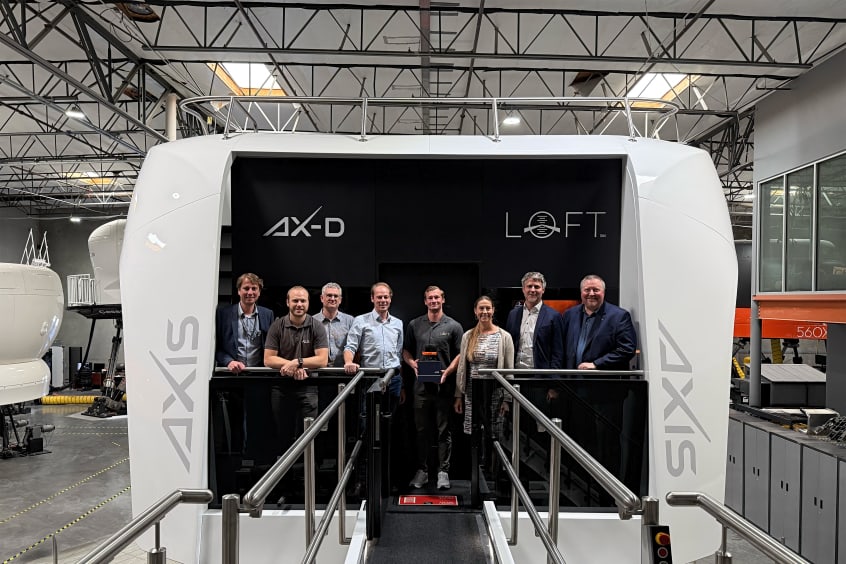
Axis Flight Training Systems has secured FAA Level D qualification for a Bombardier Challenger CL350 full-flight simulator (FFS) built for Loft, a California-based pilot training facility, taking the Austrian provider's US total to four devices.
Loft, an Axis customer since 2024, will use the FFS primarily for initial type ratings, recurrent training, Upset Prevention and Recovery Training (UPRT) and area familiarisation. The device is fitted with a Van Halteren motion system and an RSi XT6 visual system offering a 200 x 45 degree field of view, alongside Collins Pro Line 21 Advanced avionics and the optional steep approach capability specified by Loft.
Noel Yantos, CEO at Loft, says: “After operating simulators for almost 20 years, we're impressed with the quality of Axis' Challenger 350 device. We're excited to use this newly certified full Level D device to provide the boutique training experience Loft is known for to a new set of clients.”
Christian Theuermann, executive board member at Axis, adds: “Our qualification for Loft marks Axis' fourth training device in the US. This region represents a notable growth area for Axis, as an increasing number of aircraft operators and training organisations explore advanced flight training solutions for students and pilots.”
Alongside the Loft device, Axis has qualified an FAA Level D CL350 FFS in Ohio for Vista America and, under EASA, a CL350 FFS in Austria for Austrian Aviation Academy.
Theuermann continues: “The CL350 FFS has been designed to deliver unmatched level of realism, enabling operators to provide quality training across initial type ratings, recurrent training, Upset Prevention and Recovery Training (UPRT) and area familiarisation. By combining high-fidelity aircraft systems, advanced motion and immersive visuals, the simulator closely replicates real-world flight operations. For operators, this means a flexible, reliable training solution that meets FAA Level D requirements while preparing pilots to an optimal level of operational readiness.
“We're working on several exciting projects that will continue to expand our portfolio of training solutions for business and regional aviation. As demand for pilot training grows, we're focused on developing advanced simulation technologies that help operators train more efficiently while maintaining industry-leading standards of realism and performance.
“We’re continuing to work closely with customers around the world to deliver tailored training solutions that meet their operational demands and support the future of flight training.”