


 The bimonthly news publication for aviation professionals.
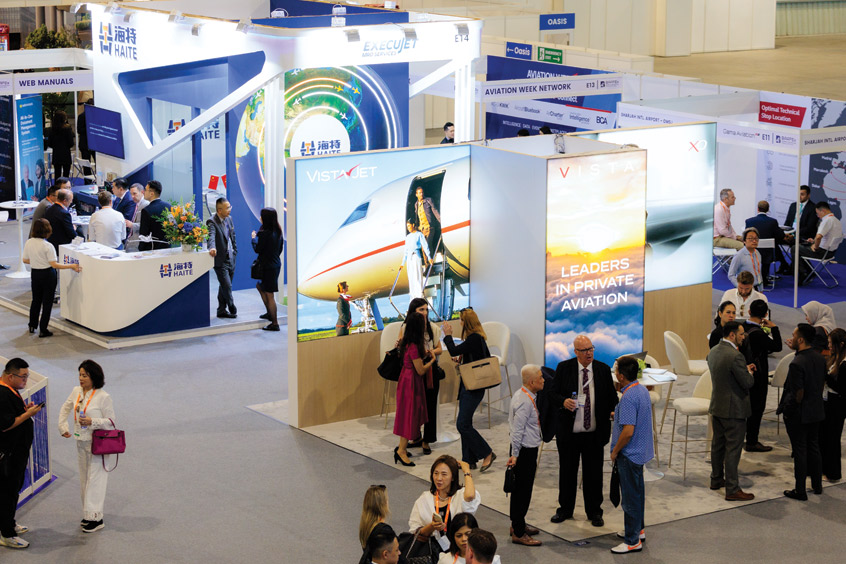
The Business Aviation Asia Forum and Expo (BAAFEx) will be returning for its second edition on 22-24 March 2027 as business aviation in Asia Pacific enters a new phase of growth.
The second edition of BAAFEx is set to be bigger, with expanded participation across all show elements, including: more than 3,000 industry professionals and trade visitors expected; more than 75 participating companies to be represented across exhibitions, sponsorships and the conference programme; a curated conference programme addressing key industry topics, including sustainability, airport infrastructure and regulatory developments; and a static aircraft display, with further details to be announced in due course.
Leck Chet Lam, managing director of show organiser Experia Events, says: “BAAFEx was launched to fill a clear gap in Asia Pacific's business aviation landscape, and the response to the first edition exceeded expectations. With the region entering a new phase of growth, the 2027 edition will be larger in scale, reflecting the momentum of the market and the increasing importance of bringing the industry together.”
The fleet of business jets in Asia Pacific grew 1.5 per cent last year to 1,168 aircraft, up from 1,151 in 2024, according to Asian Sky Group data. Growth was led by India, which recorded the largest net addition in the region with 20 aircraft, representing 11.9 per cent growth. Vietnam also emerged as a fast-growing market, with its fleet expanding by 66.7 per cent year-on-year, underscoring rising demand in emerging Southeast Asian markets. Southeast Asia remains the second largest market in the region, with a fleet of 280 aircraft, behind only Greater China.
Despite being a fast-growing region for business jets, Asia Pacific holds just seven per cent of the global business jet fleet. This shows there is still enormous potential for further growth in the fleet. North America remains the largest market by far, accounting for more than 70 per cent of the fleet.
Relatively high GDP growth, as compared to Europe and North America, underpins the increase in Asia Pacific's business jet fleet. The Asian Development Bank forecasts that Asia's GDP will grow 4.6 per cent this year. Goldman Sachs, meanwhile, forecasts that GDP growth in the US and Europe will be 2.8 and 1.3 per cent respectively this year.
Besides the economic activity, another key factor driving the growth of business aviation in Asia Pacific is rising wealth and an increase in the number of new high-net-worth individuals residing in Asia Pacific. According to Knight Frank's 2025 Wealth Report, Asia Pacific is on track to account for nearly half (47.5 per cent) of all new high-net-worth individuals (HNWIs) globally between 2024 and 2028. The population of HNWIs in Asia grew five per cent in 2024 and is accelerating. Knight Frank forecasts that the annual growth in Asia's HNWI population will increase to 8.7 per cent by 2028. Knight Frank says Singapore alone is home to 9,674 individuals with assets of USD 10 million or more, a concentration of wealth that reinforces the city-state's status as a premier business and financial hub, underpinning rising demand for business aviation.
This expanding pool of affluent individuals and entrepreneurs, combined with increasing cross-border business activity, is driving a new generation of first-time business aviation users across the region. Demand is also shifting towards ultra-long-range, large-cabin aircraft capable of connecting Asia directly to Europe and North America.
Against this backdrop, Singapore serves as the region's premier hub for the business aviation industry. Sitting at the heart of Asia's aerospace ecosystem, Singapore is home to over 130 aerospace companies spanning the sector's full value chain and supported by a 22,000-strong workforce.
According to Singapore's Economic Development Board (EDB), the city-state's aerospace output exceeded S$18 billion (USD 14 billion) in 2024, with 19 per cent year-on-year growth, and the country accounts for approximately 10 per cent of global MRO output and close to 20 per cent of global engine MRO output. This deep industrial base, encompassing aircraft management companies, charter operators, MRO facilities, avionics providers and regulatory bodies, makes Singapore a natural convening point for the sector.
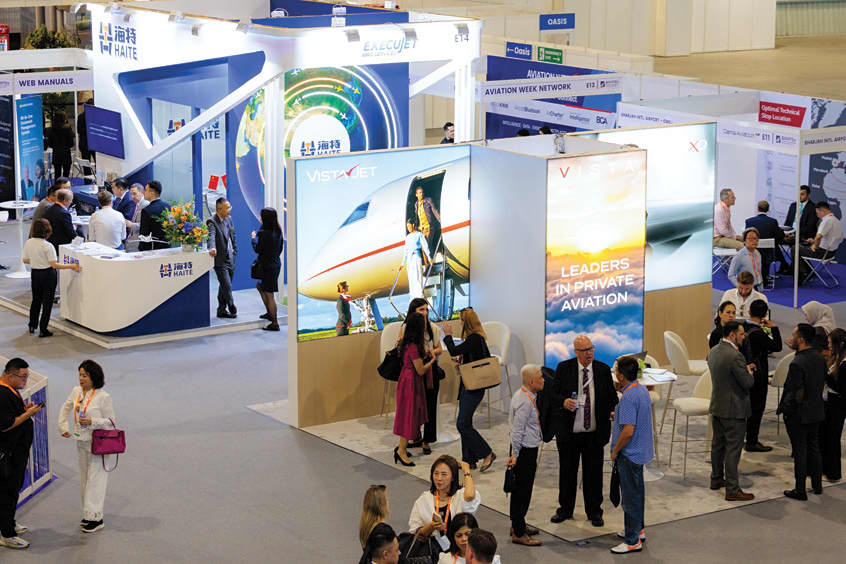
BAAFEx debuted in March 2025, drawing more than 2,000 visitors and over 50 participating companies from across the global business aviation ecosystem, including manufacturers, operators, MRO providers, regulators and service providers. The inaugural conference featured 46 speakers across 12 sessions, covering Southeast Asia's emergence as a growth hub, sustainability, regulatory harmonisation and developments in China's business aviation market.
BAAFEx forms part of Singapore's broader aviation ecosystem, alongside established global platforms such as the Singapore Airshow, reinforcing the country's role as a trusted hub for the global aviation community and supporting long-term industry growth across Asia Pacific.