 The bimonthly news publication for aviation professionals.
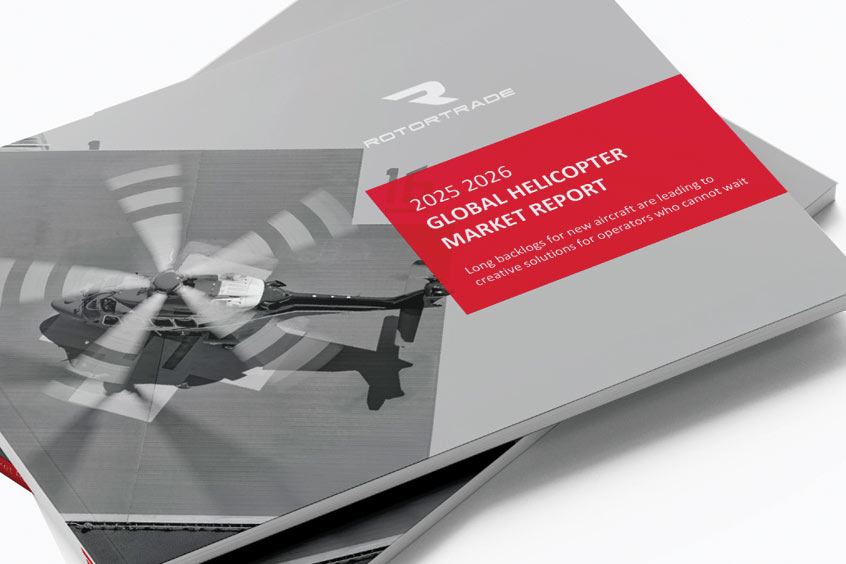
A widening imbalance between demand and supply is defining the global helicopter sector, as production constraints and extended backlogs continue to limit availability, according to Rotortrade’s Global Helicopter Market Report 2026. The report provides an overview of the global fleet as of January 1, 2026, combining OEM production data, fleet intelligence and operational analysis across major mission segments.
In the multi-turbine segment, Airbus leads with 4,459 helicopters, followed by Leonardo with 2,297 and Bell with 1,937. In the single-turbine category, Bell with 6,760 helicopters and Airbus with 6,707 remain closely positioned, while Robinson continues to grow through the R66 programme. The piston segment is dominated by Robinson with 9,929 helicopters in operation, representing around 85–90% of certified production.
Operational demand continues to shift across mission types. Emergency medical services are increasingly using twin-engine helicopters, offshore activity is expanding in regions including Brazil and the Gulf of America, and climate-driven demand has strengthened firefighting operations, with Australia contracting more than 630 helicopters each season. In advanced air mobility, four leading companies have raised more than $10.6 billion.
The report highlights a structural imbalance between strong demand and limited OEM production capacity. Delivery slots for some models now extend to 42–48 months, leading operators to use reconfigured pre-owned helicopters to enter service more quickly.
Philippe Lubrano, CEO of Rotortrade, says: “The helicopter industry remains fundamentally resilient. Demand across EMS, offshore, corporate and firefighting missions is strong, yet OEM backlogs are reshaping acquisition strategies worldwide. Our Global Helicopter Market Report is designed to provide operators, financiers and industry stakeholders with clear, data-driven insight. In this environment, access to reliable market intelligence is critical to making informed fleet decisions.”