 The bimonthly news publication for aviation professionals.
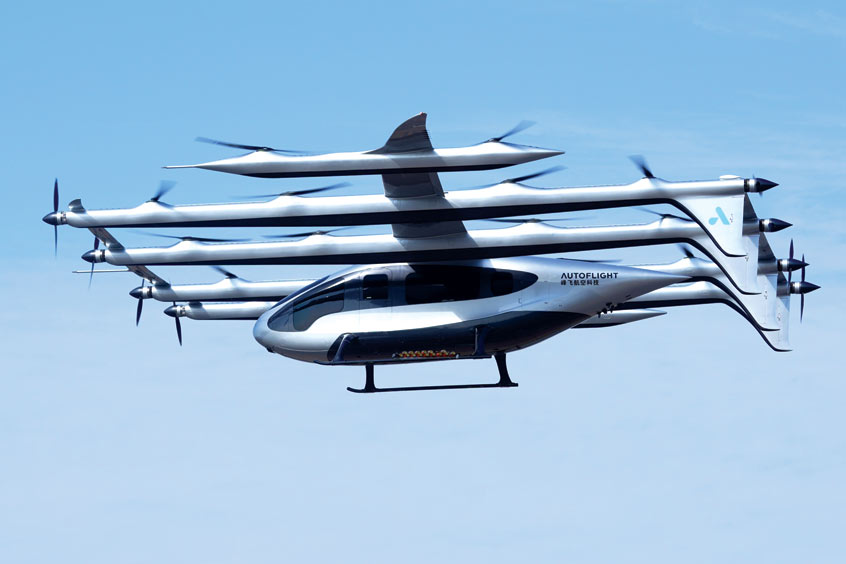
AutoFlight has unveiled Matrix, a five-tonne eVTOL aircraft, at a public demonstration where it successfully completed a full transition flight at the Chinese aircraft developer's low-altitude flight test facility centre.
During the demonstration, where it flew alongside AutoFlight's two-ton CarryAll cargo eVTOL, Matrix completed the full mode transition flight sequence, transitioning from vertical take-off through cruise flight to vertical landing. The achievement validates AutoFlight's eVTOL technologies across complex aerodynamic systems, high-power electric propulsion and advanced flight control systems, marking the first time a five-ton eVTOL has achieved full transition flight.
Matrix features a 20 metre wingspan, 17.1 metre length and 3.3 metre height, with a maximum take-off weight of 5,700kg. The cabin measures 5.25m in length, 1.8m in width and 1.85m in aisle height, providing 13.9 sqm of interior volume.
The aircraft will be available in passenger and cargo variants. The passenger version offers flexible seating configurations, accommodating either 10 business-class seats or six VIP seats. Standard amenities include premium seating, washbasins, lavatories, climate control, ambient lighting and oversized one sqm windows with 50 per cent enhanced light transmission.
The cargo variant uses a hybrid power system, supporting a maximum payload of 1,500kg, and features a large forward-opening door capable of accommodating two AKE standard air cargo containers, enhancing operational efficiency for ton-scale cargo transport.
AutoFlight's CEO and founder, Tian Yu says: “Matrix is not only a rising star in the aviation industry but also an ambitious industry disruptor. It will break the industry perception that eVTOL equals short-haul and low-load, and will reshape the rules of eVTOL routes. Through economies of scale, it significantly reduces transportation costs per seat-kilometre and ton-kilometre, revolutionising costs and embracing profitability. It covers all scenarios from urban commuting to intercity feeder routes, driving the expansion of the entire low-altitude ecosystem.”
Matrix employs AutoFlight's compound wing Lift and Cruise configuration with a distinctive triplane layout and six-arm structure, ensuring aerodynamic stability throughout all flight phases. The aircraft's high-voltage architecture incorporates up to 20 fifth-generation lift motors in a distributed propulsion system, providing redundancy to maintain flight capability in single or dual engine failure scenarios.
The pure electric version offers a maximum range of 250km, while the hybrid-electric variant extends the range to 1,500km. The platform's capacity positions it for diverse applications including regional travel, heavy logistics operations and large-scale emergency response missions.
Matrix represents a continuation of AutoFlight's product strategy, following the company's Great White Shark for industrial applications, CarryAll for autonomous logistics, and Prosperity for urban air mobility. The development programme builds upon AutoFlight's accumulated expertise in low-altitude flight technology, reliability, safety systems and airworthiness certification.