 The bimonthly news publication for aviation professionals.
Air rescue is an important component of rapid emergency care in Germany, as shown by DRF Luftrettung's mission statistics from last year. Overall, the non-profit air rescue organisation recorded a total of 36,407 helicopter missions and repatriations, marking a slight increase in missions of 1.6 per cent on 2024.
As in previous years, the most frequent reasons for helicopter emergency calls were cardiovascular diseases such as heart attacks or strokes, medical emergencies in which rapid assistance by air is vital for survival. The red-and-white air rescue service was also frequently dispatched to emergencies involving serious accidents and falls from height. Its rescue hoists were used 226 times in 2025 to provide rapid emergency medical care and airlift patients, even in difficult-to-access terrain, representing an increase of 41 per cent compared to the previous year.
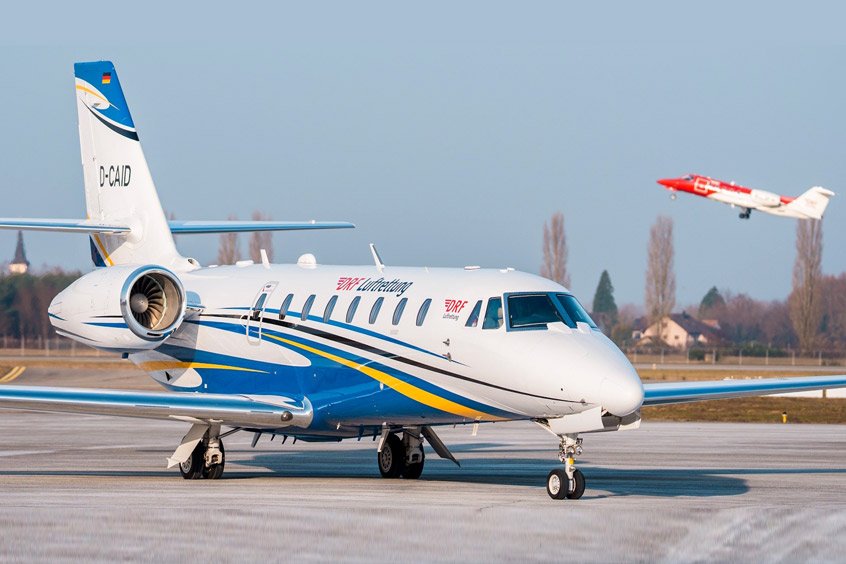
The DRF Assistance team, based at Karlsruhe/Baden-Baden airport, carried out 479 worldwide patient repatriations with medical accompaniment using its three ambulance aircraft, comprising a Citation Sovereign+ and two Learjet 35As. Here, too, there was a significant increase of 24 per cent compared to 2024. The crews flew to a total of 45 countries and covered a distance of around 1.6 million kilometres, equivalent to 40 trips around the world.
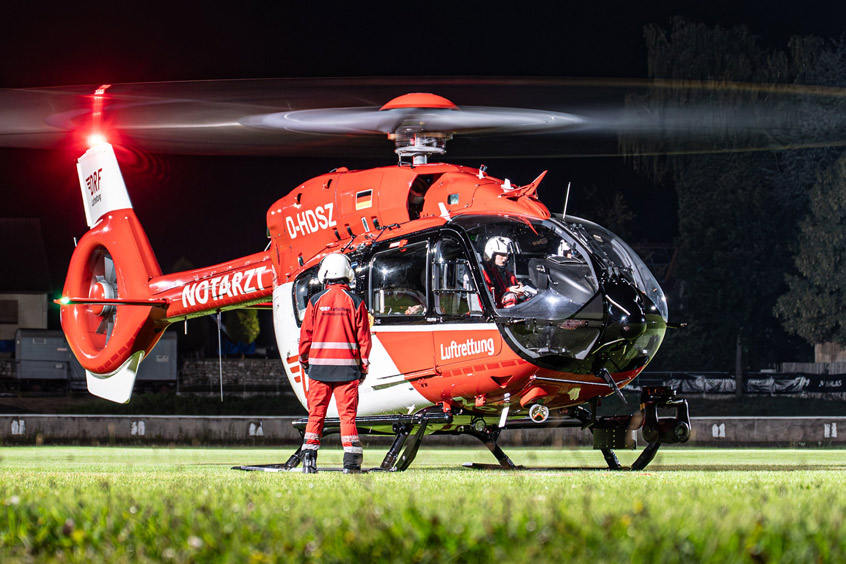
In 2025, crews were on call around the clock at 13 DRF Luftrettung HEMS bases and with extended off-peak hours at two additional HEMS bases. A total of one quarter of the missions carried out by the crews at these bases took place in the dark. This high percentage clearly shows that there is a need for rapid emergency medical assistance from the air outside of daylight hours, especially in autumn and winter, when people are often still active after sunset. Air rescue in the dark should therefore be more widely available.
“This is one of the key demands we are making emphatically to politicians,” emphasises Dr Krystian Pracz, CEO of DRF Luftrettung. “Comprehensive and nationwide emergency care must not depend on the time of day. Technically, we are already able to conduct operations after sunset from all our bases. We are therefore calling for a needs-based expansion that takes social life into account, meaning both the extension of off-peak hours and 24-hour air rescue. Emergencies know no time of day.”
Last year, several tender procedures in various regions of Germany underscored the importance of quality, reliability and experience in air rescue. The decisions made by the authorities highlight the importance of proven structures and the continuous development of airborne emergency care.
At the beginning of the year, following the completion of the tender process, the Christoph Dortmund intensive care transport helicopter operated by DRF Luftrettung officially began 24-hour operations as part of the German public emergency rescue system. In Weiden, the extension option was exercised: the responsible authority, Zweckverband Oberpfalz-Nord, thus confirmed the continuation of the existing cooperation with DRF Luftrettung. For Christoph Regensburg, a new contract period will begin in September 2026 following successful participation in the tender process. A new HEMS base in Lahr (Ortenaukreis) is scheduled to go into operation as early as spring this year. This was based on a needs assessment commissioned by the state of Baden-Württemberg and a subsequent tender process, as a result of which DRF Luftrettung was entrusted with the operation of the base. The Mannheim HEMS base will also continue to be operated by DRF Luftrettung beyond November 2026, according to the decision following the conclusion of the tender process for Christoph 53. In addition, preparations were made in 2025 for the takeover of the HEMS base in Berlin-Steglitz (Christoph 31). Since the beginning of 2026, DRF Luftrettung has been operating all three HEMS bases in the German capital.
The reform of emergency and rescue services must be consistently pursued in the interests of patients; this is one of DRF Luftrettung's key demands on politicians. “Air rescue already plays a significant role in the care of particularly complex and time-critical cases in rural areas,” Pracz points out. “The goal must be to use existing resources and expertise efficiently and to the greatest benefit of our patients.”
DRF Luftrettung is committed to connecting all emergency care providers through comprehensive digitalisation and establishing emergency rescue services that transcend district and state boundaries. DRF Luftrettung is also pushing for the creation of a legal framework to establish procedures that enable the use of air rescue even in bad weather. “From an aviation and technical point of view, DRF Luftrettung is already set up for this today,” states Pracz.
The best patient care requires the best equipment and DRF Luftrettung completed a major project in this area at the end of the year. Thanks to the continuous renewal of its helicopter fleet, the non-profit air rescue organisation is constantly in operation with helicopters of the latest generation. With H145 and H135 helicopters, DRF Luftrettung operates the most modern fleet of any air rescue organisation in Europe.
The H145 is ideally suited for a wide range of applications in dual-use operations, from emergency missions to complex intensive care transports between hospitals. Its high payload and a third seat in the cabin offer a wide range of possible applications. For example, a paediatric team can accompany the transport of a child or heavy medical equipment can be loaded for particularly complex medical missions. The crew can also carry more fuel, enabling them to fly longer distances without refuelling, which saves valuable time for patients. The helicopter's increased performance also opens up more possibilities for missions at high altitudes, such as in the Alps. In addition, the new five-blade rotor system makes it even smoother in the air, which benefits both patients and crew. The H135 and H145 helicopters are equipped with a Helionix cockpit, a digital cockpit that supports pilots in optimising flight performance, thereby increasing safety. In conjunction with a four-axis autopilot, an anti-collision system, weather radar, high-performance searchlights and state-of-the-art medical technology, the aircraft are optimally equipped for complex air rescue missions day and night.
The next step in fleet modernisation has already been taken: DRF Luftrettung and Airbus Helicopters signed a purchase agreement for 10 H140 helicopters in July 2025. With this step, DRF Luftrettung is continuing its tradition as a launch customer for new innovative helicopter types.