


 The bimonthly news publication for aviation professionals.
 Read this story in our January/February 2026 printed issue.
Full-flight simulator (FFS) manufacturer Axis Flight Training Systems (Axis) is launching the Axis AI Debriefing Station, an advanced automated platform designed to improve pilot training, support instructors and standardise assessment across training organisations.
The system automatically monitors and evaluates pilot performance during training and checking, recognising flight manoeuvres, identifying the pilot flying and analysing aircraft parameters in real time. This automation allows instructors to focus fully on crew behaviour and decision-making in the cockpit, while the AI handles the detailed technical assessment.
The Axis AI Debriefing Station can be tailored to the specific needs of an Approved Training Organisation (ATO), providing a flexible and scalable solution for organisations seeking to improve consistency and quality. It enables the straightforward adoption of Competency-Based Training and Assessment (CBTA), applying type-, SOP- and organisation-specific evaluation criteria. By standardising assessments across instructors, aircraft types and whole fleets, the platform ensures every student is evaluated against the same objective benchmark, strengthening training reliability and fairness.
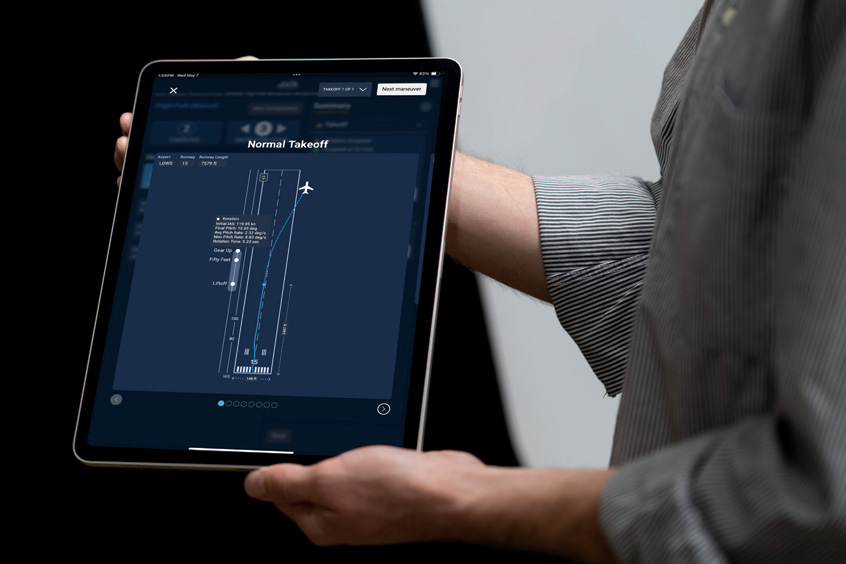
After each session, trainees and instructors receive a detailed data-driven evaluation accessible through an online platform on any device. Each assessment presents performance broken down by competencies, manoeuvres and observable behaviours, making it clear where a student is excelling and where further attention may be needed. Automatically generated insights remove the need for manual tagging, and printed or digital reports help trainees prepare for their next session while making progress over time easy to track.
For instructors, the reduction in workload is significant. The system captures what would traditionally require intensive monitoring, allowing them to concentrate on the human factors and decision-making aspects of flight training. It also helps instructors quickly identify performance shortcomings, compare progress across trainees and provide evidence-based recommendations tailored to individual needs. For training organisations, the platform offers a unified approach to assessment, improves oversight of training quality and supports the seamless implementation of CBTA.
Marcell Surányi, product manager at Axis Flight Training Systems, says: “Our goal was to create a tool that empowers instructors and strengthens training organisations with reliable, objective insights. The Axis AI Debriefing Station reduces workload, increases standardisation and ensures trainees receive the full benefit of every session. By automating data capture and analysis, instructors can focus their attention on shaping pilot performance in the cockpit.”