 The bimonthly news publication for aviation professionals.
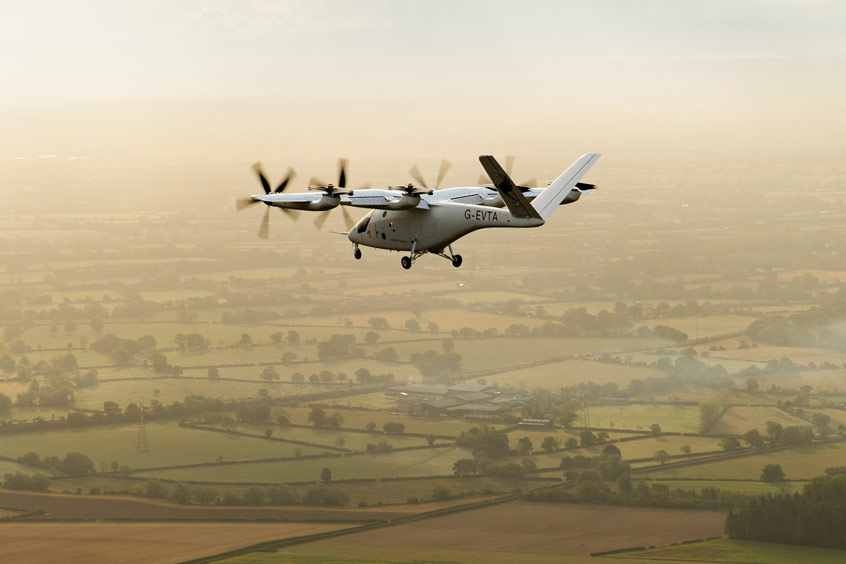
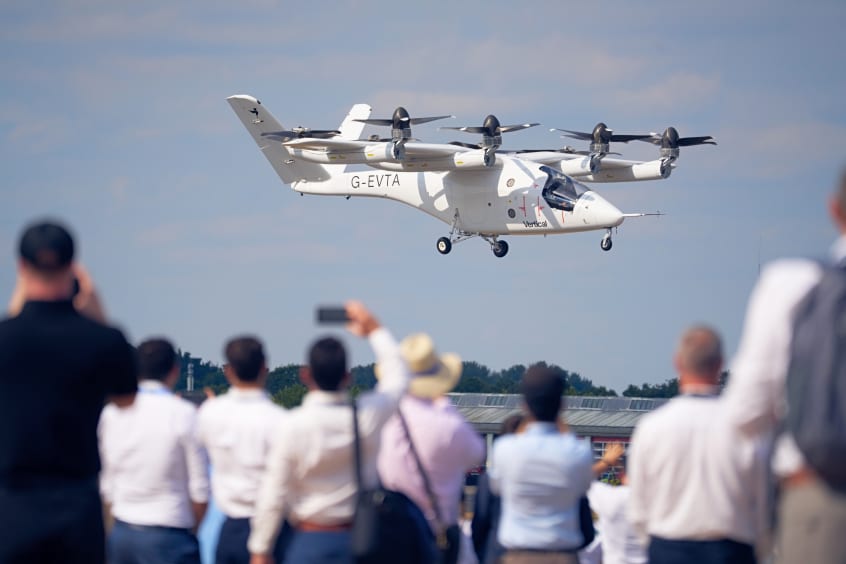
Vertical Aerospace, a UK aerospace and technology company pioneering electric aviation, has successfully completed Phase 3 piloted wingborne flight testing of its VX4 prototype.
The full scale VX4 has now taken off, flown and landed like a conventional aircraft with lift generated by its wings. This quiet, low-power mode is essential for making electric air travel practical, scalable and economically viable.
The wingborne phase included flights by chief test pilot Simon Davies and test pilot Paul Stone, switching between direct (manual) and flight (computer-assisted) control modes. The VX4 performed as modelled in the simulator, validating both the design and ease of handling.
Working closely with the UK CAA, which is collaborating with EASA for its concurrent validation and certification of the VX4 to the highest safety standards required for commercial use, Vertical secured approvals for flight testing in open airspace by extending its Permit to Fly following a rigorous review of safety and technical documentation.
Since completing Europe's first-ever piloted wingborne flight of a winged eVTOL in May 2025, Vertical has: completed piloted flight tests covering 250 miles/400 km; reached a top speed of 120 kts and altitude of 2,000 ft; and collected over 22 billion data points, validating aerodynamic models, acoustic levels, system reliability and performance.
Vertical will now move to the final test stage: transition, proving the VX4's ability to shift seamlessly between vertical lift (‘helicopter mode’) and wingborne flight (‘airplane mode’), the defining capability of a tiltrotor eVTOL aircraft, which means it can take off and land in a small space. This will be the operating mode it will use in passenger service.
Stuart Simpson, CEO of Vertical Aerospace, says: “Completing wingborne flight is a historic milestone for Vertical and the VX4. Each phase strengthens confidence among regulators, partners and investors that our aircraft will meet the highest standards of safety and performance. Now we enter the most exciting stage: transition testing, demonstrating the mode the VX4 will use in passenger service.”
Simon Davies, chief test pilot adds: “Paul Stone and I have had the privilege of flying this machine through it's wingborne test phase. It's been incredibly rewarding, with the aircraft performing just like the simulator during our first flights in open air space. With the high-quality data we've gathered and the ability to test at both high and low speeds, we are in the best possible place to explore transition with our proven tools and flight test team.”
Vertical continues to target type certification in 2028, working concurrently with the CAA and EASA, with validation across other regulators to follow.