 The bimonthly news publication for aviation professionals.
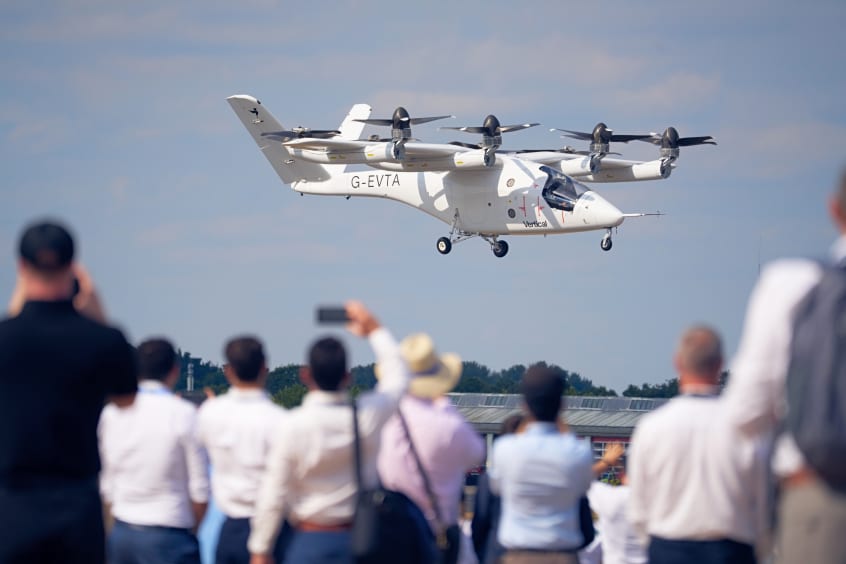
Vertical Aerospace is developing a hybrid-electric vertical take-off-and landing (VTOL) variant of its VX4 aircraft, expanding its range and payload capabilities to unlock new market opportunities within the already sizeable $1 trillion total addressable urban air mobility market.
Vertical's hybrid-electric strategy builds on its all-electric VX4 and Flightpath 2030 strategy, enabling new potential applications in defence, logistics and commercial sectors including air ambulance services, which require longer range and a higher payload than current eVTOL platforms can deliver.
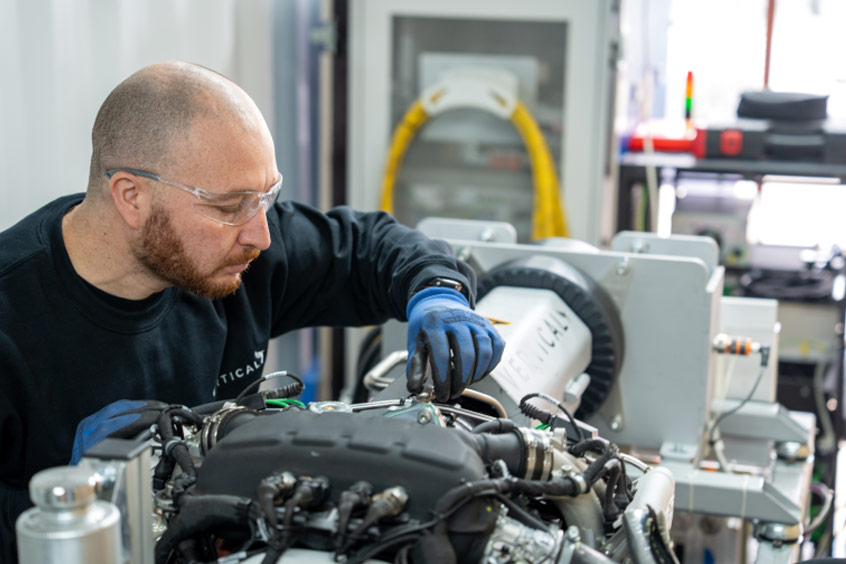
Vertical's second-generation hybrid-propulsion system, which has been in development for 18 months at the Vertical Energy Centre, will be retrofitted into one of the company's VX4 full scale prototypes and is expected to commence flight testing in Q2 2026.
Key targeted capabilities of Vertical's hybrid-electric variant include: range, up to 1,000 miles, a 10-fold increase from its all-electric aircraft; payload, configurable to carry up to 1,100 kilograms in the VX4's airframe capacity; stealth advantages, low noise and heat signatures make the hybrid variant well-suited for sensitive missions; crewed and uncrewed capabilities – hybrid-electric technology capable of being deployed autonomously, remotely or with a pilot. Uncrewed capabilities can be seamlessly integrated into the existing flight control system being developed by Honeywell; and mission resilience – built off the VX4's industry-leading redundancy and damage tolerance, boosting confidence for mission-critical operations.
“The demand for long-range, high-payload, quiet aircraft is growing rapidly, especially across defence and critical logistics.” says Stuart Simpson, CEO of Vertical Aerospace. “Our hybrid-electric VTOL strategy builds on our existing electric platform, world-class battery technology and large, versatile airframe, allowing us to offer uniquely scalable solutions that unlock a new frontier in air mobility and revenue stream for Vertical.”
Best-in-class hybrid-electric potential enabled by proprietary battery technology and airframe Vertical's proprietary battery platform, developed at its purpose-built Vertical Energy Centre, is a critical component of its hybrid-electric capability. Vertical's battery will help power the superior hybrid range and payload capabilities, enabling best-in-class performance for mission-critical use cases. Vertical's hybrid team has developed advanced control systems supporting safe operation and redundancy, meeting strict EASA and UK CAA safety standards for eVTOL flight. Bench testing has already validated its hybrid-electric architecture, including the successful integration of control algorithms between the power unit and battery.
The VX4's large and flexible airframe enables the integration of hybrid-electric propulsion technology and superior payload capacity without requiring major redesign. This design freedom supports both operational scalability and mission versatility, advantages that smaller platforms may struggle to accommodate.
As the only remaining credible European eVTOL company, Vertical's hybrid-electric capabilities position it as a key player amid growing defence budgets and increasing focus on sovereign industrial capacity. As European governments increasingly look to develop new technologies and platforms to strengthen their defence capabilities, Vertical is actively engaged in discussions with government agencies, as well as other prospective customers, around defence applications and other potential use cases for its hybrid-electric aircraft.
The hybrid-electric variant will be in addition to Vertical's all-electric VX4, which remains on target for its Flightpath 2030 goal of type certification in the UK and Europe in 2028, followed by validation by global regulatory authorities.