 The bimonthly news publication for aviation professionals.
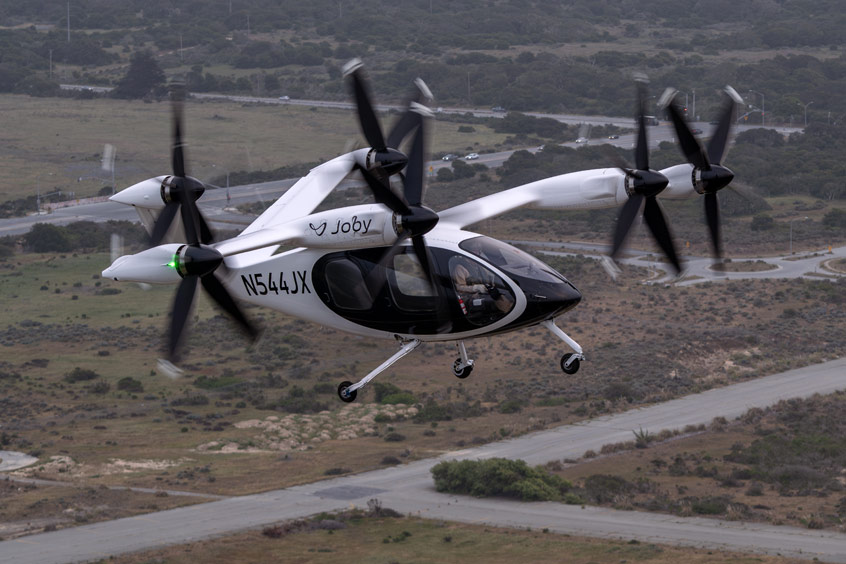
Joby Aviation has reached a milestone in its aircraft test programme, successfully completing piloted flights involving full transitions from vertical to wingborne cruise flight and back again. The tests took place at the company’s Marina, California facility using the latest aircraft built on site.
Transitioning from vertical to forward flight is central to Joby’s design, combining the vertical take-off and landing capability of a helicopter with the range and speed of a fixed-wing aircraft. This allows for fast and direct passenger operations to high-demand destinations.
The company’s first transition of a full-scale prototype was completed remotely in 2017. Since then, Joby has flown over 40,000 miles, conducted hundreds of transitions and logged more than a hundred flights with a pilot on board during hover and low-speed manoeuvres.
The first piloted full transition took place on 22 April 2025 and was flown by chief test pilot James “Buddy” Denham. Multiple flights have since been completed with three different pilots, making Joby the first to carry out routine crewed transitions on an electric air taxi.
Denham lifted vertically in aircraft N544JX, accelerated to cruise and then landed vertically on the runway. A former Naval Air Systems Command test lead, he joined Joby in 2019 after helping develop the F-35B’s Unified Control Concept.
“I’m honoured to have played a role in this historic moment,” Denham said. “The aircraft flew exactly as expected, with excellent handling qualities and low pilot workload.”
President of aircraft OEM Didier Papadopolous said: “We have taken a very methodical approach to achieving this long-planned milestone, with an immense amount of testing, both in the air and on the ground, helping form a solid foundation that allowed us to move from one historic flight to routine pilot-on-board transitions almost overnight.”
Thousands of tests were conducted in Joby’s Integrated Test Lab to replicate aircraft systems and assess propulsion and actuator behaviour before any piloted flights took place. Additional validation occurred at Edwards Air Force Base, where ground-based remote pilots confirmed system redundancy by simulating failure scenarios such as motor and battery loss. The aircraft remained controllable in each case and was able to land vertically using just four of six propellers.
Joby has previously flown demonstration flights in New York, Japan and Korea. Of its five test aircraft, two are assigned to Edwards for use in defence-related testing. Its all-electric aircraft is built to carry a pilot and four passengers at up to 200 mph with low noise and no operating emissions.
Joby remains on track to deliver an aircraft to Dubai by mid-2025 for further testing before entering commercial passenger service.