

 Read this story in our May/June 2025 printed issue.
German medevac organisation ADAC Luftrettung has completed the world’s first long-term project using SAF in air rescue operations.
The most important results are the emission of significantly fewer ultra fine particles, colloquially known as soot, as well as the unrestricted performance and operational readiness of the two SAF-fuelled helicopters. No negative effects on the aircraft’s technology or engines were measurable during the three-year research period. The research project, initiated and funded by ADAC Luftrettung, was carried out in close collaboration with the German Aerospace Center (DLR), the engine manufacturers Safran Helicopter Engines from France and RTX’s Pratt & Whitney Canada, as well as helicopter manufacturer Airbus Helicopters.
The ADAC rescue helicopters ‘Christoph Rheinland’ from Cologne and ‘Christoph Europa 1’ from Aachen/Würselen flew a total of more than 1,800 hours to save lives with a so-called SAF blend in the tank, which refers to a mixture of up to 38 per cent SAF from sustainable raw materials such as recycled vegetable fats, and conventional Jet-A1 kerosene. As a so-called drop-in fuel, SAF can in principle be mixed with conventional kerosene.
Findings for the project managers and researchers are that when SAF blend is burned instead of pure kerosene, ultra fine particle emissions are reduced by 44 per cent at idle speeds typical for take off and by 33 per cent at cruise speeds. In addition, CO2 emissions are reduced over the life cycle of the aviation fuel, from production to combustion, because the recycled fats and oils are CO2-neutral and replace the CO2-heavy fossil components.
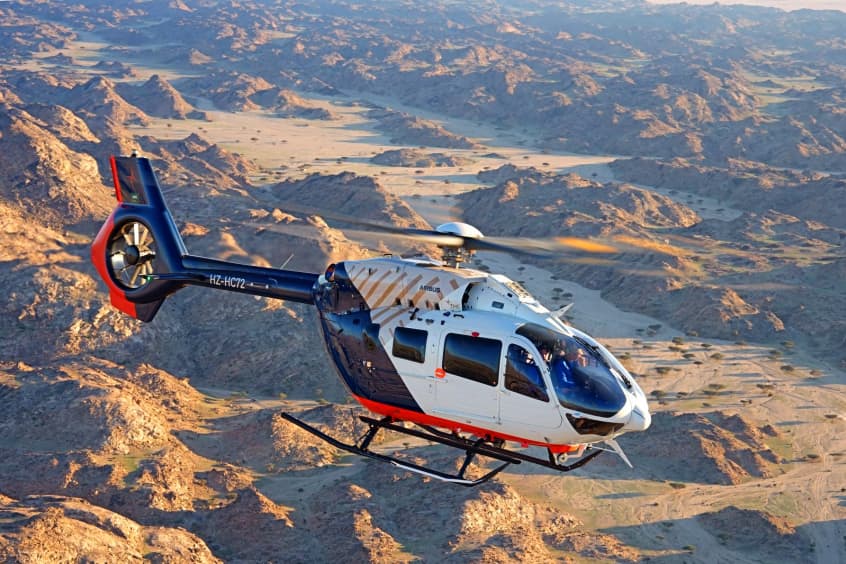
While significant differences were measurable in ultra fine particles, no changes were detected in the combustion gases carbon dioxide (CO2), carbon monoxide (CO) and nitrogen oxide (NOx), an indicator of smooth engine operation. At the same time, the engine manufacturers regularly tested their own technology in the two helicopters, the Airbus H145 (‘Christoph Rheinland’ with Safran engines) and the Airbus H135 (‘Christoph Europa 1’ with Pratt & Whitney engines). Compared to the wear and tear caused by burning conventional kerosene, they found no significant differences.
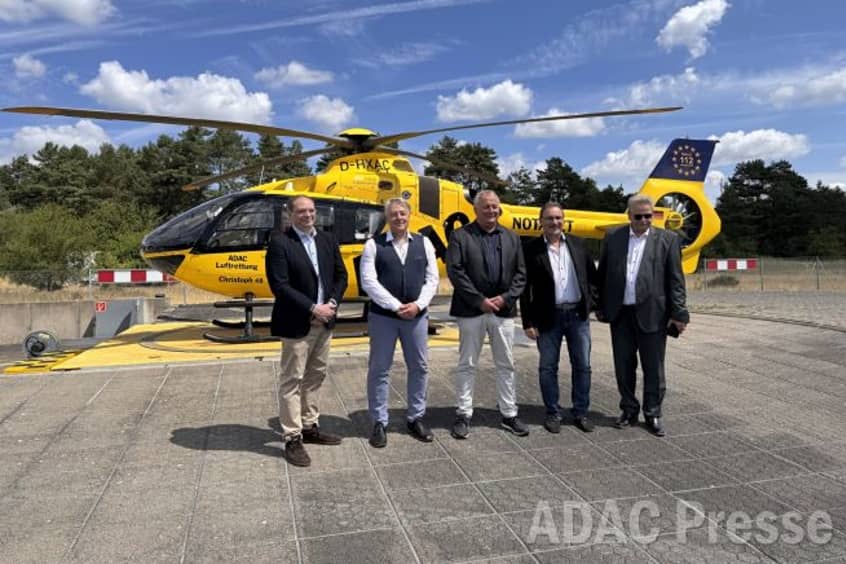
At the conclusion of the long-term international project, MD of ADAC Luftrettung Frédéric Bruder emphasised the pioneering role of the flying Yellow Angels in the use of biokerosene and, with a view to climate change, their social responsibility to be a driving force in the decarbonisation of aviation. Following the promising initial results, he announced: “We would like to further intensify research and development in this area and further increase the proportion of SAF.”
ADAC Luftrettung’s long-term goal is to increase the blend to 100 per cent and subsequently enable the use of synthetic e-fuel, also known as power-to-liquid kerosene (PtL). PtL refers to the production of liquid fuels using electrical energy (power) from renewable sources.
The launch of this unique research project was marked by the first flight of a rescue helicopter, an ADAC Luftrettung H145, with a 40 per cent SAF blend in Munich in the summer of 2021. In December of the same year, ADAC Luftrettung, together with DLR, Safran Helicopter Engines and Airbus Helicopters, began its studies on the long-term effects of SAF from the aviation fuel provider Air bp on aircraft and engine technology with the ‘Christoph Rheinland’ helicopter. To provide a broader scientific basis, ‘Christoph Europa 1’ was also fuelled with SAF blend from the multi-energy company TotalEnergies starting in December 2021 in cooperation with RTX’s Pratt & Whitney. It is also expected to have completed 1,000 operating hours by summer 2025. Project participants expect comparable results.
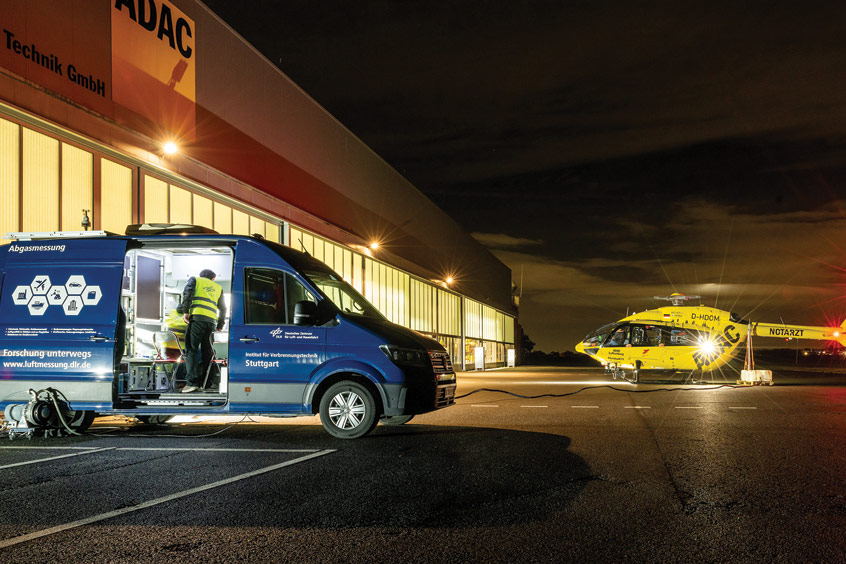
“For this first and so far unique measurement campaign of this kind, we used our mobile DLR measurement laboratory. It contains special measuring and analysis equipment suitable for examining ultra fine particles down to seven nanometers in size. Before each measurement campaign, we develop a customised concept and determine the set-up, position of the measuring probe and the duration of the measurements. This is the only way to obtain reliable and comparable data,” explains researcher Tobias Grein from the DLR Institute of Combustion Technology, who supervised the project on the DLR side. His conclusion: “These measurements were very exciting, and it was also something special for our team to do everything ‘live’ on a helicopter shortly before take off.”
Jean-François Sauer, EVP programmes at Safran Helicopter Engines, adds: “This long-term study of SAF use in an H145 helicopter powered by our Arriel engine is an important milestone. It demonstrates the compatibility of our engines with SAF in long-term operation and enables the assessment of the environmental benefits, both in terms of reducing CO2 and local pollutant emissions. We are pleased to have been able to participate in this experiment together with ADAC Luftrettung, DLR and Airbus. Safran Helicopter Engines has been committed to the widespread use of SAF in the helicopter industry for several years. All Safran Helicopter Engines are already qualified for use with up to 50 per cent SAF. The next short-term step is the qualification of 100 per cent drop-in SAF, a fuel that can be used to power current engines with little or no modification. We plan to achieve this by 2025.”
“ADAC Luftrettung’s initiative effectively demonstrates the readiness and adaptability of current aircraft and engines to operate on SAF, delivering tangible benefits without compromising our high standards of performance and safety,” says Nico Chabée, vice president of marketing and sales, Helicopters at Pratt & Whitney Canada. “The PW206B turboshaft engines powering ADAC Luftrettung’s H135 helicopters are certified for SAF blends of up to 50 per cent with conventional Jet A/A1 kerosene according to ASTM International specifications. Our commitment to advancing alternative fuels includes supporting customer initiatives and developing future fuel specifications to enable the use of up to 100 per cent SAF.”
“Our clear goal at Airbus is to be a pioneer in sustainable aviation,” concludes Stefan Thomé, CEO of Airbus Helicopters in Germany. “We see the use of sustainable aviation fuel as a key lever for achieving the aviation industry’s decarbonisation goals. Collaboration between helicopter manufacturers, operators, engine manufacturers, research institutes and all other stakeholders, such as in this project, is essential and crucial to ensure we achieve our common goal of further reducing helicopter emissions.”












 The bimonthly news publication for aviation professionals.
