 The bimonthly news publication for aviation professionals.
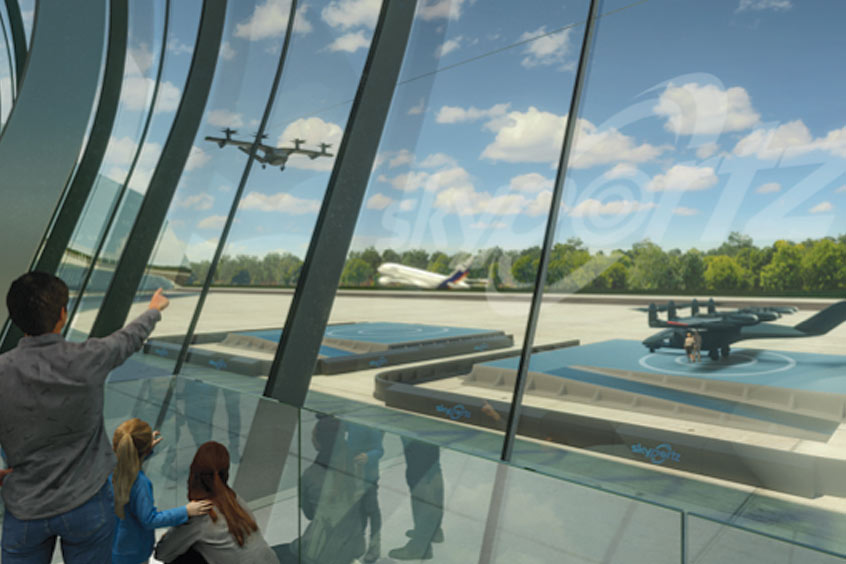
Australian vertiport company Skyportz has released a patent for a modular vertipad designed to reduce downwash and outwash from air taxis. Presented at the Avalon International Airshow, the patent describes a landing surface that may dissipate airflow energy up to 250% faster than flat concrete, according to research from Swinburne University.
The issue of downwash was recently highlighted by the FAA, which in its Engineering Brief 105A stated that vertipads will need wind safety zones beyond their landing areas. These zones are triggered where wind speeds exceed 34.5 mph, which could lead to larger footprint requirements depending on aircraft type.
Skyportz CEO Clem Newton-Brown claims that the company's new design will help to reduce those needs: “With our vertipad you can safely use less land, or fit more pads onto smaller plots.” He adds: “The vertiport infrastructure is the missing piece of the puzzle for this industry. Without a multitude of new vertipad landing sites in places people want to go, the aircraft will never fulfil their potential.”
Professor Justin Leontini, Department of Mechanical and Product Design Engineering, Swinburne University of Technology, adds: “Our next step will involve adding mechanical devices detailed in the patent under and around the vertipad, which we expect will induce a Magnus effect and dissipate energy at an even higher rate while directing flows to desired zones away from waiting passengers. The practical implications for this research are that the safety area requirements around a vertipad may be reduced, enabling operations from smaller footprints safely.”
The design is listed under Australian provisional patent 2024901767, with international rights reserved, as Skyportz intends to license the product globally. Skyportz reports that international air regulators, future air taxi and vertiport operators have already expressed an interest in the patented design.