


 The bimonthly news publication for aviation professionals.
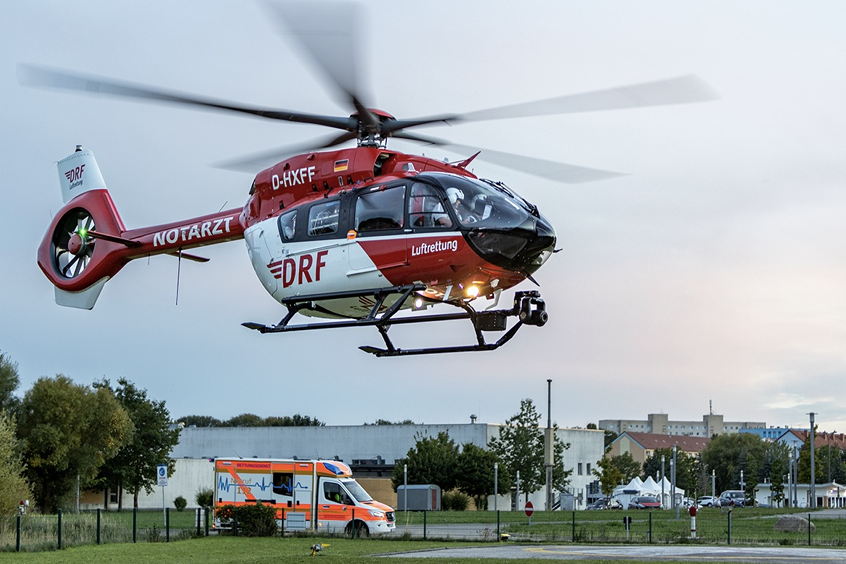
In 2024, DRF Luftrettung continued to focus on the consistent development of emergency rescue by air, and completed many missions in the dark. A total of 35,850 missions by the German non-profit air rescue organisation included rapid assistance from the air; in a changing German healthcare system, DRF continues to play a central role in ensuring reliable and comprehensive emergency care for the population.
Last year, DRF Luftrettung was in higher demand at night compared to the previous year. Its 14 helicopter bases that are on duty 24 hours a day and with extended off-peak hours carried out 17,907 missions in 2024, 4,058 of which were at night, representing just under a quarter (23 per cent) of all missions carried out by these bases. Compared to 2023, there was an increase of 13 per cent in the number of missions carried out by these crews after sunset. The conversion of DRF Luftrettung's base in Niebüll to 24-hour operation in May 2024 and the start of operations with extended off-peak hours at the HEMS bases in Berlin-Buch and Bremen are therefore only logical, says Dr Krystian Pracz, CEO of DRF Luftrettung: “This is important and right, because emergencies know no time. Emergency medical care for the population should be just as good in the dark as it is during the day. Technically, this is already possible today at all our locations,” emphasises Pracz.
A look at the reasons for emergency call-outs reveals a largely comparable picture to previous years: the crews were most frequently called out to patients with cardiovascular diseases such as heart attacks or strokes, as well as accidents and fall injuries. In 2024, the crews flew 160 rescue hoist missions to provide rapid emergency medical care and evacuate patients even in terrain that is difficult to access, representing an increase of 22 per cent compared to the previous year. Worldwide patient repatriations were carried out 385 times by DRF's Learjet air ambulance flight team based at Karlsruhe/Baden-Baden Airport.
According to Pracz, structural changes, such as extended competences for emergency paramedics, also required a rethink among air ambulance crews. “However, we see change as a great opportunity to improve the system for the benefit of patients and to set it up efficiently for the future. In our role as a driver of innovation, we therefore see ourselves as an indispensable part of fast and effective emergency rescue in Germany.”
Last year, DRF Luftrettung retired the last EC135 helicopter from its fleet. Since then, only Airbus H135 and H145 helicopters have been used, meaning DRF Luftrettung operates the most modern fleet in civil air rescue throughout Europe. Focusing on these two ultra-modern models stands for constant further development and the highest quality standards for patient welfare on the one hand and for increased efficiency on the other. In terms of interoperability, training courses for pilots, technicians and medical staff can be standardised and personnel can be flexibly transferred to other HEMS bases if necessary.
The continued expansion of the H145 fleet to 32 aircraft sets a further course for the future. This makes the fleet ideally suited for dual-use operations, i.e. for both rapid primary emergency rescue and highly complex secondary transport between hospitals. The larger dimensions and higher payload capacities make it easier to transport additional personnel, such as paediatricians, as well as extensive medical equipment. The H145 is also perfectly suited for nighttime missions, where two pilots sit in the cockpit for safety reasons.
DRF Luftrettung also pushed ahead with the further development of emergency care in the field of medical technology: one example of this is the use of a new blood test to recognise cerebral haemorrhages on board DRF's Christoph 51 helicopter in Stuttgart. The innovative procedure, which is currently being tested as part of a study, was developed by a team of researchers from the Department of Neurology at the RKH Klinikum Ludwigsburg. It is based on a protein blood test, which can perspectively make a decisive contribution to even better diagnosis and initial treatment of affected patients at the point of use.