



 The bimonthly news publication for aviation professionals.
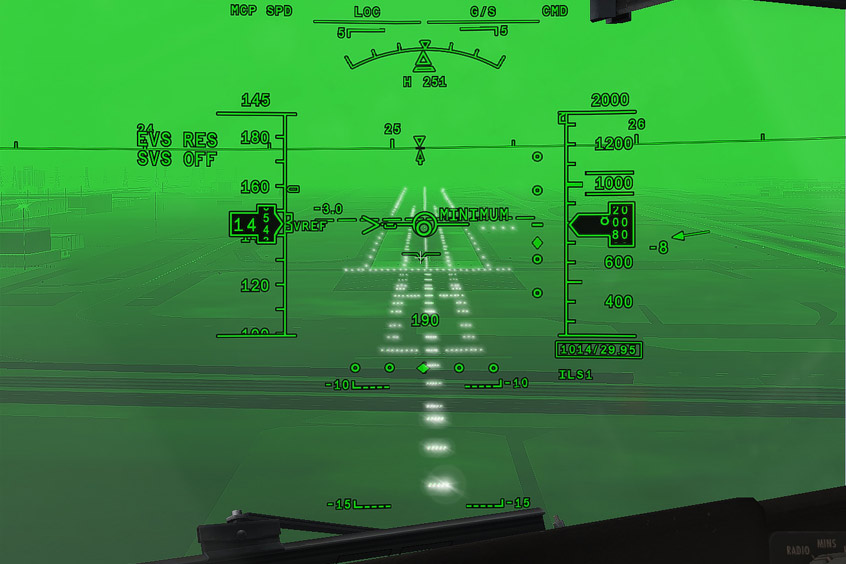
Universal Avionics’ (UA) ClearVision Enhanced Flight Vision System (EFVS) now mitigates changes recently reflected by the FAA to approach light systems. The EVS-5000 multispectral camera seeks to ensure pilots can identify Light-Emitting Diodes (LED) to land safely in low-visibility conditions.
In March 2024, the FAA announced that due to a dwindling supply of the incandescent lamps used in approach light systems, airports would have to replace these lamps with energy-efficient LEDs following a similar runway lighting transition. While this shift increases efficiency, it renders many current IR-based EVS sensors ineffective at identifying runways.
Dror Yahav, CEO of Universal Avionics, says: “Our EVS-5000 camera does not rely solely on thermal sensors to detect lighting on approach; it uses five sensors in addition to the thermal imager. This technology, which we started to develop 15 years ago, was designed to meet the most stringent requirements, including detecting LED lights and ensuring that our customers can continue to operate confidently without disruption. Our EVS-5000 is the only camera that received the maximum allowable credit of 50 per cent visual advantage by the FAA on top of those unique LED support characteristics.
“Our forward-thinking approach and commitment to innovation set us apart from other EVS manufacturers, many of whom have been slow to address the challenges posed by LED lights and are now feeling the heat from customers in North America who will likely soon run into issues when they land at an airport and are unable to see the required lightings.”
ClearVision significantly enhances situational awareness, displaying clear, high-definition imaging of the aircraft’s external environment in a wearable head-up display for pilots, even in challenging weather conditions. It enhances the pilot’s ability to see and interpret the surroundings accurately, allowing for better object recognition and improving safety during take off, landing and taxi operations.
The EVS-5000 uses multispectral imaging with six sensors rather than a single heat-detecting sensor. Five sensors use a combination of millimetre wavelengths across the light spectrum to detect and display terrain features, runways, taxiways and other obstacles that may not be visible to the naked eye. The sixth sensor is high-resolution infrared to capture thermal images of the environment.
ClearVision offers a 50 per cent visual advantage over the naked eye, compared to the traditional EFVS offering of 33 per cent. The system’s FAA compliance enables operators to take advantage of operational credits when landing.
Installed on the aircraft nose, the EVS-5000 is designed to seamlessly integrate with a wide range of aircraft types, from business jets and regional airliners to helicopters and light aircraft, where the smaller EVS-4000 version is suitable.