


• StandardAero
Maintenance
• StandardAero (Asia)
Maintenance
• StandardAero (Summerside)
Maintenance
• PW100
BAN's World Gazetteer
• Canada The bimonthly news publication for aviation professionals.
Aerospace engine aftermarket services provider StandardAero is celebrating 40 years of supporting Pratt & Whitney Canada's PW100 turboprop. The PW100 engine family is a leading powerplant for the regional turboprop, utility and cargo segments, with close to 3,000 PW100-powered aircraft currently in service with over 600 operators in 128 countries worldwide.
In 1984, Dallas Airmotive (acquired by StandardAero in 2021) became the first independent MRO provider to enter into an agreement with Pratt & Whitney Canada for the PW100 turboprop, the initial PW120 variant, which had received Canadian certification approval the prior year.
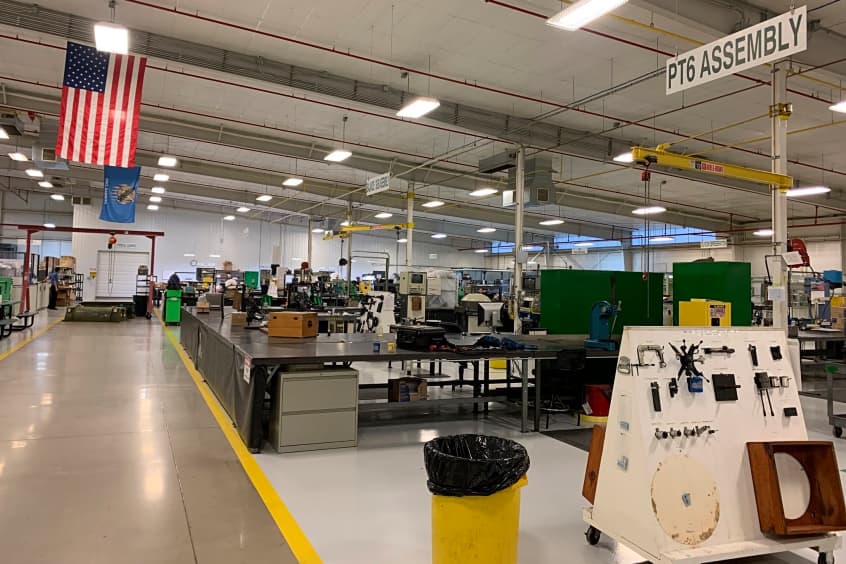
StandardAero supports the PW100 engine family from three overhaul locations worldwide: its Center of Excellence for Turboprop Engine MRO in Summerside, Prince Edward Island, Canada, which commenced work on the PW100 in 1991; Gonesse, France, which began supporting the PW100 in 1986; and Seletar, Singapore, which opened in 2015 as a dedicated PW150A overhaul facility. Operators are also able to benefit from access to six additional StandardAero PW100 service centres across North America, South America, Africa and Australasia.
“StandardAero is pleased to support Pratt & Whitney Canada and its worldwide PW100 operator community by providing reliable maintenance, repair and overhaul support for the engine,” says Jeff Poirier, vice president/general manager of the turboprops and fleets business unit. “PW100-powered aircraft play an important role in connecting communities worldwide, securing borders, safeguarding habitats and saving lives, and StandardAero's skilled employees play an important part in ensuring that operators are able to rely on their PW100 turboprops whenever needed. We look forward to supporting the global PW100 community for many decades to come.”
To date Pratt & Whitney Canada has certified 30 PW100 models and produced 9,000 engines, which have logged approximately 200 million flight hours. The PW100 family powers a broad range of applications including the Airbus C295, ATR 42/72, AVIC XAC M60/M600, De Havilland Canada Dash 8 and CL-215/CL-415/DHC-515, Dornier 328, Embraer EMB-120 Brasilia and Fokker 50/60.
StandardAero is a Pratt & Whitney Canada PW100 designated overhaul facility with overhaul facility locations in Summerside, Canada, Gonesse, France and Seletar, Singapore, supported by six service centre locations across the Americas, Europe, Africa and Australasia. With 60 years of reliable turboprop MRO experience, StandardAero provides engine support options and recommendations that are tailored to operator's specific needs. StandardAero's service offering on the PW100 family also includes engine condition trend monitoring (ECTM) services, as a CAMP Systems Designated Analysis Centre.