 The bimonthly news publication for aviation professionals.
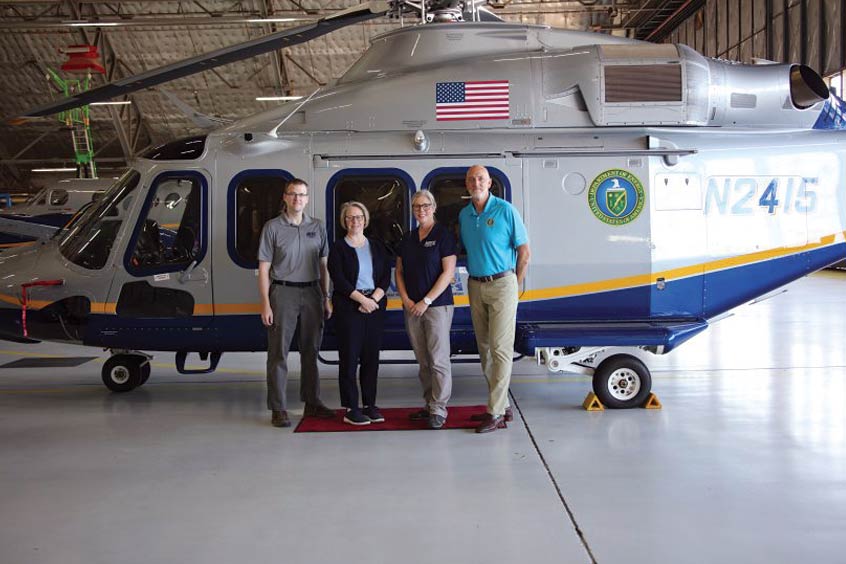
It wasn't a bird, a plane or a certain cape-wearing superhero that aircraft aficionados in the National Capital Region saw when they looked to the skies last month. Instead it was National Nuclear Security Administration's newest aerial measuring system (AMS) helicopter arriving at Joint Base Andrews, near Washington, DC.
The AW139 was the first of two new Leonardo-manufactured helicopters, the second arrived soon after, being delivered to the Remote Sensing Lab's facility. The AW139s will replace two Bell 412 helicopters that have been in service nearly 30 years.
AMS aircraft, both rotary and fixed-wing, can be deployed rapidly to respond to nuclear incidents and accidents in the US and overseas as part of the Nuclear Emergency Support Team (NEST).
“The data provided by AMS aircraft are often the first readings that federal, state, local, territorial and tribal officials can use to make vital health and safety decisions,” says Kasia Mendelsohn, acting associate administrator for the NNSA Office of Counterterrorism and Counterproliferation. “These new helicopters will increase NEST's ability to conduct a wide range of national security and public safety missions.”
Equipped with specialised radiation detection systems, AMS aircraft are a key way NNSA performs radiological and nuclear detection activities at large-scale special events, from the Super Bowl to the Boston Marathon to the upcoming national political party conventions. The AMS fleet, which includes three King Air 350 extended range aircraft, is based at Andrews and at Nellis Air Force Base in Nevada, and is on-call 24 hours a day, 365 days a year.
Sensors on the new aircraft offer 50 per cent more gamma detection capability, which improves data collection. The AW139 also has all of its detection equipment mounted inside the cabin or baggage compartment, increasing both the speed and range of the helicopters and decreasing response time. Finally, the new helicopters are equipped with monitoring systems to decrease maintenance costs, as well as technology enabling them to fly more quietly in urban areas.
“These helicopters will modernise NEST's aerial capability and allow us to better support all our partners in both national security and public health and safety missions,” says Rick Christensen, director of the NNSA Office of Nuclear Incident Response. “Their improved performance will improve our ability to protect the nation.”
The AW139s were manufactured by Leonardo at its helicopter assembly plant in Philadelphia, and their delivery marks the culmination of a nearly decade-long initiative to improve NEST's public health and safety capabilities.
Now that the new helicopters have arrived, it will take approximately six weeks to get them mission-ready as the flight crews familiarise themselves with the configuration of the controls, conduct a thorough validation of their scientific equipment and calibrate the detectors.