


 The bimonthly news publication for aviation professionals.
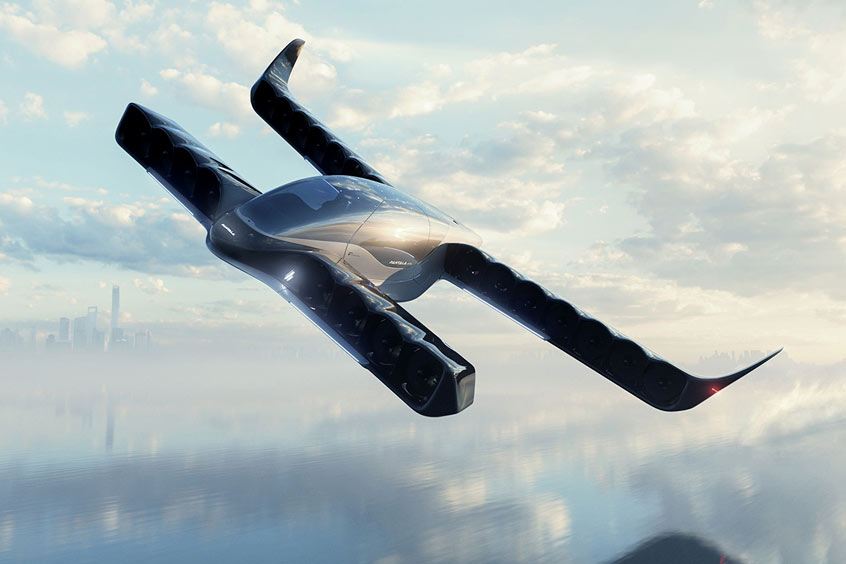
Chinese eVTOL developer Pantuo Aviation and German design studio studiokurbos have won the iF Design Award 2023 for their innovative eVTOL product, the Pantala Concept H in the Professional Concept category.
“The Pantala Concept H is a disruptively innovative transportation tool that revolutionises the way people travel," says Pantuo founder and CEO Ms Zhang. "We envision the future urban mobility to be more safe, intelligent and sustainable. We are delighted that iF holds this common vision. With industrial ecosystem support and government involvement, we are determined to bring the future of mobility to life.”
The Pantala Concept H stood out among almost 11,000 entries from 56 countries, impressing the 133 member jury of independent experts with its unique configuration. By tilting the ducted fan wings, this eVTOL aircraft can take off and land in confined urban spaces, revolutionising fast door-to-door transport.
Few ducted fan configurations are seen in eVTOL designs worldwide, not to mention tilt-wing ducted fan configuration, which makes it the first in civil aviation. This unique design provides the highest level of safety and the lowest level of operation noise to both passengers and the surroundings. At the same time, the advanced aerodynamic shape allows it to fly faster and further, especially as battery technology evolves.
The Pantala Concept H was released in September 2021, and ever since then Pantuo has been developing its half-scaled technology demonstrator, T1. In June 2022, the company shared a video of T1’s first flight.
T1 was built by the company's core engineering team. The key technologies, such as battery pack design, flight control system, scalable ducted fan wing and so on were developed in-house. The success of T1 not only verifies the feasibility of this configuration, but also is the best proof of the team’s development capability.
The scaled-down technology demonstrator provides an opportunity for the team to push the boundaries of technology with a fraction of the development budget. This small and agile group has successfully overcome countless obstacles and challenges. This project has allowed them to gain a comprehensive understanding of requirement generation, validation and verification, laying the groundwork for expediting the certification process in the future.
Meanwhile, Pantuo Aviation is working on T2, a second-generation technology demonstrator, to verify a complete flight profile.