• LifeFlight Engineering and Technical Services
Maintenance
• LifeFlight Rescue Air Ambulance
Charter
BAN's World Gazetteer
• Australia The bimonthly news publication for aviation professionals.
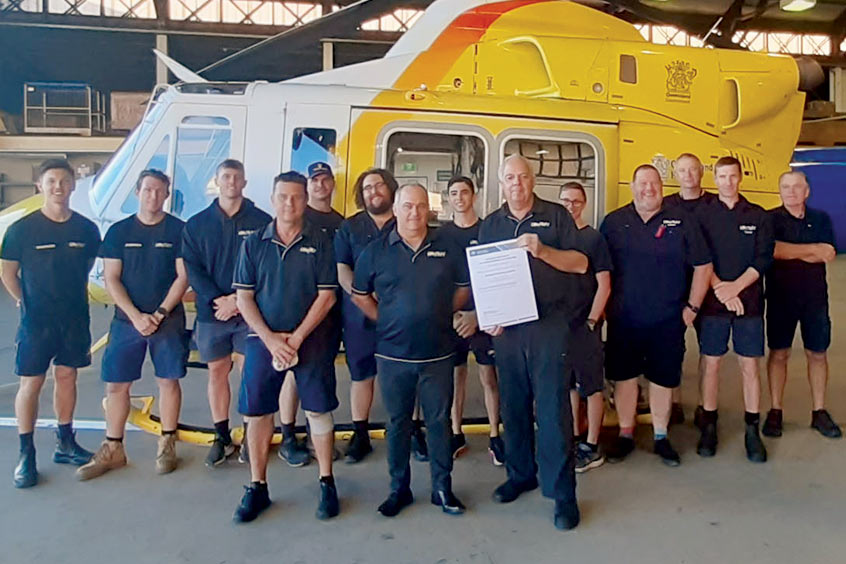
The Approved Maintenance Organisation (AMO) team at Australia-based aeromedical service LifeFlight has added another significant notch to its belt after being granted a five year Part 145 approval by the country's Civil Aviation Safety Authority (CASA).
In 2022, LifeFlight's AMO was granted the initial one year certification, while CASA assessed the team's performance and compliance as a Part 145 organisation. CASA has now granted them the official five year approval, which demonstrates that the LifeFlight AMO is operating to internationally recognised aviation regulations.
“Being recognised under CASA's Part 145 regulation for a further five years means we continue to demonstrate good business practices, focus on safety, training and human factor management," says engineering operations manager Michael Dopking.
"The AMO has seen significant growth over the past few years, and being granted the five year Part 145 approval by CASA is a proud moment for the engineering team at LifeFlight," adds general manager of engineering and maintenance Peter De Marzi.
The CASA Parts 42, 66, 145 and 147 regulations introduced an outcome-based approach to aviation safety and brought flexibility to how maintenance organisations can achieve regulatory compliance. Until recently, Regular Public Transport (RPT) operators such as international and commercial airlines were the main organisations that had transitioned to Part 145. For the past five years, although approved as a CASA CAR 30 organisation, the engineering department of LifeFlight has been operating to many of the Part 145 requirements, such as human factors management and tool control.
Surat Gas Aeromedical Service and Queensland Health, organisations to which LifeFlight is contracted, have aviation standards that draw heavily from the EASA and CASA Part 145 Regulations. So, while LifeFlight has already been practising the requirements of Part 145, the approval granted by CASA is the official recognition that the processes, procedures, people and culture of the AMO are to the standard required by Part 145 regulations.
"This has been a real team effort with input from all the engineering team," adds De Marzi. "The AMO’s exposition and all the development work to gain Part 145 approval was carried out in house by LifeFlight staff."
The AMO is responsible for the maintenance of 16 helicopters including one of the biggest fleets of AW139s in Australia, three Bell 412s, a BK117 and AS350, and four Bombardier 604s jets.
LifeFlight's AMO maintenance bases are located as far afield as Singapore, Tasmania and throughout Queensland and operate 24/7/365 days a year.